Bhote Koshi Flood
Government to Prepare a Joint Report by Combining RDNA and World Bank Studies on Bhote Koshi Flood Damages
Once the final details of the disaster damages are ready, the government will base its plans for immediate relief, rehabilitation, and reconstruction on them. This report will also serve as the foundation for determining the scale of investment required for reconstruction and for mobilizing resources. After finalizing the exact state of damage and required funds, the government intends to coordinate with development partners and friendly nations for assistance. While initial estimates showed severe economic damage, exact sectoral impacts and reconstruction costs will only become clear following this joint report.
Dipesh Ghimire
2 min read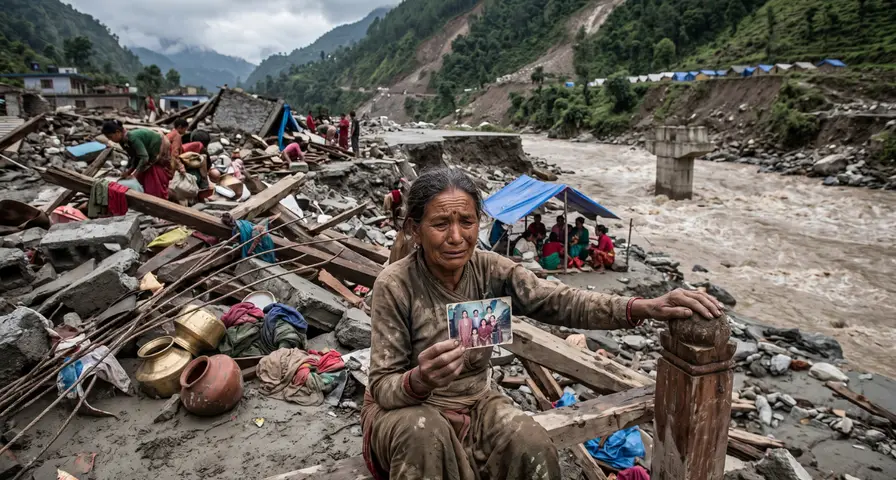
Kathmandu — The government is set to prepare a unified report by combining two separate preliminary studies to accurately assess the physical damages and necessary reconstruction resources caused by the Bhote Koshi flood. Finance Minister Dr. Swarnim Wagle has instructed that the damage assessments currently being prepared by the National Planning Commission and the World Bank be made realistic and fact-based.
During a discussion held at the Ministry of Finance on Tuesday regarding the preliminary details of the Rapid Damage and Needs Assessment (RDNA) prepared by the National Planning Commission and the Global Rapid Post-Disaster Damage Estimation (GRADE) prepared by the World Bank, Minister Wagle issued these directives. Highlighting that planning reconstruction and rehabilitation is difficult without ascertaining the actual damage, Wagle stressed the need to make both studies fact-based. He stated that the evaluations of the RDNA and GRADE should be prepared in a way that they can be utilized as a national document to help the government make correct decisions and raise necessary investments for reconstruction.
The National Planning Commission is preparing a rapid preliminary assessment report on physical and human losses, dividing physical damages into four sectors:
Social Sector: Studies damage to private buildings and structures, public buildings, education, health, and cultural heritage.
Productive Sector: Assesses impacts on agriculture, fisheries, livestock, financial, and other economic activities.
Infrastructure Sector: Covers damages to hydropower projects, transmission lines, household green energy, roads, bridges, telecommunications, environmental health, irrigation, and river management.
Cross-Cutting Issues: Evaluates accumulated debris and hazardous waste in flood-affected areas as a separate intersectoral topic.
The government plans to merge the preliminary data of the RDNA being prepared by the Commission and the World Bank's GRADE assessment to release a unified preliminary report shortly. Discussions to verify these preliminary statistics took place with high-ranking officials, including National Planning Commission Vice-Chairman Dr. Gunakar Bhatta. The RDNA report is being compiled by a team led by Joint Secretary Arjun Bhandari, with representatives from the Ministry of Physical Infrastructure and other relevant ministries.
Once the final details of the disaster damages are ready, the government will base its plans for immediate relief, rehabilitation, and reconstruction on them. This report will also serve as the foundation for determining the scale of investment required for reconstruction and for mobilizing resources. After finalizing the exact state of damage and required funds, the government intends to coordinate with development partners and friendly nations for assistance. While initial estimates showed severe economic damage, exact sectoral impacts and reconstruction costs will only become clear following this joint report.
Advertisement
Written by
Dipesh Ghimire