Governor Poudel
Governor Poudel earns ‘B’ grade from Global Finance as sluggish credit growth offsets external sector gains
Globally, only the central bank governors of Denmark and Peru achieved the top ‘A+’ distinction in the 2026 edition—a benchmark Global Finance has published annually since 1994 on a scale from ‘A+’ to ‘F’ for governors serving at least one full year. Eight countries, including India, Singapore, Chile, and South Africa, earned an ‘A’, while Nepal shared the ‘B’ bracket with peers such as the United Kingdom, Sweden, Qatar, Bahrain, Turkey, Armenia, and Bosnia and Herzegovina. Ultimately, the scorecard illustrates that while Nepal’s monetary authority has mastered macroeconomic defense through reserve accumulation and price stability, translating financial liquidity into productive economic momentum remains a challenge that monetary policy alone cannot solve.
Dipesh Ghimire
3 min read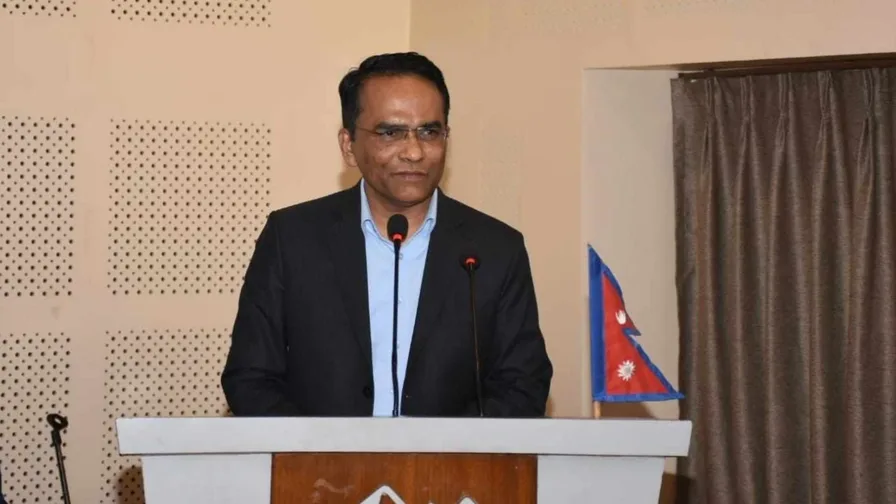
KATHMANDU — Despite banking vaults brimming with over Rs 100 billion in excess loanable liquidity and interest rates sitting at historic lows, the persistent inability to spur private-sector credit expansion has emerged as the defining macroeconomic hurdle for Nepal. Highlighting this sharp disconnect between monetary easing and real-sector borrowing, international financial publication Global Finance awarded Nepal Rastra Bank (NRB) Governor Dr. Bishwanath Poudel a ‘B’ grade in its ‘Central Banker Report Cards 2026’, crediting his stewardship for fortifying external stability while flagging weak credit transmission as a primary concern.
Evaluating central bank chiefs for the one-year window from July 1, 2025, to June 30, 2026, the report notes substantial improvement in Nepal’s external economic buffers following Poudel’s appointment in May 2025. Powered by resilient remittance inflows, the country’s gross foreign exchange reserves surpassed USD 24 billion by June 2026—a cushion sufficient to finance roughly 19 months of merchandise and service imports. Simultaneously, consumer price inflation cooled to between 1 and 1.5 percent during the initial phase of his tenure before stabilizing near 5 percent, remaining comfortably within the central bank's target ceiling and creating policy room for monetary accommodation.
Armed with comfortable external reserves and anchored inflation, the central bank progressively lowered its policy rate to 4.25 percent and the bank rate to 5.75 percent, supporting an estimated economic growth rate of 3.85 percent in fiscal year 2025/26. Yet, an analytical look at the credit numbers exposes a glaring transmission bottleneck: private-sector credit expansion remained stuck between 5 and 7 percent, falling well short of the NRB’s 12 percent annual target. As Global Finance observes, abundant liquidity and cheap borrowing costs have proven insufficient on their own to stimulate industrial and commercial lending, underscoring that sustainable investment recovery requires broader policy certainty and restored private-sector confidence alongside accommodative monetary conditions.
Beyond monetary transmission, the assessment identifies regulatory oversight and international compliance as urgent priorities for the central bank leadership. The report emphasizes the need to sharpen the NRB’s supervisory capacity to detect institutional risks early and safeguard asset quality across banks and financial institutions. Equally critical is steering Nepal off the Financial Action Task Force (FATF) grey list, a milestone that demands stricter enforcement against financial crimes, robust anti-money laundering controls, and tighter regulatory discipline across the financial sector.
Within a broader historical context, Poudel’s ‘B’ rating marks a one-notch improvement for Nepal compared to the ‘C+’ grade recorded by his predecessor, Maha Prasad Adhikari, in 2024. Adhikari’s ratings fluctuated sharply across macroeconomic cycles—starting at a ‘C’ in 2022 amid acute foreign exchange depletion, depressed tourism receipts, and severe liquidity shortages, rising to a ‘B-’ in 2023 as remittance inflows stabilized reserves, before slipping back to ‘C+’ the following year. Poudel’s debut score reflects the consolidation of those external gains, though structural domestic stagnation prevented a leap into the top tier.
Regionally, Nepal trails its major South Asian neighbors in central bank performance rankings. Reserve Bank of India Governor Sanjay Malhotra secured an ‘A’ grade on the back of robust economic expansion, benign inflation, and a calibrated policy rate cut to 5.25 percent, while Sri Lanka’s Nandalal Weerasinghe earned a ‘B+’ for anchoring post-crisis financial stability and rebuilding foreign reserves. Nepal placed ahead of Pakistan, where Governor Jameel Ahmad received a ‘B-’ despite pushing reserves past USD 18 billion and securing sovereign rating upgrades, as deep-seated structural vulnerabilities continue to weigh on the economy.
Globally, only the central bank governors of Denmark and Peru achieved the top ‘A+’ distinction in the 2026 edition—a benchmark Global Finance has published annually since 1994 on a scale from ‘A+’ to ‘F’ for governors serving at least one full year. Eight countries, including India, Singapore, Chile, and South Africa, earned an ‘A’, while Nepal shared the ‘B’ bracket with peers such as the United Kingdom, Sweden, Qatar, Bahrain, Turkey, Armenia, and Bosnia and Herzegovina. Ultimately, the scorecard illustrates that while Nepal’s monetary authority has mastered macroeconomic defense through reserve accumulation and price stability, translating financial liquidity into productive economic momentum remains a challenge that monetary policy alone cannot solve.
Advertisement
Written by
Dipesh Ghimire