Mahalaxmi Bikas Bank
Mahalaxmi Bikas Bank Wins Regional Growth Award as Digital Push Gains Pace
The award strengthens the bank’s regional profile. The more important test, however, will be whether the growth recognised internationally can be translated into durable improvements in profitability, loan quality and shareholder returns.
Dipesh Ghimire
6 min read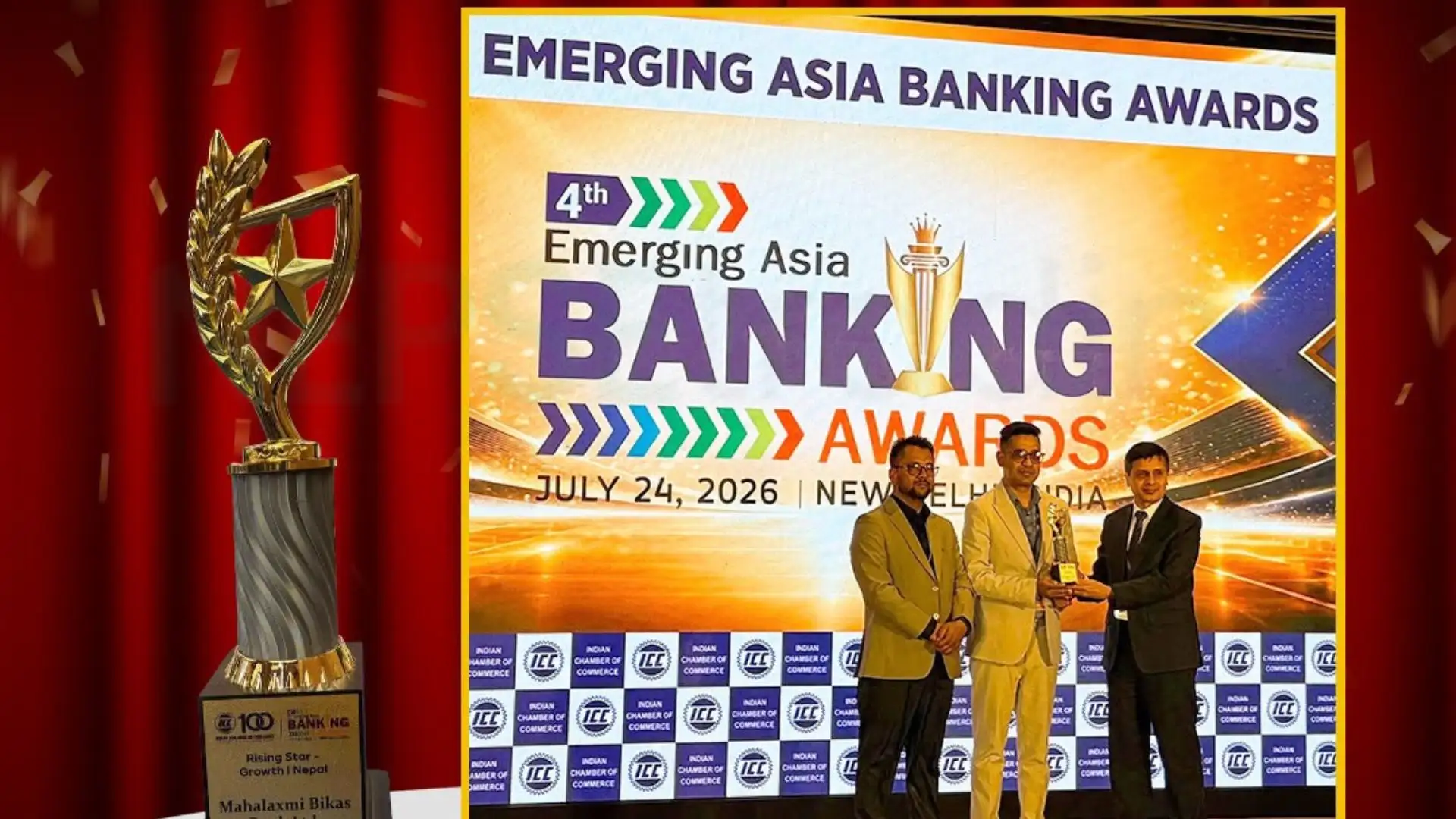
Kathmandu — Mahalaxmi Bikas Bank has received the ‘Rising Star–Growth’ award from the Indian Chamber of Commerce, marking its second consecutive recognition at the Emerging Asia Banking Conclave and highlighting the development bank’s growing emphasis on digital services, business expansion and customer-focused banking.
The award was presented at the fourth Emerging Asia Banking Conclave and Awards held in New Delhi on July 24, 2026. Banks from several South and Southeast Asian economies participated in the regional event.
The latest recognition comes a year after Mahalaxmi Bikas Bank received an award in the ‘Asset Quality’ category at the same regional banking platform.
The shift from an asset-quality award to a growth-focused recognition is significant. It suggests that the bank is increasingly seeking to position itself not only around balance-sheet management but also around service expansion, digital innovation and wider customer reach.
According to the bank, its work in digital banking, development of new financial products, business expansion, financial inclusion and responsible banking practices contributed to the latest recognition.
But an award for growth does not necessarily mean that every financial indicator is expanding at the same pace. A closer look at the bank’s latest financial figures shows a more mixed picture.
Profit rises despite modest credit expansion
Mahalaxmi Bikas Bank reported net profit of around Rs 460 million during the first nine months of fiscal year 2082/83, compared with approximately Rs 437 million during the corresponding period a year earlier.
This represents profit growth of about 5.4 percent.
Operating income increased more strongly, rising by around 8.8 percent to approximately Rs 1.91 billion from Rs 1.76 billion.
Net interest income increased by about 6.2 percent, while net fee and commission income grew by more than 23 percent.
The relatively strong growth in fee income is noteworthy because it suggests that the bank is gradually generating more income from services outside its traditional interest-based lending business.
For banks, a broader income base can be useful because excessive reliance on the difference between lending and deposit rates makes profitability more vulnerable to changes in interest rates.
However, lending itself has expanded only moderately.
Loans and advances to customers stood at approximately Rs 42.36 billion at the end of the third quarter, compared with around Rs 41.51 billion at the end of the previous fiscal year.
That represents growth of only about 2.1 percent.
Deposits, meanwhile, stood at around Rs 53.22 billion, below the Rs 55.12 billion reported at the end of the previous fiscal year.
This means the bank’s recent growth story is being driven more by income improvement, digital expansion and operational initiatives than by aggressive balance-sheet growth.
Lower funding costs support earnings
One of the more favourable developments has been the sharp decline in the bank’s cost of funds.
The cost of funds dropped to 3.78 percent from 5.04 percent in the corresponding period a year earlier.
The bank’s base rate also declined to 5.83 percent from 7.20 percent.
Falling funding costs can help banks maintain profitability even when lending rates are declining because they reduce the amount banks must pay to mobilise deposits.
Mahalaxmi’s net interest income increased despite the broader decline in interest rates in Nepal’s banking system, indicating that lower funding costs have provided some support to earnings.
Its return on equity improved marginally to 8.52 percent from 8.45 percent, while return on assets increased to 0.96 percent from 0.91 percent.
The improvements are modest, but they indicate that the bank is generating slightly better returns from its capital and asset base.
Capital position becomes stronger
The bank’s capital adequacy position has also strengthened.
Its total capital fund to risk-weighted assets increased to 17.24 percent from 15.75 percent a year earlier.
Tier 1 capital also improved to 13.64 percent from 12.31 percent.
A stronger capital position provides additional capacity to absorb unexpected losses and can create room for future business expansion.
This is particularly important in an environment where banks are facing pressure from rising bad loans and slower credit demand.
Total equity stood at around Rs 7.31 billion at the end of the third quarter, up from approximately Rs 7.08 billion at the previous fiscal year-end.
The stronger capital buffer therefore adds weight to the bank’s growth ambitions.
Asset quality remains the major challenge
The most important weakness in the latest numbers is the increase in non-performing loans.
Mahalaxmi Bikas Bank’s non-performing loan ratio rose to 6.59 percent from 4.99 percent in the corresponding period a year earlier.
That is an increase of 1.60 percentage points.
The rise is particularly notable because the bank received the ‘Rising Star in Asset Quality’ award at the Emerging Asia Banking Awards in 2025.
The two developments should not necessarily be treated as contradictory because the earlier award and the latest financial figures cover different assessment periods. Nevertheless, the increase in bad loans shows that asset quality remains an area requiring close attention.
Loan impairment charges and other credit losses also increased.
The bank recorded approximately Rs 333 million in impairment charges during the first nine months of the fiscal year, up from around Rs 259 million in the corresponding period.
That represents an increase of nearly 29 percent.
Higher impairment costs indicate that the bank is setting aside more money against potential loan losses.
Without stronger operating income, such provisioning could place greater pressure on profitability.
The bank’s ability to control non-performing loans will therefore be one of the most important indicators to watch as it pursues further growth.
Digital banking becomes a bigger part of strategy
The award also arrives as Mahalaxmi Bikas Bank is stepping up its digital banking strategy.
The bank recently opened a Digital Hub with a Coffee Lounge at Gyaneshwor in Kathmandu.
The concept combines conventional financial services with a more technology-oriented customer environment, allowing customers to access digital banking facilities while also receiving guidance on electronic services.
The initiative appears particularly aimed at younger and digitally active customers.
Mahalaxmi has also introduced services such as QR-based cash withdrawal, allowing customers to withdraw money by scanning a QR code through the bank’s mobile banking application rather than relying solely on cheques or ATM cards.
These developments show that the bank is attempting to compete not only through its branch network but also through customer experience and technology.
That distinction is becoming increasingly important as Nepal’s banking sector becomes more digitally competitive.
Most banks now provide mobile banking, QR payments and online services. Simply offering digital banking is therefore no longer enough to differentiate one institution from another.
The competition is shifting toward how easily customers can use those services and whether banks can convert digital engagement into stronger customer relationships and new business.
Second consecutive regional recognition
The latest award also gives Mahalaxmi Bikas Bank two consecutive recognitions from the Indian Chamber of Commerce platform.
In 2025, the bank was recognised for asset quality. In 2026, it received recognition under the growth category.
For the bank, repeated participation and recognition at a regional event can help increase visibility outside Nepal, particularly as financial institutions across South Asia seek partnerships in payments, technology and cross-border financial services.
However, awards themselves do not determine a bank’s financial strength.
For depositors, shareholders and investors, indicators such as profitability, capital adequacy, loan growth, liquidity and non-performing loans remain more important measures of underlying performance.
Viewed through those indicators, Mahalaxmi Bikas Bank currently presents a mixed but improving picture.
Profit and operating income are growing, funding costs have declined, fee income is expanding and the capital position has strengthened.
At the same time, credit growth remains modest and the rise in non-performing loans poses a significant challenge.
The ‘Rising Star–Growth’ award therefore arrives at an important point for the bank.
Its digital initiatives and stronger income generation suggest that Mahalaxmi is trying to broaden its business model beyond conventional branch-based banking.
But the sustainability of that growth will ultimately depend on whether the bank can turn digital expansion and customer growth into stronger business while bringing asset quality under control.
The award strengthens the bank’s regional profile. The more important test, however, will be whether the growth recognised internationally can be translated into durable improvements in profitability, loan quality and shareholder returns.
Advertisement
Written by
Dipesh Ghimire