Top4 min readNepal's Political Crisis: A Call for Restructuring and RenewalNepal's Political Crisis: A Call for Restructuring and Renewal The recent election results in Nepal have sent a strong message to the traditional political parties, warning them of the urgent need for reform or risk extinction. Political giants like the Nepali Congress and the Communist Party of Nepal (CPN-UML), which have dominated the political scene for decades, must rethink their strategies or face irrelevance. These parties, once built upon the legacy of struggle for democracy and institutional control, now find themselves at a crossroads, overwhelmed by shifting societal, technological, and economic landscapes.Dipesh Ghimire·11 Mar, 2026
Top3 min readUnderstanding RSI: How Traders Use Momentum to Read Market BehaviorUnderstanding RSI: How Traders Use Momentum to Read Market Behavior In modern financial markets, technical indicators have become essential tools for traders attempting to interpret price movements and market psychology. Among these indicators, the Relative Strength Index (RSI) remains one of the most widely used momentum indicators for analyzing market trends. Developed to measure the speed and strength of price changes, RSI helps traders understand whether a market is potentially overbought, oversold, or preparing for a trend shift.Dipesh Ghimire·10 Mar, 2026
Top3 min readWhy Most Traders Lose Money: The Hidden Psychological Battle of the MarketWhy Most Traders Lose Money: The Hidden Psychological Battle of the Market In financial markets around the world, a common pattern repeatedly appears: a large majority of traders fail to generate consistent profits. While many beginners assume that trading losses occur mainly because of market volatility or lack of information, analysts increasingly argue that the real causes are psychological and strategic rather than technical. A closer look at trading behavior shows that misunderstanding the market itself is often the first and most fundamental mistake made by new traders.Dipesh Ghimire·10 Mar, 2026
Top3 min readInflation and Investment: Why Keeping Money Idle Is the Costliest Financial DecisionInflation and Investment: Why Keeping Money Idle Is the Costliest Financial Decision A decade-long comparison of different investment options reveals a striking reality about wealth creation: money that remains idle gradually loses its value due to inflation. Financial data covering the period 2015 to 2025 suggests that individuals who chose not to invest their savings experienced a significant decline in purchasing power. For example, a cash amount of Rs. 10 lakh held without investment over ten years effectively falls to around Rs. 5.7 lakh in real value, implying a loss of about 43 percent when adjusted for inflation.Dipesh Ghimire·10 Mar, 2026
Top2 min readNepal’s Road to a USD 100 Billion Economy: What Growth Rate Is Required?Nepal’s Road to a USD 100 Billion Economy: What Growth Rate Is Required? Nepal has increasingly been discussing the possibility of expanding its economy to USD 100 billion, a milestone that would significantly transform the country's economic landscape. With the current gross domestic product estimated at around USD 45 billion, reaching this ambitious target requires sustained economic expansion over the coming years. However, the pace of growth required depends heavily on the time frame within which policymakers aim to achieve this goal. Economic calculations show that if Nepal intends to reach a USD 100 billion GDP within five years, the country would need to maintain an annual economic growth rate of approximately 17.3 percent. Such a growth rate is extraordinarily high by global standards and would require rapid expansion across multiple sectors including hydropower, tourism, manufacturing, digital services, and infrastructure development. For comparison, very few economies in the world have been able to sustain such high growth rates over a continuous five-year period.Dipesh Ghimire·10 Mar, 2026
Top3 min readNepal’s Capital Market Could Transform Dramatically if Economic Targets Are AchievedNepal’s Capital Market Could Transform Dramatically if Economic Targets Are Achieved Nepal’s economy and capital market could witness a profound transformation over the next decade if projected growth targets materialize. Current indicators show that the country’s economic size and stock market remain relatively modest, but the projections for the next five to ten years suggest a scenario where both the real economy and the capital market expand significantly. Such a shift would not only change the scale of Nepal’s financial system but could also reshape the role of the stock market in national economic development.Dipesh Ghimire·10 Mar, 2026
Top2 min readUnderstanding NEPSE Circuit Breakers: How Automatic Trading Halts Protect the MarketUnderstanding NEPSE Circuit Breakers: How Automatic Trading Halts Protect the Market Nepal’s stock market operates under a circuit breaker mechanism designed to control excessive volatility and protect investors from sudden market shocks. The Nepal Stock Exchange (NEPSE) applies a tiered system of trading halts when the market index moves sharply within a short period. These rules act as a cooling-off mechanism, temporarily pausing trading when the market rises or falls beyond specific thresholds. Under the current system, the first circuit breaker is triggered when the NEPSE index moves by 4 percent, either upward or downward, from the opening level. When this threshold is reached, trading across the market is suspended for 20 minutes. The pause allows investors and traders to reassess information, control panic-driven decisions, and prevent excessive speculation that may distort prices.Dipesh Ghimire·10 Mar, 2026
Top3 min readStrong Election Momentum for RSP Raises Expectations of Political Stability and Market OptimismStrong Election Momentum for RSP Raises Expectations of Political Stability and Market Optimism Early vote trends from Nepal’s House of Representatives election suggest an unexpected surge of public support for the Rastriya Swatantra Party (RSP), a political force that emerged only a few years ago. Preliminary results and political projections indicate that the party may secure not only a parliamentary majority but could even approach a two-thirds mandate. While final results are still awaited, the current momentum has already begun reshaping political discussions and economic expectations across the country.Dipesh Ghimire·8 Mar, 2026
Top4 min readRSP’s Capital Market Promises Raise Investor Expectations as Early Election Trends Show Strong SupportRSP’s Capital Market Promises Raise Investor Expectations as Early Election Trends Show Strong Support Preliminary vote counts and exit polls from the ongoing House of Representatives election have indicated a surprisingly strong performance by the Rastriya Swatantra Party (RSP), raising expectations among millions of investors in Nepal’s capital market. Early projections from several media outlets suggest the possibility that the party could secure a dominant position in parliament, with some estimates even hinting at the chance of forming a majority government. While the final results remain to be confirmed, the emerging trend has already sparked optimism among participants in Nepal’s stock market.Dipesh Ghimire·8 Mar, 2026
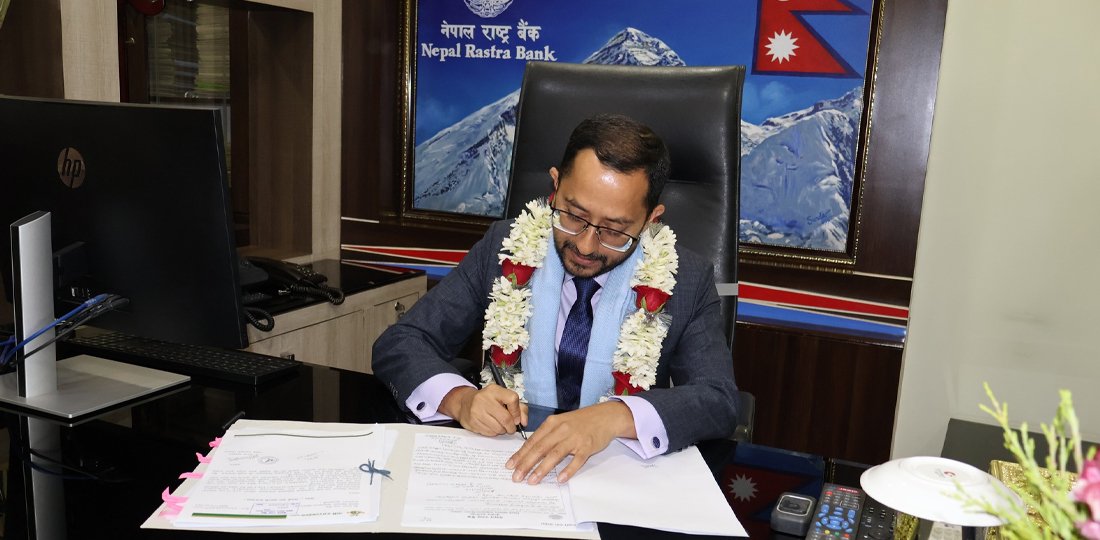
Top4 min readNepal’s Economic Growth Stuck Around 4% as Industry Shrinks and Service Sector Dominance ExpandsNepal’s Economic Growth Stuck Around 4% as Industry Shrinks and Service Sector Dominance Expands Nepal’s economic growth has historically remained around an average of 4 percent, reflecting a relatively modest pace of expansion over the long term. According to the latest Macroeconomic Report released by the Nepal Rastra Bank on Tuesday, the country’s potential growth rate has been estimated at around 4.3 percent. The report identifies the period between 1986 and 1995 as a significant phase of economic expansion, during which the growth rate surpassed the estimated potential level. In the years that followed, however, economic growth largely stabilized around the potential rate, while structural changes within the economy gradually began to emerge.Dipesh Ghimire·5 Mar, 2026