PM Shah at UNGA
PM Shah at UNGA: A Shift in Diplomatic Protocol and a Clarion Call for Climate Justice
However, as Prime Minister Shah prepares to return to Kathmandu on Ashoj 10, the true measure of his UNGA outing will lie in its execution. While he successfully captured international media attention and domestic political support, the challenge now shifts from rhetoric to hard diplomacy. With Foreign Minister Shishir Khanal tasked with managing the broader diplomatic engagements and sideline meetings, Kathmandu now faces the crucial task of lobbying the international community to transform Shah's proposed Himalayan resilience mechanism and grant-based funding demands into a tangible reality.
Dipesh Ghimire
3 min read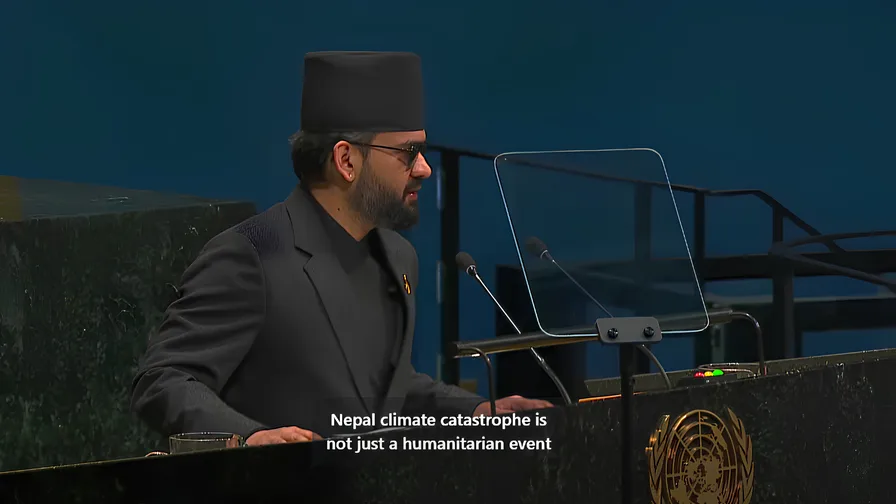
Breaking away from the entrenched culture of lavish airport send-offs, Prime Minister Balendra Shah departed for the United States on Sunday to attend the 81st United Nations General Assembly (UNGA). Stripping away the red carpets, military salutes, and large entourages, Shah opted for a standard Qatar Airways flight, signaling a stark departure from the traditional VIP pageantry that has long characterized Nepali statesmanship. Bypassing the customary pre-departure parliamentary address, he was seen off by just two cabinet members—Home Minister Sudhan Gurung and Tourism Minister Ganesh Poudel—reflecting a strictly business-first approach to his diplomatic mission.
Upon arriving in New York, the Prime Minister’s agenda was sharply focused on the existential threat of global warming. Delivering a compelling 14-minute address on Friday, Shah elevated Nepal’s localized environmental disasters to the global stage. He cited the recent devastating Bhotekoshi-Trishuli floods not merely as a domestic tragedy, but as a dire warning to the world regarding the accelerating impacts of climate change. Echoing the UN Secretary-General's previous warnings from the Everest region, Shah criticized global political leadership for failing to translate glaring scientific evidence into concrete climate action, noting that the destabilization of the fragile Himalayan ecosystem threatens massive populations across the entirety of South Asia.
The crux of Shah's address was rooted in a firm demand for climate justice. He forcefully argued against burdening climate-vulnerable, developing nations with additional debt, demanding that post-disaster recovery and reconstruction be funded exclusively through international grants, not loans. Underscoring the disproportionate price Nepal pays despite its negligible greenhouse gas emissions, the Prime Minister pitched a pragmatic regional solution. He proposed the establishment of a trilateral 'Himalayan Climate Resilience Mechanism' comprising Nepal, India, and China. This framework aims to strengthen joint early warning systems, share critical satellite data, and rigorously monitor high-risk glacial lakes.
Shah’s delivery was as much a talking point as his policy stance. Utilizing a teleprompter—a standard practice for global heads of state but a notable technological shift that sparked widespread curiosity on Nepali social media—he delivered a seamless, fluent English speech. He grounded his global appeal in Nepali identity at the very end, invoking Lord Pashupatinath and the teachings of Buddha before signing off with a traditional "Dhanyabad, Namaste." His assertive messaging quickly caught the attention of major international news agencies, with the Associated Press (AP) highlighting his framing of the floods as a global warning, and Reuters amplifying his plea for grant-based climate finance.
This refined presentation and strong nationalistic undertone garnered rare bipartisan applause back home. Leaders across the political spectrum commended the Prime Minister for effectively voicing the nation's core grievances. Rastriya Prajatantra Party lawmaker Gyanendra Shahi praised the speech for instilling hope, while CPN-UML leader Gokul Baskota lauded it as "firm, meaningful, and forceful." The widespread political consensus was further underscored by Nepali Congress Vice President Bishwa Prakash Sharma, who had previously advised the Prime Minister to center his UN agenda on the Bhotekoshi disaster and climate facts.
However, as Prime Minister Shah prepares to return to Kathmandu on Ashoj 10, the true measure of his UNGA outing will lie in its execution. While he successfully captured international media attention and domestic political support, the challenge now shifts from rhetoric to hard diplomacy. With Foreign Minister Shishir Khanal tasked with managing the broader diplomatic engagements and sideline meetings, Kathmandu now faces the crucial task of lobbying the international community to transform Shah's proposed Himalayan resilience mechanism and grant-based funding demands into a tangible reality.
Advertisement
Written by
Dipesh Ghimire