SEBON
SEBON-IMF Dialogue Signals Push for Deeper Capital Market Reforms in Nepal
The meeting between SEBON and the IMF represents a step toward greater international coordination in Nepal’s capital market development. However, the success of these efforts will depend on consistent implementation, stronger institutions, and the ability to create a market environment where investors feel secure and participation continues to expand.
Dipesh Ghimire
2 min read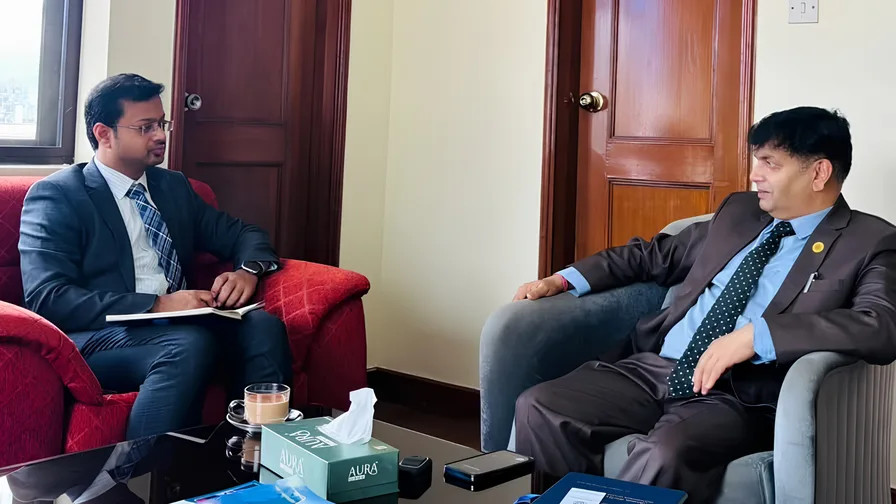
Kathmandu. Nepal’s capital market reform agenda has gained renewed attention after discussions between the Securities Board of Nepal (SEBON) and the International Monetary Fund (IMF), with both sides highlighting the need for stronger regulation, institutional capacity, and investor confidence.
The meeting between SEBON Chairman Dr. Gopal Prasad Bhatt and IMF Nepal Resident Representative Pranav Kumar Gupta focused on the current challenges of Nepal’s capital market, ongoing policy reforms, and ways to improve the effectiveness of the regulatory framework.
The discussion comes at a time when Nepal’s stock market has been seeking structural improvements beyond short-term market movements. While increased participation of investors, technological development, and expansion of financial instruments have supported market growth in recent years, concerns remain regarding transparency, market depth, regulatory effectiveness, and investor confidence.
Chairman Bhatt informed the IMF representative about the reform initiatives being undertaken by SEBON to make Nepal’s capital market more organized, transparent, competitive, and investment-friendly. The board has been prioritizing policy improvements and institutional strengthening to address existing weaknesses in the market ecosystem.
Analysts view regulatory capacity as one of the key factors determining the long-term sustainability of Nepal’s capital market. A growing market requires not only higher trading volumes but also stronger surveillance mechanisms, effective enforcement of regulations, better corporate governance practices, and protection of investors’ interests.
During the meeting, discussions also focused on improving market supervision and strengthening investor confidence. This indicates that future reforms may place greater emphasis on improving regulatory systems rather than only introducing new market products.
IMF Resident Representative Pranav Kumar Gupta expressed a positive view of the reform initiatives being carried out by SEBON and highlighted the importance of capital markets in supporting financial stability and economic development.
A developed capital market can play a significant role in mobilizing domestic savings, providing alternative financing sources for businesses, and reducing excessive dependence on traditional banking channels. For Nepal, where bank lending remains the dominant source of corporate financing, expansion of the capital market could help diversify the financial system.
The involvement of international financial institutions such as the IMF could provide technical expertise, international practices, and institutional support for Nepal’s regulatory reforms. However, experts suggest that external support alone will not be sufficient unless reforms are implemented effectively at the domestic level.
The immediate challenge for SEBON will be converting policy commitments into practical improvements that investors can experience in the market. Issues such as timely regulation, market transparency, enforcement capacity, and confidence-building measures will determine whether reform initiatives create meaningful changes.
The meeting between SEBON and the IMF represents a step toward greater international coordination in Nepal’s capital market development. However, the success of these efforts will depend on consistent implementation, stronger institutions, and the ability to create a market environment where investors feel secure and participation continues to expand.
Advertisement
Written by
Dipesh Ghimire