Madan Bhandari Highway
Unclaimed Deposits at Madan Bhandari Highway Office Point to a Wider Pattern of Contractor Fund Neglect in Nepal's Road Sector
For the 40 firms named, the practical takeaway is straightforward and time-sensitive: verify project completion records and submit refund applications with supporting documents to the Tamghas office before the 15-day deadline lapses. For the broader system, the notice is a small but useful illustration of a structural gap — one where neither delayed government processing nor contractor follow-up failures alone explain the years-long backlog, but where both combine to leave public funds unreturned and unclaimed well past the point they should have been settled.
Dipesh Ghimire
3 min read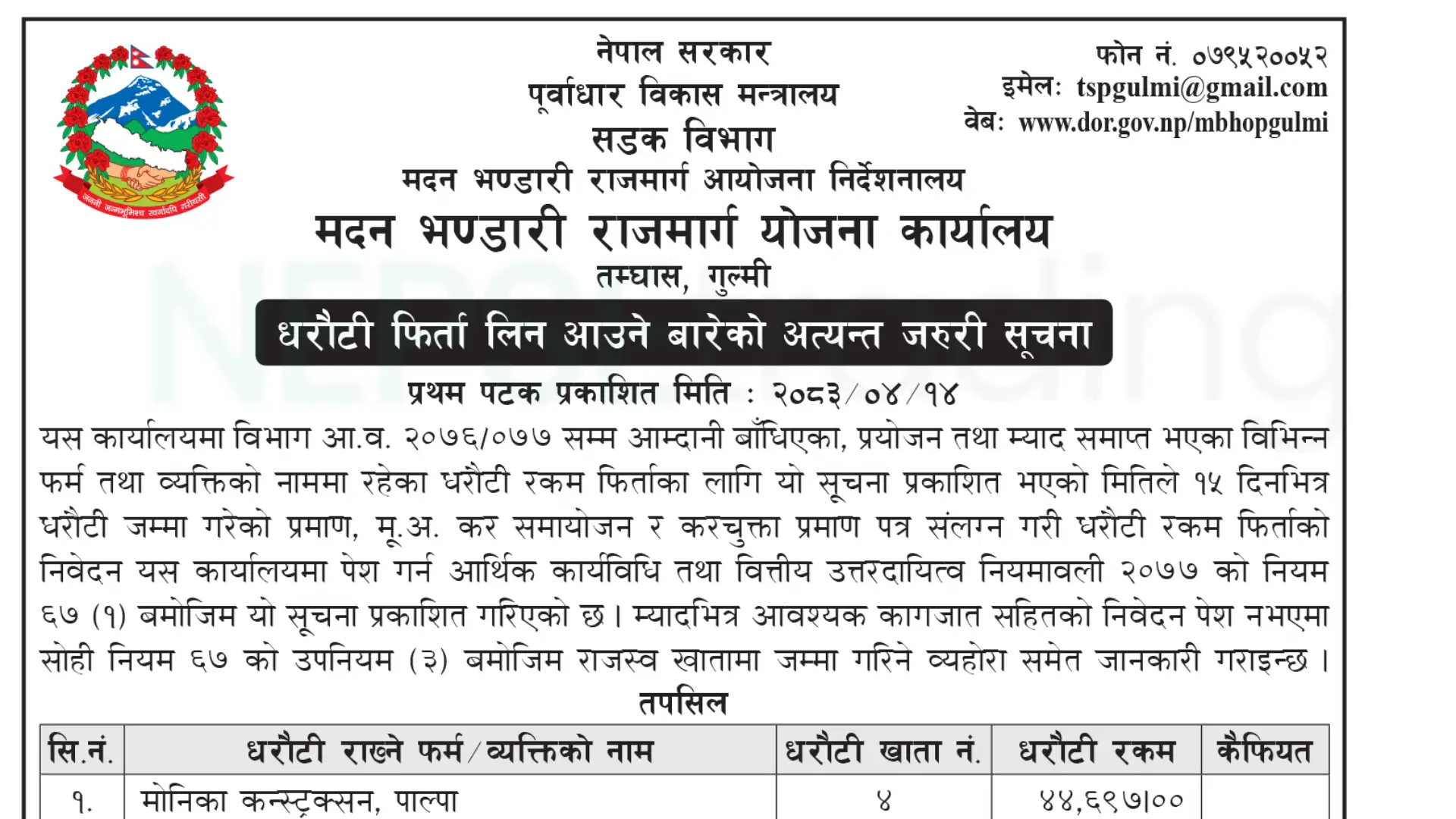
KATHMANDU — On its face, the Madan Bhandari Highway Project Office's notice asking 40 construction firms to reclaim their security deposits looks like routine administrative housekeeping. Looked at more closely, however, the details of the notice — particularly its timeline and its legal fallback provision — reveal a recurring inefficiency in how Nepal's public infrastructure offices manage contractor funds long after projects have closed.
The most striking detail is the age of these claims. The office has specified that the deposits belong to firms whose accounts were settled as far back as fiscal year 2076/77 — meaning some of this money has likely sat unclaimed in government custody for four to five years or more. In a normal contracting cycle, security or performance deposits (dharauti) are meant to be returned to contractors relatively soon after a project is completed and final accounts are settled, since the funds exist to guarantee performance during construction, not to be retained afterward. A multi-year gap between project completion and deposit refund suggests either that contractors were unaware their money remained unclaimed, or that neither party actively pursued closure of these accounts — a lapse that points more toward administrative inertia on both sides than to any single cause.
The 15-day window given for firms to respond is notably tight relative to the years-long delay that preceded it, and it comes with a specific legal consequence attached: failure to apply within that period triggers Rule 67(1) of the Financial Procedures and Fiscal Accountability Regulations, 2077, under which the funds would eventually be deposited into the government's revenue account. This is a meaningful detail, because it means unclaimed contractor deposits do not simply remain in limbo indefinitely — Nepali fiscal law provides a mechanism for the state to absorb such funds if the rightful owners do not come forward in time. For the 40 named firms, this transforms what might seem like a minor administrative notice into a genuine financial deadline: money that is rightfully theirs could be permanently transferred to the state treasury if they miss this narrow window.
The decision to publicly name all 40 companies — from established contractors like Monika Construction and Ramshree Construction to smaller engineering consultancies such as Swaraj Consultancy and Circle Engineering Consultancy — is itself a procedural signal. Public naming is typically a last-resort measure used when direct notification (through registered contact information, site addresses, or past correspondence) has failed or is considered insufficient, suggesting the office may have already made earlier, less visible attempts to reach these firms without success. This also indicates that record-keeping on current contractor contact details may itself be a contributing factor to the delay, since firms that have completed projects and moved on to other contracts may no longer maintain active communication with a specific project office years later.
There is a broader institutional pattern worth noting here as well. Public notices of this kind — government offices publishing lists of unclaimed contractor deposits — are not unique to the Madan Bhandari Highway Project Office; similar notices surface periodically across Nepal's road, irrigation, and infrastructure agencies. This suggests a systemic rather than isolated issue: security deposits are being collected and processed at the point of contract award and project execution, but the administrative loop is not being reliably closed once the corresponding obligations are fulfilled. The result is idle public office liability sitting on the books, and idle contractor funds that could otherwise be recirculated into their working capital.
For the 40 firms named, the practical takeaway is straightforward and time-sensitive: verify project completion records and submit refund applications with supporting documents to the Tamghas office before the 15-day deadline lapses. For the broader system, the notice is a small but useful illustration of a structural gap — one where neither delayed government processing nor contractor follow-up failures alone explain the years-long backlog, but where both combine to leave public funds unreturned and unclaimed well past the point they should have been settled.
Advertisement
Written by
Dipesh Ghimire