2083/84 budget
2083/84 budget : Inside the Budget Room — Nepal's Finance Minister Is Sleeping Four Hours a Night to Rewrite Economic History
2083/84 budget : The fiscal year 2083/84 budget — the first to be presented under the Balendra Shah-led government — is days away from public release. The anticipation surrounding it extends well beyond the usual pre-budget curiosity. This is not merely another annual financial document. It is, for many observers, a test of whether the new political dispensation can translate its ambitions into credible economic policy at a moment when Nepal's fiscal space is narrow, public trust in government delivery is fragile, and the expectations being projected onto this administration are unusually high.
Dipesh Ghimire
8 min read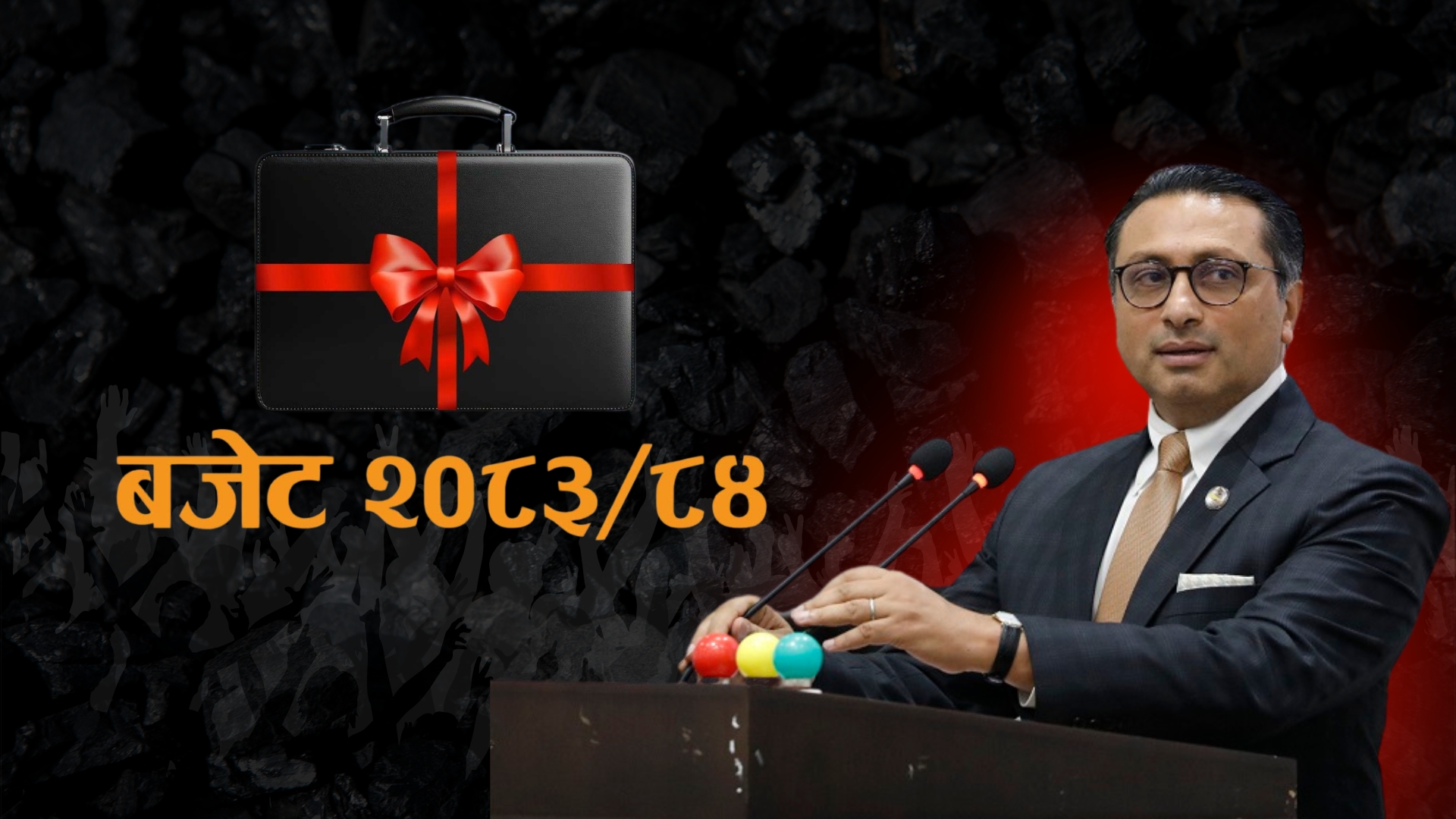
KATHMANDU — The corridors of Singhadurbar that ordinarily hum with the steady traffic of officials, petitioners, and journalists have gone unusually quiet around one particular wing. The Ministry of Finance, which in ordinary times is accessible enough that a visitor could wander to the working chambers without much scrutiny, has become in recent weeks something closer to a sealed vault. Doors that were once open are now closed. Entry requires authorization. Even government employees without specific clearance are being turned away at the gate. And at the center of this controlled silence, a finance minister is working himself to the edge of exhaustion to produce what he hopes will be the most consequential budget Nepal has seen in a generation.
The fiscal year 2083/84 budget — the first to be presented under the Balendra Shah-led government — is days away from public release. The anticipation surrounding it extends well beyond the usual pre-budget curiosity. This is not merely another annual financial document. It is, for many observers, a test of whether the new political dispensation can translate its ambitions into credible economic policy at a moment when Nepal's fiscal space is narrow, public trust in government delivery is fragile, and the expectations being projected onto this administration are unusually high.
Finance Minister Dr. Swarnima Wagle arrives at the ministry between seven and eight o'clock each morning. He does not leave until around two in the morning. By ministry sources, that translates to roughly sixteen hours inside the building every day — a pace that has been sustained not for a day or two, but consistently through the final stretch of budget preparation. His meals — breakfast, lunch, evening snacks, and dinner — are being prepared inside the ministry itself. He has not left the Singhadurbar compound for anything other than essential parliamentary appearances.
Foreign visits that had been scheduled on his calendar have been cancelled. Invitations to events within Kathmandu are being addressed through virtual participation rather than physical attendance. The only exceptions are parliamentary sessions — where he appeared to defend the government's policy and programme — and unavoidable committee meetings that required his in-person presence. Everything else has been subordinated to the singular task of getting this budget right.
What makes this level of personal investment notable is not the hours alone. According to ministry insiders, Dr. Wagle is not simply reviewing the draft budget at a summary level and approving broad directions. He is reading the document line by line. Every allocation, every programme description, every policy commitment is being examined by the minister himself — a degree of personal engagement with the technical detail of budget preparation that is described internally as unusual, even by the standards of previous administrations that took the process seriously.
The draft itself has been prepared by a budget drafting committee led by Joint Secretary Uttar Kumar Khatri, who heads the Revenue Management Division. The committee has completed its work on the annual policy and programme framework, the prioritization of projects, and the draft appropriation bill. What remains is the tax rate structure — the most politically sensitive and economically consequential component of any budget — which Dr. Wagle is still deliberating over. Everything else, sources say, is essentially complete.
The physical atmosphere inside the ministry is worth understanding in its own right, because it tells a story about the seriousness with which this process is being treated. There is a dedicated budget room — a separate, secured space where the drafting team works in conditions of strict confidentiality. The room operates in quiet intensity. Outside observers who pass by the ministry building see little signs of activity. The building looks calm, almost deserted. Inside, the work is unceasing.
This combination of external stillness and internal urgency is deliberate. Budget confidentiality is a standard practice in democratic governments — a leak of tax rate changes or major expenditure decisions before the official announcement can distort markets, trigger speculation, and undermine the government's policy intentions. But the level of security being maintained at the Finance Ministry this cycle appears to go beyond routine caution. It reflects, sources suggest, a genuine fear that the scale of what is being planned could be misread or misused if it becomes public before the minister is ready to present and defend it in parliament.
The budget that emerges from this process is expected to be larger than the current year's actual expenditure, even if it may be constrained in certain directions. To understand the numbers requires a brief look at where Nepal's fiscal situation currently stands.
The budget for the current fiscal year was originally set at NPR 19 trillion 640 billion. However, in the mid-term review conducted by Finance Minister Rameswar Khanal — who served under the transitional government following the GenZ movement — the actual expenditure estimate was revised downward significantly, to approximately NPR 16 trillion 880 billion. In other words, only around 86 percent of the originally appropriated budget was expected to be spent. This kind of systematic under-execution is not a minor administrative inconvenience — it represents a structural failure of government capacity that has direct consequences for public services, infrastructure development, and economic activity.
The National Planning Commission had set a budget ceiling of NPR 18 trillion 900 billion for the coming fiscal year — actually lower than the original current-year figure. Yet ministry sources indicate that the final budget will exceed this ceiling. The increases are being driven primarily by two factors: a long-overdue revision of civil service salaries, which successive governments have deferred, and planned investment in large transformative projects designed to stimulate economic activity in an environment where private sector momentum has been weak.
The most revealing window into Dr. Wagle's intentions is not found in the numbers but in the historical references he has chosen as his benchmarks. He is, by accounts from within the ministry, measuring his work against a specific set of budgets from Nepal's past — each of which represented a genuine turning point in the country's economic direction rather than a continuation of existing trends.
The first of these is the budget of 2048 BS, presented on Ashadh 27 of that year by then State Minister for Finance Mahesh Acharya. That budget, modest in nominal size at NPR 26 billion 640 million, was historically significant because it opened Nepal's economy to liberalization for the first time — introducing market principles, private sector participation, and the beginning of privatization in a country that had until then operated under a largely state-directed economic model. It came in the wake of the restoration of multiparty democracy and marked a structural break from what had come before.
The other benchmarks are the transformative budgets presented by Manomohan Adhikari, Dr. Ram Sharan Mahat, and Dr. Baburam Bhattarai — each of whom, in their respective periods, used the budget not merely as an accounting exercise but as an instrument for redirecting the economy in meaningful ways. Dr. Wagle is reported to be studying what specifically made each of those budgets consequential — what choices they made, what they prioritized, what they were willing to leave out — and using those lessons to shape his own document.
The implication is that he intends this budget to signal a second wave of economic reform — a structural shift comparable in ambition, if not necessarily in specific content, to what 2048 represented. Whether the fiscal constraints of 2083 allow for that level of ambition is a legitimate question. But the intent, at least, appears to be genuine.
In preparing this budget, Dr. Wagle did something that not every finance minister bothers to do — he systematically consulted the people who have held his position before him. On Jestha 7, he met collectively with eight former finance ministers: Dr. Prakash Chandra Lohani, Bishnu Paudel, Dr. Yubraj Khatiwada, Janardan Sharma, Barshaman Pun, Dr. Rameswar Khanal, Dr. Prakash Sharan Mahat, and Shankar Koirala.
The format of that meeting is itself instructive. Rather than inviting open-ended reflections or general advice, Dr. Wagle asked each former minister for exactly three concrete suggestions — nothing more. He specifically requested that they focus on practical recommendations for economic reform and current challenges, and explicitly discouraged lengthy or abstract inputs. This is a minister who knows what he wants to find out and is not interested in using consultation as a performance of inclusion.
He has also held intensive discussions with private sector representatives and independent economists, again with an eye toward what is implementable rather than what sounds appealing in principle.
The weight that rests on this budget is not merely technical. It is political and historical. Dr. Wagle is operating under pressure from multiple directions simultaneously. He must satisfy a public that has been promised meaningful economic relief — on taxes, on cost of living, on employment. He must satisfy investors and the private sector, who need credible signals that Nepal is serious about creating a stable business environment. He must satisfy the international financial institutions and development partners who are watching Nepal's fiscal management closely. And he must satisfy his own party's electoral commitments, which are specific enough to create real accountability if left unfulfilled.
All of this must be done within a resource envelope that is tighter than any of those constituencies would prefer. Nepal's revenue performance has been under pressure, capital expenditure execution has been chronically weak, and the public debt trajectory requires careful management. A finance minister who simply promises everything to everyone will be credible to no one.
The sealed doors of the Finance Ministry will open soon. When they do, and when Dr. Wagle rises in parliament on Jestha 15 to present his budget to the nation, the document he reads will be the product of months of preparation, weeks of near-total isolation, sixteen-hour working days, and a deliberate ambition to produce something that will be remembered not just as one more annual budget but as a moment when Nepal chose a different economic direction.
Whether it succeeds in that ambition will not be known on the day it is announced. Budgets are judged by what they deliver over the months and years that follow — by whether the projects they fund are actually built, whether the tax reforms they propose actually change behavior, whether the relief they promise actually reaches the people who need it.
But the seriousness of the process, at least, appears to be beyond question. The man preparing this budget is not treating it as a routine document. The hours he is spending on it, the consultations he has conducted, the historical benchmarks he has set for himself — all of it points to a finance minister who understands that this is his single most important professional moment, and who intends to use it accordingly.
Nepal is watching. The budget room is still closed. And the minister is still at his desk.
Advertisement
Written by
Dipesh Ghimire