Financial Regulators
Among Three Financial Regulators, NRB Employees Receive the Highest Pay Package
Among Three Financial Regulators, NRB Employees Receive the Highest Pay Package Kathmandu — A comparative review of remuneration across Nepal’s three key financial regulatory bodies has revealed that employees of Nepal Rastra Bank (NRB) enjoy the highest salary and allowance benefits. The analysis shows a wide income gap between officers working at NRB, Nepal Insurance Authority (NIA), and the Securities Board of Nepal (SEBON).
Dipesh Ghimire
2 min read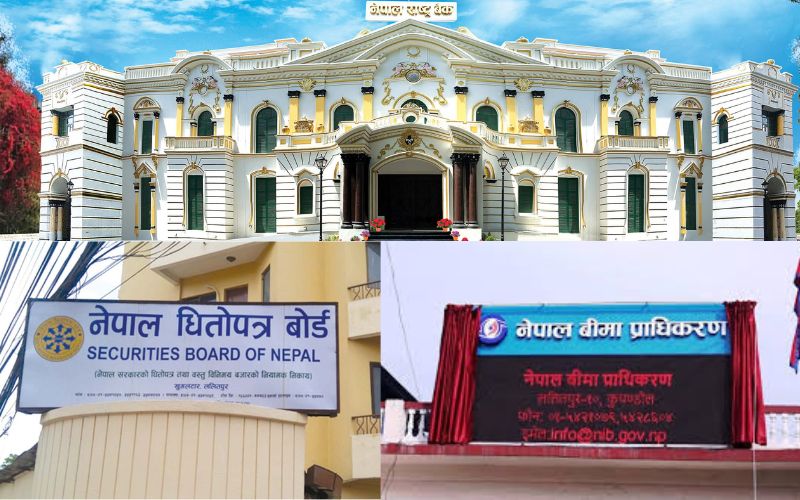
Kathmandu — A comparative review of remuneration across Nepal’s three key financial regulatory bodies has revealed that employees of Nepal Rastra Bank (NRB) enjoy the highest salary and allowance benefits. The analysis shows a wide income gap between officers working at NRB, Nepal Insurance Authority (NIA), and the Securities Board of Nepal (SEBON).
NRB Officers Earn Over Rs 1.6 Million Annually
According to the data, an officer-level (Assistant Director) employee at NRB receives a total annual income of Rs 1,600,164, making it the most lucrative among the three regulators.
On a monthly basis, this translates to around Rs 133,000, combining both salary and allowances. While the basic monthly salary is just Rs 50,100, various allowances push the total income significantly higher.
NRB officers receive multiple categories of allowances—
Monthly allowances: temporary allowance, central bank allowance, snacks, fuel, internet, and other operational facilities.
Annual allowances: festival allowance, anniversary allowance, and other financial support.
This generous compensation structure highlights the central bank’s historically strong financial capacity and its extensive regulatory responsibilities.
Insurance Authority Ranked Second with Rs 1.11 Million Annual Income
The Nepal Insurance Authority (NIA) stands in second position. An officer-level employee at NIA earns Rs 1,112,904 annually, equivalent to a monthly average of Rs 92,700.
The basic salary at NIA is Rs 43,689, while the remaining income is composed of several allowances such as transport allowance, fuel allowance, inflation allowance, monthly institutional allowance, and other support payments. Annual benefits include festival grants and anniversary-related pay.
Although NIA is relatively new compared to NRB and SEBON, its allowance structure is becoming increasingly competitive as the insurance market expands.
SEBON Officers Earn Rs 1.09 Million—Slightly Lower Than NIA
The Securities Board of Nepal (SEBON), the regulator of the capital market, ranks third in this comparison. An officer-level employee earns Rs 1,090,733 annually, which equals roughly Rs 90,900 per month.
Despite having the same basic salary as NIA—Rs 43,689—SEBON’s annual allowances are noticeably lower.
Its monthly benefits include newspaper allowance, telephone reimbursement, incentive allowance, transport, fuel, inflation allowance, and medical reimbursement. Annual facilities include festival expenses and attire allowance.
The comparatively lower annual allowance amount keeps SEBON behind NRB and NIA in total yearly income.
Analysis: Why Such a Gap Between the Regulators?
Different Levels of Responsibility
NRB oversees the entire banking and monetary system of the country, making it the most sensitive and high-pressure financial institution. Its pay structure reflects the broader scope and higher risks associated with its mandate.
Historical Pay Structures
NRB has maintained a strong allowance system for decades. Meanwhile, NIA—still evolving—and SEBON—operating with limited financial independence—have comparatively modest structures.
Market Size and Regulatory Influence
The banking sector is the largest in Nepal, placing NRB at the top in terms of responsibility.
The insurance sector is expanding, which is reflected in NIA’s growing benefits.
The capital market is still developing, limiting SEBON’s resource base and financial flexibility.
These factors collectively shape the differences in salary and allowance distribution.
The comparison clearly shows that Nepal Rastra Bank offers the highest compensation, followed by the Insurance Authority, and finally SEBON.
With public discussion growing around transparency and fairness in the financial sector, the significant gap in income among regulatory employees may prompt future debate on whether pay structures across these institutions should be reviewed for uniformity.
Advertisement
Written by
Dipesh Ghimire