NEPSEtrading

Make smarter moves backed by machine learning. Join thousands of traders leveraging AI to maximize profits.

nepsetrading.com is an online news portal that provides insights into trading and investment by analyzing the stock market and the global economy. We create charts based on the analysis of various indicators. Please do not rely solely on this information for investment decisions. Self-study is crucial. Use this information only as an educational and informational resource.

Marketminds Investment Group Private Limited

DOIB Registration certificate no. :

4680-2081/2082

Chairman: Bishal Bikram Bimali

Director and Editor-in-chief:

Dipesh Ghimire

(

9802363868,

9851119988

)

Koteshwor 32 , Kathmandu

01-5253221

+977 9709066745

Contact support

Subscribe to our newsletter

Weekly insights from the NEPSE market in your inbox.

Market

StocksSectors

Company

About UsOur TeamTerms of UseOur PolicyTrainingContact Us

Help

SupportReportFAQ

© 2026 nepsetrading.com. All rights reserved.
This website is owned and operated by Marketminds Investment Group Private Limited.

Charts are powered byTrading View

NEPSEtrading

  • Home
  • Market
  • Charts
  • News
  • Blogs
  • Training
  • Pricing
  1. Blogs
  2. Weighted Assets
  3. Capital Adequacy of Nepalese BFIs Shows Stable Health as of Mid-May 2025
Weighted Assets

Capital Adequacy of Nepalese BFIs Shows Stable Health as of Mid-May 2025

As of Mid-May 2025 (Baisakh End, 2082), Nepal’s Banks and Financial Institutions (BFIs) maintain strong capital adequacy. The overall Core Capital to Risk-Weighted Assets (RWA) stands at 9.57%, while the Total Capital to RWA is 12.42%. Class "B" development banks lead with the highest ratios, reflecting sound financial health and compliance with regulatory norms. These figures indicate Nepal’s banking sector is well-capitalized and resilient against financial risks.

SCSandeep Chaudhary
Published on June 13, 20251 min read
Capital Adequacy of Nepalese BFIs Shows Stable Health as of Mid-May 2025

As of Baisakh End, 2082 (Mid-May, 2025), the capital adequacy ratios of Nepal's Banks and Financial Institutions (BFIs) indicate a stable and healthy position in terms of risk coverage and regulatory compliance. The Capital Adequacy Ratio (CAR), a key measure of a bank's capital in relation to its risk-weighted assets (RWA), helps gauge the institution’s ability to absorb potential losses.

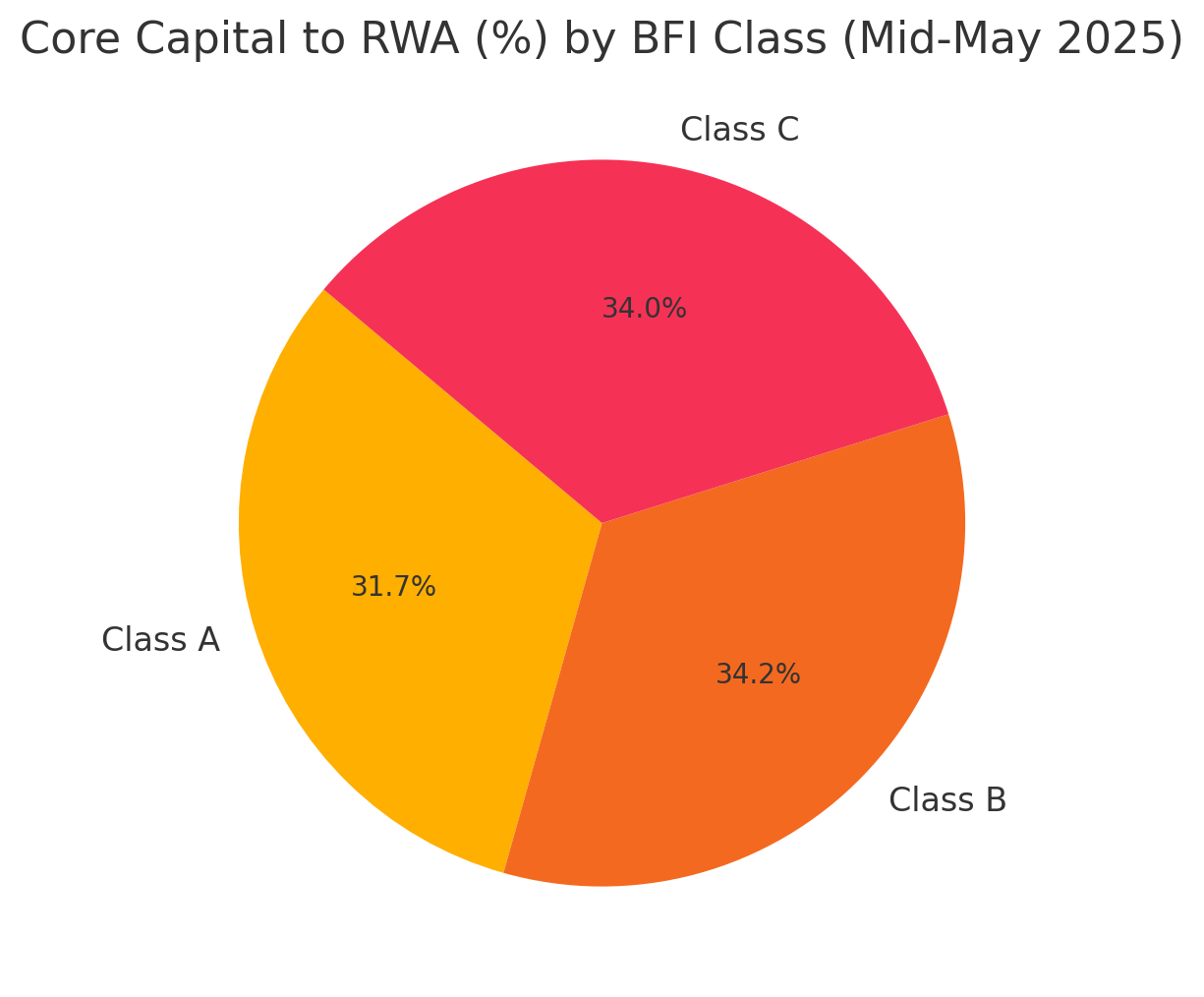
Core Capital to RWA, also known as Tier 1 capital ratio, stood at 9.57% overall, slightly above the regulatory minimum set by Nepal Rastra Bank. Breaking it down by institution class:

  • Class “A” commercial banks posted a ratio of 9.50%,

  • Class “B” development banks achieved 10.24%, and

  • Class “C” finance companies reported 10.19%.

This suggests that development and finance companies have maintained a relatively higher cushion of core equity and retained earnings compared to commercial banks, which is crucial for absorbing immediate financial stress without external support.

Total Capital to RWA, which includes both Tier 1 and Tier 2 capital (such as subordinated debt, hybrid capital instruments), was 12.42% on average across all BFIs:

  • Class “A” banks posted 12.39%,

  • Class “B” banks recorded 12.87%, and

  • Class “C” companies stood at 12.33%.

All these figures are comfortably above the minimum regulatory thresholds, reflecting prudent capital management and moderate risk exposure. The strong capital base across all three classes of BFIs enhances the resilience of Nepal’s financial system and its capacity to support credit growth and economic expansion.

In summary, the capital adequacy position of Nepalese BFIs as of mid-May 2025 remains robust, contributing to overall financial stability and investor confidence in the banking sector.

SC

Written by

Sandeep Chaudhary

Capital Adequacy of Nepalese BFIs Shows Stable Health as of Mid-May 2025

Related News

View all
  • Tourism Earnings Slip While Education Spending Abroad Climbs: Nepal's Services Account Remains in Deficit at Rs.68 Billion
    Nepal’s Economy

    Tourism Earnings Slip While Education Spending Abroad Climbs: Nepal's Services Account Remains in Deficit at Rs.68 Billion

    10 Jun, 2026

  • Nepal's Terms of Trade Deteriorate by 16.9 Percent: Import Prices Surge 24 Percent While Export Prices Crawl at 3.1 Percent
    Nepal’s Economy

    Nepal's Terms of Trade Deteriorate by 16.9 Percent: Import Prices Surge 24 Percent While Export Prices Crawl at 3.1 Percent

    10 Jun, 2026

  • Trade Deficit Crosses Rs.1,443 Billion: Exports Grow But Imports Outpace Them, China-Bound Exports Collapse by 41 Percent
    Nepal’s Economy

    Trade Deficit Crosses Rs.1,443 Billion: Exports Grow But Imports Outpace Them, China-Bound Exports Collapse by 41 Percent

    10 Jun, 2026

Related News