Top
Credit Growth Slows Despite Ample Liquidity, Raising Concerns Over Economic Recovery
Credit Growth Slows Despite Ample Liquidity, Raising Concerns Over Economic Recovery Nepal’s banking data for the second quarter of the current fiscal year point to a continuing slowdown in private sector credit expansion, underlining the fragile state of domestic economic activity. Figures released by Nepal Rastra Bank show that lending to the private sector has grown by only 3.6 percent by mid-January, adding NPR 197.47 billion and taking the total outstanding credit to NPR 5,695.17 billion. The pace of growth remains noticeably weaker than policymakers had anticipated at the start of the fiscal year.
Dipesh Ghimire
3 min read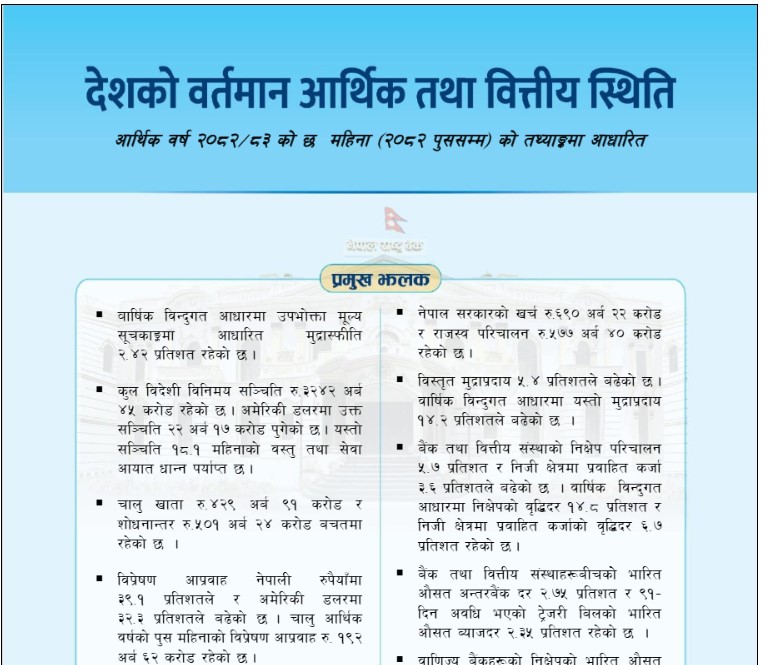
Nepal’s banking data for the second quarter of the current fiscal year point to a continuing slowdown in private sector credit expansion, underlining the fragile state of domestic economic activity. Figures released by Nepal Rastra Bank show that lending to the private sector has grown by only 3.6 percent by mid-January, adding NPR 197.47 billion and taking the total outstanding credit to NPR 5,695.17 billion. The pace of growth remains noticeably weaker than policymakers had anticipated at the start of the fiscal year.
A breakdown of the data reveals that credit expansion has remained subdued across all categories of banks. Commercial banks recorded a modest growth of 3.7 percent, while development banks expanded lending by 2.9 percent. Finance companies lagged further behind, posting a growth of just 1.2 percent. This broad-based slowdown suggests that the issue is not confined to a particular segment of the banking system, but reflects weak demand from the private sector as a whole.
The structure of lending also highlights long-standing imbalances. By mid-January, loans backed by real estate accounted for 63.9 percent of total outstanding credit, underscoring the continued dominance of property-based collateral in bank lending. Credit secured by current assets—both agricultural and non-agricultural—stood at 15 percent. Compared to a year earlier, the shift in collateral composition has been minimal, indicating that banks remain cautious about extending credit without strong asset backing.
Sectoral data from the first six months of the fiscal year further reinforce concerns about the quality of credit growth. Lending has increased most sharply in consumption-related areas, rising by 9.1 percent, followed by construction at 7.2 percent. Credit to transportation, communication, and public services grew by 6.2 percent, while industrial production saw a moderate increase of 4.4 percent. In contrast, credit to agriculture declined by 1.1 percent, raising questions about the effectiveness of policies aimed at channeling finance toward productive and employment-generating sectors.
An analysis by loan type paints a similar picture. Margin lending rose by 8.3 percent, reflecting continued activity in capital market–linked borrowing. Import-related trust receipt loans increased by 7.8 percent, and hire-purchase loans by 7.3 percent. However, growth in working capital loans, term loans, and real estate lending remained limited. Notably, overdraft lending declined by 3.3 percent, suggesting tighter short-term credit use by businesses.
The slowdown becomes more pronounced when compared with last year’s performance. During the same period of the previous fiscal year, private sector credit had expanded by NPR 265.56 billion, significantly higher than this year’s increase. On an annual point-to-point basis, credit growth stood at 6.7 percent by mid-January—well below levels typically associated with a strong economic recovery.
The composition of borrowers has also shifted slightly. Non-financial institutions accounted for 62.7 percent of total private sector credit, while individuals and households made up 37.3 percent. Compared to last year, institutional borrowing has declined, suggesting that businesses remain hesitant to undertake new investments despite improved liquidity conditions and relatively lower interest rates.
Economists argue that the sluggish credit growth reflects deeper structural challenges rather than a shortage of funds. Weak investment confidence, slow recovery in industrial activity, and uncertainty in agriculture have dampened demand for loans. While monetary conditions are accommodative, analysts stress that credit expansion alone cannot revive the economy without parallel improvements in business sentiment, policy clarity, and sector-specific incentives.
Overall, the latest data suggest that Nepal’s banking system is flush with liquidity but struggling to convert it into productive lending. Unless confidence in investment and production improves, credit growth is likely to remain muted, posing a challenge to broader economic recovery in the months ahead.
Advertisement
Written by
Dipesh Ghimire