Dipesh Ghimire
Election Momentum Lifts Market Sentiment as NEPSE Breaks Above 2,700
Election Momentum Lifts Market Sentiment as NEPSE Breaks Above 2,700 Kathmandu — Nepal’s stock market extended its upward momentum on Tuesday, buoyed by growing election activity and renewed investor confidence. As political uncertainty gradually eases and the country moves deeper into an election cycle, optimism has begun to reflect clearly in market performance. The benchmark index climbed above the key psychological level of 2,700, supported by strong turnover and broad-based buying interest. With nomination filings underway across the country for the House of Representatives election scheduled on Falgun 21, market participants appeared encouraged by expectations of political stability and policy continuity. The upbeat mood translated directly into trading, helping the long-sidelined market recover closer to levels seen before the decline triggered by the so-called “Gen-Z movement.”
Dipesh Ghimire
4 min read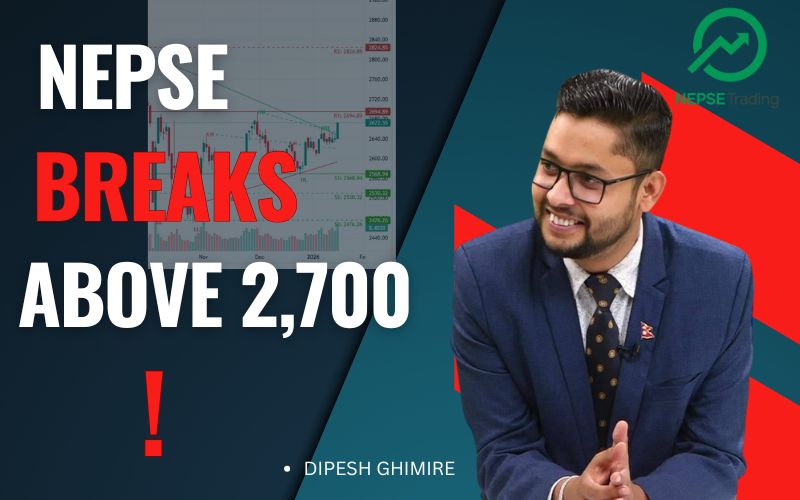
Dipesh Ghimire
Nepal’s stock market extended its upward momentum on Tuesday, buoyed by growing election activity and renewed investor confidence. As political uncertainty gradually eases and the country moves deeper into an election cycle, optimism has begun to reflect clearly in market performance. The benchmark index climbed above the key psychological level of 2,700, supported by strong turnover and broad-based buying interest.
With nomination filings underway across the country for the House of Representatives election scheduled on Falgun 21, market participants appeared encouraged by expectations of political stability and policy continuity. The upbeat mood translated directly into trading, helping the long-sidelined market recover closer to levels seen before the decline triggered by the so-called “Gen-Z movement.”
The rally marks a notable turnaround from the prolonged sideways and pressured phase that followed the September unrest. On Tuesday, the index reclaimed the 2,700 mark, a level widely viewed by investors as a confidence threshold. Analysts attribute the surge to expectations of increased liquidity during the election period, a pickup in economic activity, and hopes that a new government will adopt more capital-market-friendly policies.
By the close of trading, the benchmark index had gained 42 points, rising 1.58 percent to settle at 2,714.81. Buying pressure was visible from the opening bell, signaling that investor confidence—dented over recent months—is gradually returning. Market breadth also remained firmly positive, reinforcing the bullish undertone.
Turnover figures added further strength to the rally. Total transactions for the day reached approximately NPR 11.85 billion, reflecting a sharp increase in market participation. Shares of 339 companies were traded through more than 115,000 transactions, underlining the renewed activity across the exchange.
Market sentiment was overwhelmingly positive, with share prices of 224 companies advancing, while only 31 declined and five remained unchanged. Such a wide advance suggests a clear bullish bias rather than a narrow, selective rally. According to analysts, this pattern often emerges when investors begin positioning for a sustained upward move rather than short-term speculation.
Technical Signals Reinforce the Optimism
From a technical perspective, the market has delivered several encouraging signals. The index has decisively broken above the neckline of an ascending triangle formation, closing firmly above it. This breakout indicates a potential shift in the medium-term trend, suggesting that the market may be transitioning from consolidation to expansion.
One of the most significant developments is the index’s breakout above its 200-day moving average after nearly 71 trading sessions. The 200-day average is widely regarded as a key indicator of long-term trend direction, and reclaiming it is often interpreted as confirmation that the broader bearish phase has weakened.
Momentum indicators also support the positive outlook, though with some caution. The Relative Strength Index (RSI-14) has moved close to the 70 level, signaling that the market is approaching overbought territory. While this does not necessarily imply an immediate reversal, it raises the possibility of a short-term pause or mild pullback that could help cool momentum before the next move higher.
Bollinger Bands, meanwhile, are beginning to expand, a technical sign that volatility may increase in the coming sessions. Such expansion typically accompanies the early stages of a new trend, lending further credibility to the recent breakout.
Volume, Sector Rotation and Market Structure
Volume behavior has played a crucial role in validating the breakout. Trading volume on the breakout session was higher than that recorded over the previous 95 trading days, indicating fresh capital inflows rather than a low-liquidity price spike. This increase in volume strengthens the reliability of the move above key resistance levels.
The market opened with a gap-up and maintained a positive tone throughout the session. Although the index faced some pressure after hitting the day’s high around 12:50 PM, it did not retrace to fill the opening gap. The opening level ultimately became the day’s low, a structure often interpreted as a sign of strong buyer dominance.
Sector-wise, hydropower stocks accounted for a noticeably larger share of total turnover, while trading activity in most other sectors eased comparatively. This suggests short-term leadership from hydropower, even as overall market participation remains healthy. Broker data also indicated balanced activity among the top 10 brokers, with buying and selling volumes evenly matched—pointing to orderly trading rather than aggressive distribution or speculative excess.
Looking Ahead
Historical trends show that Nepal’s stock market often experiences short-term volatility during election periods, but tends to reward investors over the longer term once political transitions settle. Market experts believe that if a stable government emerges with clear economic priorities, the groundwork could be laid for a stronger and more sustained market cycle.
For now, the technical and fundamental signals appear aligned. While a brief consolidation or retest cannot be ruled out given near-overbought conditions, the broader structure suggests that the market is building a foundation for further gains. As election momentum continues and policy expectations take shape, investors are increasingly hopeful that the market could be entering a new, more resilient phase of growth.
Advertisement
Written by
Dipesh Ghimire