Finance Minister Wagle
Finance Minister Wagle Addresses Parliament on Wealth Commission, AI Infrastructure, and the Fight Against Poverty
The recurring theme across Wagle's responses was that the current government sees economic growth and institutional reform as complementary rather than competing priorities. Tightening accountability for public officials through the wealth commission, fixing the project delivery system, building digital infrastructure, and directing budget resources toward disadvantaged regions are all presented as parts of a coherent development strategy. Whether that coherence holds in practice — whether the reforms are implemented rather than announced, whether the accountability mechanisms apply equally across political affiliations, and whether the growth strategy actually reaches the communities it is designed to serve — are questions that Thursday's parliamentary session could raise but not answer. Those answers will emerge in the months and years ahead.
Dipesh Ghimire
5 min read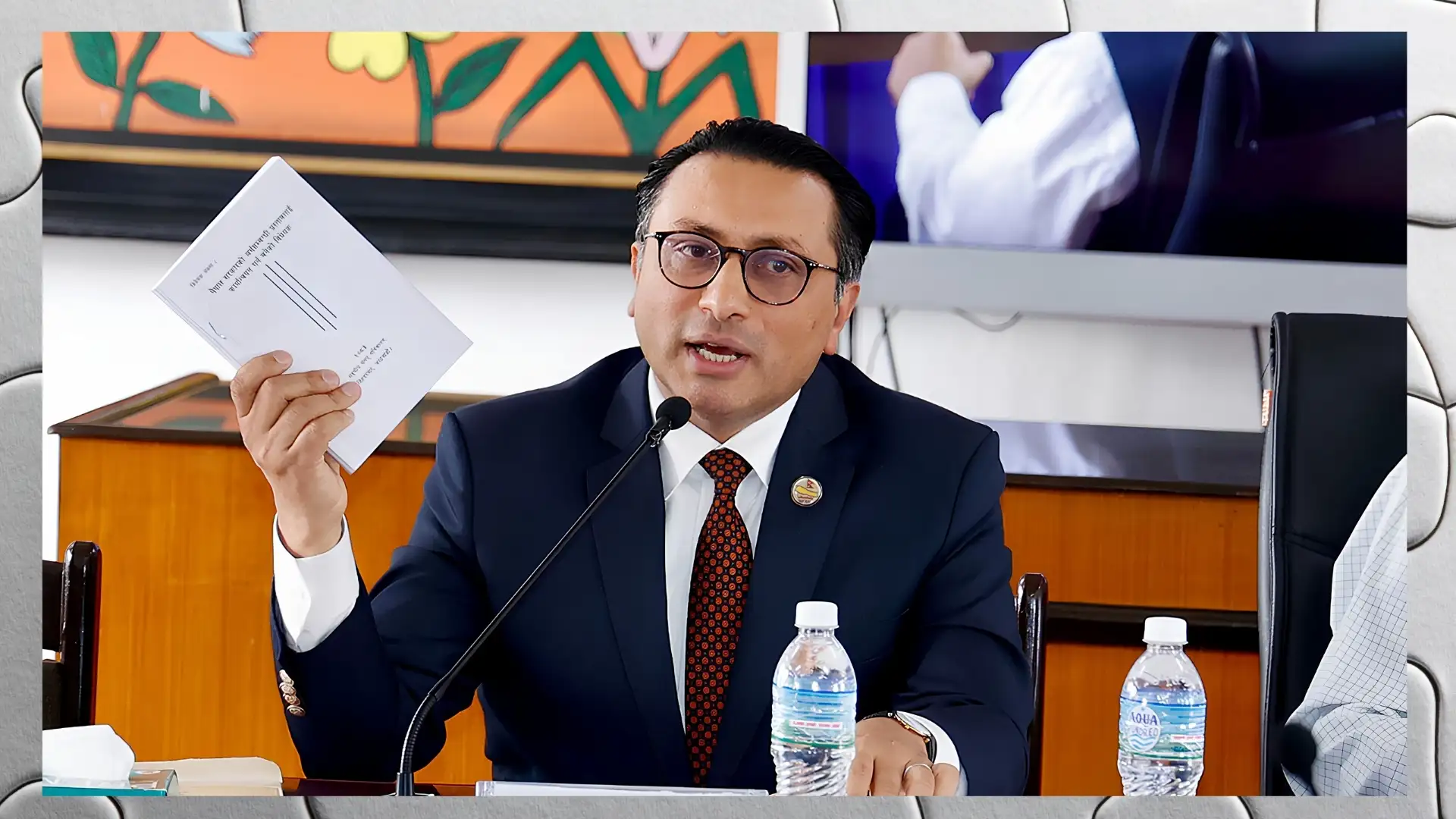
Thursday's session of the House of Representatives turned into one of the more substantive parliamentary exchanges of the current budget cycle, as Finance Minister Dr. Swarnima Wagle fielded a wide range of pointed questions from lawmakers during deliberations on the Appropriation Bill 2083. Speaking on behalf of Prime Minister Balendra Shah, Wagle addressed concerns spanning the newly formed Wealth Scrutiny Commission, the government's approach to national pride projects, digital infrastructure ambitions, cybersecurity, the use of security forces in informal settlement evictions, and the budget's strategy for reducing poverty in Nepal's most disadvantaged regions.
The sharpest questions of the session centered on the Wealth Scrutiny Commission — a body established to examine the assets of individuals holding political and public office. Lawmakers had raised concerns about whether the commission would duplicate or encroach upon the work of the Commission for the Investigation of Abuse of Authority, a constitutionally mandated institution with independent investigative powers. Wagle moved quickly to address those concerns head-on. The Wealth Scrutiny Commission, he explained, is not an investigative body and was never intended to be one. It is a specialized mechanism with a narrowly defined mandate — to examine the asset declarations of designated public officials, identify potential irregularities, and recommend further action to the government when evidence of illegally acquired wealth is found. The power to investigate, prosecute, and punish remains where it has always resided, within the CIAA and the judicial system.
The distinction Wagle drew is important and deserves careful consideration. Critics of the commission have argued that creating a parallel body to examine public officials' wealth risks either duplicating existing institutional functions or, worse, providing a political tool that could be deployed selectively. The Finance Minister's clarification that the commission functions as a study and recommendation body rather than an enforcement agency addresses part of that concern, but the effectiveness of such a body will ultimately depend on whether its recommendations are acted upon and whether its scope is applied consistently across political lines rather than targeted at opponents.
On the long-running problem of national pride projects failing to meet their deadlines, Wagle acknowledged what has been a persistent and costly failure of governance across multiple administrations. Projects have routinely been announced before land acquisition was complete, before feasibility studies were conducted, and before the logistical groundwork was in place. The result has been years of delays, cost overruns, and public frustration. The government's new approach, Wagle said, will require all preliminary work — land acquisition, feasibility assessment, and preparation — to be fully completed before any project is formally added to the national pride list and receives budget allocation. This is a sensible reform that previous governments have also promised but struggled to implement consistently, and its success will depend on whether the discipline holds when political pressures push for early announcements.
The federal governance dimension also received attention. Wagle confirmed that the process of revising the Work Detail Report — the document that defines the division of functions between the federal, provincial, and local governments — is underway. Consultations with stakeholders at all three tiers of government have been conducted, a draft has been prepared, and further revisions based on additional study are planned. The ambiguities in functional assignment that have plagued federalism implementation since 2015 are a genuine obstacle to effective service delivery at the sub-national level, and the revision process, if conducted thoroughly and in good faith, could meaningfully improve how government actually works for citizens outside Kathmandu.
Perhaps the most forward-looking portion of Wagle's responses dealt with digital infrastructure. The minister confirmed that the data centre in Kohalpur has been completed and that preliminary work on a new facility in Khumaltar is already in progress, joining the existing Integrated Data Management Centre at Singha Durbar and the Disaster Recovery Centre at Hetauda. More significantly, he announced that Nepal's first sovereign artificial intelligence compute centre will be established at Syuchatar in Kathmandu — a commitment that has been formally included in the national budget. The minister added that future AI-focused infrastructure decisions will be guided by assessments of climate, geography, environmental impact, and social considerations, suggesting a degree of long-term planning that goes beyond simply building facilities wherever land is available.
The cybersecurity dimension of national security also came up during the session. Wagle confirmed that the National Investigation Department, the National Cybersecurity Centre, and the Cyber Bureau are actively engaged in reducing cyber risks and controlling digital crime. Further infrastructure development and institutional capacity building in the cybersecurity space are planned. Given the rapid expansion of digital financial services and government digital systems, investment in cybersecurity is not optional infrastructure — it is foundational to the credibility and safety of everything built on top of it.
A politically sensitive question arose around the eviction of informal settlements, with allegations that the Nepali Army had been deployed in the process. Wagle rejected that characterization directly. He clarified that relocating residents from high-risk areas was carried out in coordination with local governments, with Nepal Police playing a facilitative and security role — not the army. He acknowledged that security forces including the army can be mobilized when national security or territorial integrity requires it, but maintained that this was not such a case. The distinction between police and army involvement in civilian displacement operations matters both legally and politically, and the government's position is that the line was respected.
The most extensive portion of Wagle's responses addressed poverty reduction and the budget's approach to Nepal's most disadvantaged regions. He confirmed that Karnali, Madhesh, and Sudurpashchim — provinces that consistently rank lowest on economic, social, and human development indicators — have been given priority in budget allocations. The nutrition allowance for Dalit children has been doubled, and no existing social protection programs have been cut. These are concrete, verifiable commitments that lawmakers and civil society groups will be watching closely.
On the broader philosophy of poverty reduction, Wagle articulated a position that distinguishes the current government's approach from simple cash transfer dependency. "Handing out cash cannot sustainably end poverty," he said. "The goal is not to make people dependent on assistance but to create conditions where they can earn their own income and become self-reliant." The strategy he outlined centers on agricultural modernization, irrigation expansion, crop insurance, worker protection, skills development, industrial promotion, digital economy growth, and private sector investment as the primary engines of job creation. This framework reflects an economic logic that is broadly sound — sustainable poverty reduction requires productive employment, not just welfare transfers — but its credibility rests on delivery rather than articulation.
The recurring theme across Wagle's responses was that the current government sees economic growth and institutional reform as complementary rather than competing priorities. Tightening accountability for public officials through the wealth commission, fixing the project delivery system, building digital infrastructure, and directing budget resources toward disadvantaged regions are all presented as parts of a coherent development strategy. Whether that coherence holds in practice — whether the reforms are implemented rather than announced, whether the accountability mechanisms apply equally across political affiliations, and whether the growth strategy actually reaches the communities it is designed to serve — are questions that Thursday's parliamentary session could raise but not answer. Those answers will emerge in the months and years ahead.
Advertisement
Written by
Dipesh Ghimire