Top
Finance Minister Wagle Pitches Nepal to Indian Corporate Leaders, Guarantees Legal Reforms and Profit Repatriation
Combined with the government-to-government reconstruction and infrastructure discussions taking place during Prime Minister Shah's visit, engaging CII and leading Indian CEOs signals that Kathmandu is looking beyond concessional sovereign aid toward sustainable, private-sector-led foreign direct investment to drive domestic job creation and economic growth.
Dipesh Ghimire
2 min read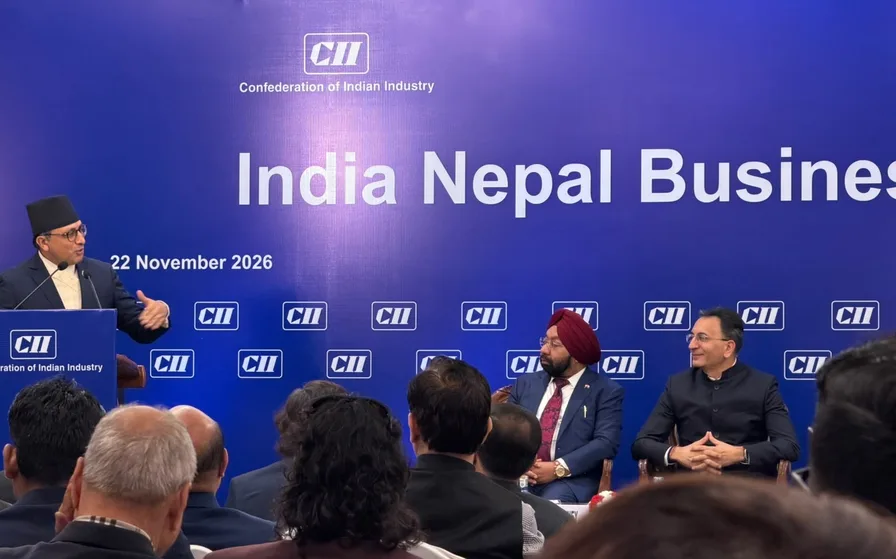
NEW DELHI — Finance Minister Dr. Swarnim Wagle has called on Indian industrialists and corporate leaders to invest confidently in Nepal, highlighting emerging opportunities in information technology, hydropower, and regional connectivity.
Speaking at the 'India–Nepal Business Roundtable' organized by the Confederation of Indian Industry (CII) at the Taj Palace Hotel in New Delhi on Sunday, Dr. Wagle urged both prospective and existing Indian investors to treat Nepal as a fertile and high-potential destination for capital deployment.
The high-level private-sector interaction took place on the sidelines of Prime Minister Balendra Shah's two-day official state visit to India, aimed at strengthening bilateral economic and diplomatic ties.
Addressing a gathering of top business executives, Dr. Wagle emphasized that Nepal offers an increasingly conducive environment for foreign direct investment. He encouraged Indian companies already operating in Nepal to scale up their ventures alongside newcomers entering priority growth sectors.
To reassure foreign investors wary of bureaucratic hurdles, the Finance Minister stated that Kathmandu is actively streamlining its legal and regulatory frameworks to make them simpler and more business-friendly.
He specifically underscored the government's commitment to safeguarding invested capital, ensuring predictable returns, and easing statutory procedures for the smooth repatriation of profits back to investors' home countries.
Indian Minister of State for Commerce and Industry Jitin Prasada and CII International Council Chair Dr. Vikramjit Singh Sahney also addressed the roundtable, echoing calls for deeper private-sector collaboration between the two neighbors.
The forum brought together members of the Nepali business delegation accompanying Prime Minister Shah alongside more than a dozen prominent Indian industrialists and chief executive officers of major Indian corporations.
Finance Minister Dr. Swarnim Wagle's pitch in New Delhi represents a targeted economic diplomacy effort to attract private Indian capital into sectors where Nepal holds natural comparative advantages and growing regional demand.
By spotlighting hydropower, information technology, and connectivity, Kathmandu is aligning its investment appeal with India's own strategic needs—namely clean energy imports to meet decarbonization targets, cost-effective IT and digital outsourcing talent, and integrated cross-border supply chains.
Crucially, Dr. Wagle's explicit assurances regarding capital protection and profit repatriation directly address long-standing pain points for foreign investors in Nepal. Historically, complex bureaucratic approvals, overlapping tax interpretations, and procedural delays at the central bank when repatriating dividends have deterred multinational firms despite Nepal's proximity to the vast Indian market.
Combined with the government-to-government reconstruction and infrastructure discussions taking place during Prime Minister Shah's visit, engaging CII and leading Indian CEOs signals that Kathmandu is looking beyond concessional sovereign aid toward sustainable, private-sector-led foreign direct investment to drive domestic job creation and economic growth.
Written by
Dipesh Ghimire