Top
Former Planning Commission Leaders Enter Electoral Race, Shift From National Vision to Local Promises
Former Planning Commission Leaders Enter Electoral Race, Shift From National Vision to Local Promises Two former vice chairpersons of Nepal’s National Planning Commission—once responsible for drafting the country’s long-term development strategies—have stepped into the electoral battlefield ahead of the February 21 House of Representatives election, highlighting a striking contrast between national policy expertise and grassroots electoral politics. The candidates are Dr Govind Raj Pokharel, contesting from Pyuthan, and Dr Swarnim Wagle, running from Tanahun–1. Both are economists with national and international credentials, now seeking voter support in highly competitive constituencies where local dynamics may outweigh technocratic vision.
Dipesh Ghimire
3 min read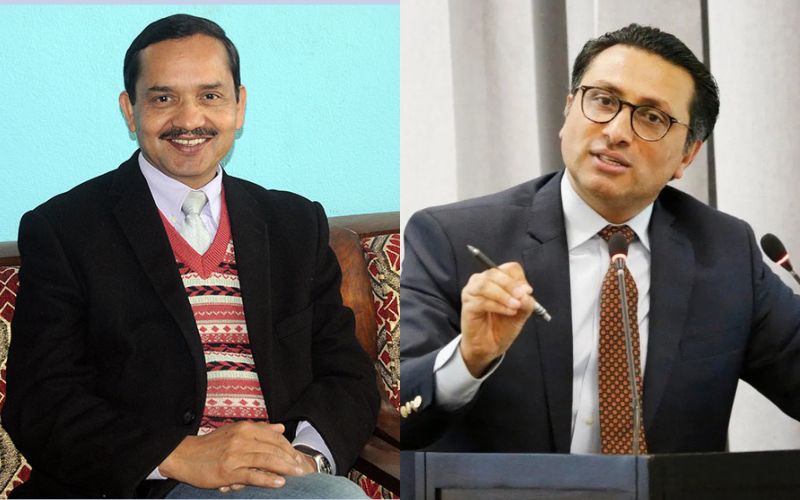
Two former vice chairpersons of Nepal’s National Planning Commission—once responsible for drafting the country’s long-term development strategies—have stepped into the electoral battlefield ahead of the February 21 House of Representatives election, highlighting a striking contrast between national policy expertise and grassroots electoral politics.
The candidates are Dr Govind Raj Pokharel, contesting from Pyuthan, and Dr Swarnim Wagle, running from Tanahun–1. Both are economists with national and international credentials, now seeking voter support in highly competitive constituencies where local dynamics may outweigh technocratic vision.
Dr Pokharel, born in Raspurkot of Pyuthan, holds a master’s degree in rural energy technology from the University of Flensburg in Germany and a PhD in energy economics and policy from the same institution. A professor at Thapathali Engineering Campus, he has previously served as Executive Director of the Alternative Energy Promotion Centre and Chief Executive Officer of the National Reconstruction Authority.
His electoral history in Pyuthan has been mixed. In the 2017 general election, Pokharel was defeated by Durga Paudel of Rastriya Janamorcha. While Paudel secured 47,514 votes, Pokharel finished second with 31,286 votes. In the 2019 election cycle, alliance politics denied him a ticket, as his party supported Paudel, who eventually lost to Surya Bahadur Thapa Chhetri of CPN-UML.
This time, Pyuthan has become a crowded contest with candidates from 14 parties. Thapa is once again contesting for UML, while Pokharel represents the Nepali Congress. With no major alliances in place, analysts say the race will test the true organizational strength of each party. Despite Pyuthan’s reputation as a leftist stronghold, UML managed to win even against a broad alliance in the previous election, making Pokharel’s challenge formidable.
Meanwhile, in Tanahun–1, Dr Swarnim Wagle—now a vice-chair of the Rastriya Swatantra Party—has returned to the electoral arena. Born in Gorkha in 1974, Wagle is an internationally recognized development economist. He previously served as Asia-Pacific Chief Economic Adviser at the United Nations Development Programme headquarters in New York, overseeing economic advisory work across 36 countries.
Once considered a close intellectual ally of former Nepali Congress president Sher Bahadur Deuba, Wagle was appointed Planning Commission member and later vice chair under Deuba’s leadership. Political fallout later pushed him out of Congress, and he joined Rastriya Swatantra Party in 2023. He went on to win the Tanahun–1 by-election by a wide margin.
In the current election, Wagle faces a three-way contest against Nepali Congress candidate Govinda Bhattarai and UML’s Bhagwati Neupane. Adding further complexity is the so-called “Joshi factor.” Former Congress leader Govinda Raj Joshi, who was expelled from the party, still commands influence through his “Independent Congress Campaign.” His son, Dipak Raj Joshi, is also in the race, and observers believe his estimated 5,000 vote base could significantly affect the final outcome.
Historical voting data underscores Tanahun–1’s volatility. In the 2022 general election, Ram Chandra Paudel won from the constituency before vacating the seat upon becoming President. In the subsequent by-election, Wagle defeated Bhattarai by a margin of nearly 15,000 votes, consolidating his reputation as a strong contender. Yet, with UML now fielding a stronger candidate and factional dynamics within Congress unresolved, the race remains unpredictable.
Beyond electoral arithmetic, the candidacies of Pokharel and Wagle have sparked broader debate. Both are widely regarded as intellectually capable and comparatively honest figures, often speaking about transforming Nepal’s economic structure and offering national-level reform agendas. However, critics note that their campaigns increasingly rely on promises of small, localized projects—road upgrades, neighborhood infrastructure, and ward-level schemes—to attract voters.
A former vice chair of the National Planning Commission, speaking anonymously, remarked that Nepal’s electoral culture often forces even technocrats to abandon macro-level visions in favor of micro-level pledges. “Economists should be presenting national development blueprints during elections,” he said, “but our political environment pushes even intellectuals to compete on the same transactional promises as traditional politicians.”
As election day approaches, Pyuthan and Tanahun–1 are shaping up not just as contests between parties, but as tests of whether policy expertise can translate into electoral success. Whether voters reward long-term national vision or immediate local incentives may ultimately determine the fate of two men who once helped plan Nepal’s future from the center of power.
Advertisement
Written by
Dipesh Ghimire