Top
From Failure to Success: The Stock Market Mindset Inspired by Abraham Lincoln
From Failure to Success: The Stock Market Mindset Inspired by Abraham Lincoln There is a deep connection between life and the stock market—both are driven by uncertainty, emotional swings, setbacks, and moments of breakthrough. The journey of Abraham Lincoln is not just a political success story; it is a powerful lesson in mindset, especially for those navigating the ups and downs of the stock market.
Dipesh Ghimire
2 min read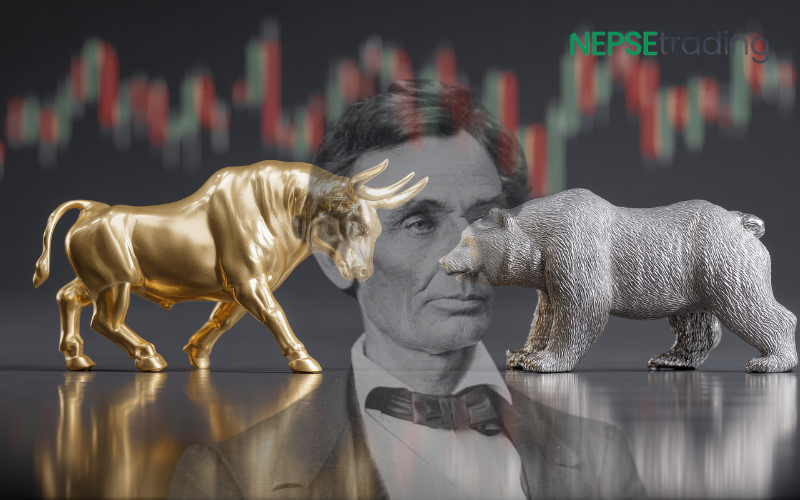
There is a deep connection between life and the stock market—both are driven by uncertainty, emotional swings, setbacks, and moments of breakthrough. The journey of Abraham Lincoln is not just a political success story; it is a powerful lesson in mindset, especially for those navigating the ups and downs of the stock market.
There was a time when no one imagined Lincoln as a future leader. Born into a poor family, he had no strong resources, no powerful connections, and very little support. But what truly defined his early life was repeated failure. If his life were to be plotted on a stock chart, it would clearly resemble a prolonged downtrend—continuous declines, weak signals, and negative sentiment.
At the age of 21, he lost his first election. At 22, he faced failure in love. By 24, his business had completely collapsed. At 27, he went through a serious mental breakdown. Even later, at 32, 37, 42, and 47, he continued to lose elections repeatedly. For most people, such a pattern would feel like hitting multiple stop losses in a row—enough to exit the market of life entirely.
But Lincoln was different. He was not a weak trader reacting to short-term losses; he was like a fundamentally strong stock. In the market, when weak hands panic and exit, strong investors hold their positions. Lincoln did the same—where others gave up, he stayed committed; where others focused on short-term outcomes, he believed in long-term vision. Despite repeated failures, he never collapsed to zero—he kept building resilience.
At the age of 52, he finally experienced his major “breakout”—he became the President of the United States. This moment was similar to a stock that consolidates for years and then suddenly delivers a massive bullish breakout. Long periods of struggle and patience eventually turned into a defining success.
This story offers several powerful lessons for the stock market. First, patience is power. Those who chase quick profits often fail in the long run. Like Lincoln, waiting for the right opportunity matters. Second, losses are temporary. A losing trade does not define your entire journey—it is just one part of the process. Lincoln faced multiple “stop losses,” but still achieved his ultimate target.
Third, emotional discipline is critical. During market crashes, fear and panic drive poor decisions. Successful investors, however, remain calm, strategic, and patient. Fourth, consistency matters more than talent. Lincoln was not known as a genius, but he was consistent. In the stock market, regular investing, discipline, and sticking to a system often outperform raw talent.
Today, your portfolio might be in the red. You might be facing losses and uncertainty. But that is not the end of the story. Lincoln appeared like a failure even into his 50s, yet he ultimately made history. The market works in a similar way—weak hands exit, but strong hands build wealth over time.
In the end, success in the stock market is not about perfect timing. It is about having an unbreakable mindset—the ability to stay patient, disciplined, and focused even when everything seems to be going against you.
Advertisement
Written by
Dipesh Ghimire