Top
Investor Confidence at Historic Low Ahead of Elections, Study Warns of Deepening Private Sector Crisis
Investor Confidence at Historic Low Ahead of Elections, Study Warns of Deepening Private Sector Crisis A recent study published by the online news portal Clickmandu, titled “Investor Confidence and Business Environment after the Gen Z Uprising, 2082,” As Nepal prepares for the House of Representatives election scheduled for Falgun 21, most major political parties have already unveiled their election manifestos, promising policy reforms to strengthen the private sector and revive economic growth. The manifestos emphasize keeping tax rates stable, promoting domestic production, encouraging entrepreneurship, reducing monopolies, improving regulations, and creating a fear-free business environment. Political leaders have repeatedly described the private sector as the “engine of the economy” and pledged to restore business confidence through supportive policies.
Dipesh Ghimire
5 min read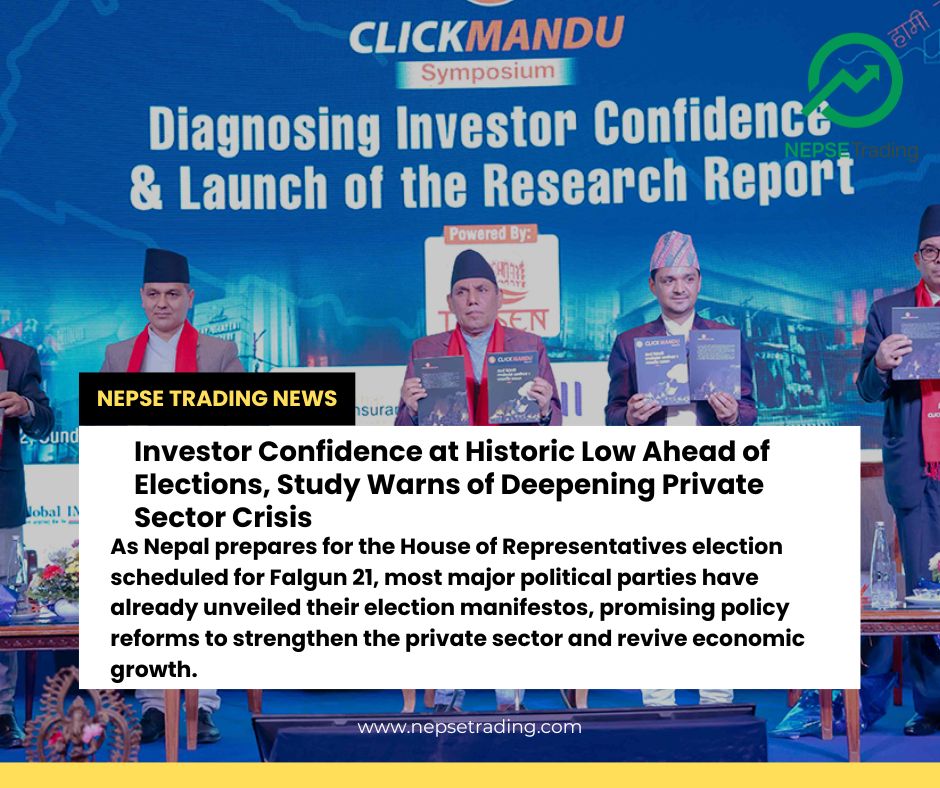
As Nepal prepares for the House of Representatives election scheduled for Falgun 21, most major political parties have already unveiled their election manifestos, promising policy reforms to strengthen the private sector and revive economic growth. The manifestos emphasize keeping tax rates stable, promoting domestic production, encouraging entrepreneurship, reducing monopolies, improving regulations, and creating a fear-free business environment. Political leaders have repeatedly described the private sector as the “engine of the economy” and pledged to restore business confidence through supportive policies.
However, despite these commitments, confidence within the business community remains deeply shaken. The scars left by the Gen Z protests of Bhadra 23 and 24, 2082, during which widespread vandalism and attacks on private property occurred, have not yet healed. Many entrepreneurs continue to feel insecure about the safety of their investments, regardless of which political party forms the next government. Analysts believe that rebuilding trust will require more than policy promises and will demand concrete actions to restore security and stability.
A recent study published by the online news portal Clickmandu, titled “Investor Confidence and Business Environment after the Gen Z Uprising, 2082,” reveals the depth of the crisis. According to the report, 98 percent of investors reported that their morale has weakened to some degree, while 97 percent said the overall investment environment has deteriorated. Furthermore, 70 percent of business owners stated that they are currently in a “wait-and-see” position, delaying further investments due to uncertainty.
The study, conducted to assess physical damage, economic losses, and psychological impact on entrepreneurs, found that established and large-scale businesses have suffered both financially and emotionally. While infrastructure and physical assets can be rebuilt over time, the report notes that the loss of confidence and trust is far more difficult to restore. In many cases, psychological damage has proven more severe than material loss.
The private sector plays a critical role in Nepal’s economy by contributing significantly to GDP, capital formation, employment generation, and government revenue. Yet, the two days of unrest disrupted production systems, service delivery, and supply chains, while causing massive losses. Participants in the study estimated that billions of rupees were lost directly through damage, along with indirect losses from halted production, interrupted trade, and rising unemployment.
During the protests, many business establishments, banks, vehicles, and even personal homes of entrepreneurs were attacked. The report highlights that while physical destruction was widespread, the deeper impact was on the mental well-being of business owners. Fear, anxiety, and uncertainty continue to affect their willingness to take risks and expand operations.
Speaking as a key informant in the study, Chandra Prasad Dhakal, President of the Federation of Nepalese Chambers of Commerce and Industry, stated that vandalism and looting destroy not only property but also the foundation of entrepreneurial confidence. He emphasized that living in constant fear over whether one’s investment is safe is one of the greatest hardships for any businessperson. According to him, psychological losses—impossible to quantify—are far greater than physical damage and could seriously hinder long-term development.
Former FNCCI President Shekhar Golchha echoed similar concerns, noting that while financial loss figures continue to emerge, mental trauma is even more severe. He criticized the narrative that portrays entrepreneurs as “profiteers” and “exploiters,” arguing that businesses generate employment, pay taxes, and take major risks to create wealth. Golchha stressed that profit, when earned legally and ethically, is not immoral and should not be stigmatized.
The survey data further highlights declining investment willingness. Only 21 percent of business owners said they are currently interested in expanding investment, while eight percent stated they are completely unwilling to invest. The overwhelming majority remains hesitant, reflecting a climate of uncertainty and fear. The report warns that such prolonged hesitation could slow economic recovery and weaken industrial growth.
The study concludes that while physical and economic damage from the protests may gradually be repaired, the psychological trauma remains deeply embedded. Many entrepreneurs reported feelings of extreme frustration, insecurity, and pessimism. Some have even begun considering capital flight, shifting investments abroad due to perceived instability at home. This trend, if continued, could severely weaken Nepal’s long-term economic prospects and discourage foreign direct investment.
Financial estimates in the report indicate that the Gen Z protests caused approximately NPR 34 billion in direct physical damage, while indirect economic losses reached nearly NPR 81 billion. Combined, these losses are estimated to have affected up to five percent of Nepal’s GDP. Such figures highlight that social unrest can have long-lasting macroeconomic consequences beyond immediate destruction.
Respondents also expressed concern over growing social hostility toward entrepreneurs. Many feel that media narratives, political rhetoric, and shortcomings in the education system have failed to promote respect for entrepreneurship. Instead, business owners are often portrayed negatively, contributing to public mistrust and resentment toward the private sector.
Following the protests, the government introduced some immediate relief measures and strengthened security, which helped restore limited optimism. However, experts argue that temporary responses are insufficient. Sustainable recovery requires consistent enforcement of the rule of law, protection of property rights, and long-term policy stability.
According to Clickmandu Chairman Pushpa Prasad Dulal, the stress caused by the Gen Z uprising represents not merely a psychological issue but a threat to the survival of Nepal’s private sector. He warned that failure to guarantee security, uphold legal governance, and create a business-friendly environment could lead the country toward prolonged economic stagnation and large-scale capital and talent migration.
The report concludes that investor confidence has reached its weakest point in history. Many entrepreneurs continue to operate under constant fear, believing that making profits is increasingly viewed as morally questionable. The growing “rich versus poor” narrative, it argues, has severely damaged business morale and entrepreneurial spirit.
Looking ahead, the study emphasizes that restoring investment confidence will take considerable time unless the state takes decisive steps. Without strong guarantees of security, legal protection, and institutional support, the investment climate is unlikely to return to normal in the near future. The report stresses that political stability alone will not be enough; trust must be rebuilt through consistent actions.
Ultimately, the study highlights that sustainable economic development in Nepal is impossible without a confident and protected private sector. It calls for stronger cooperation between the state, businesses, and society, based on mutual trust, dialogue, and respect. The report recommends that the government act as a facilitator, the private sector maintain professionalism, and society recognize entrepreneurs as partners in development. Only by building this “bridge of trust,” the report concludes, can Nepal achieve long-term economic stability and prosperity.
Advertisement
Written by
Dipesh Ghimire