Italy visa
Italy Visit Visa from Nepal 2026: Application Process
Italy is a favorite destination for Nepali travelers because of its historic cities, art and architecture, scenic countryside, coastal towns, and rich cultural heritage. In 2026, Nepalese passport holders planning to visit Italy for tourism, leisure, or visiting family and friends must apply for a Schengen Visit Visa (Type C) in advance. Italy does not offer visa-free or visa-on-arrival access for Nepali citizens, and all applications are assessed under the Schengen Visa Code.
Sandeep Chaudhary
3 min read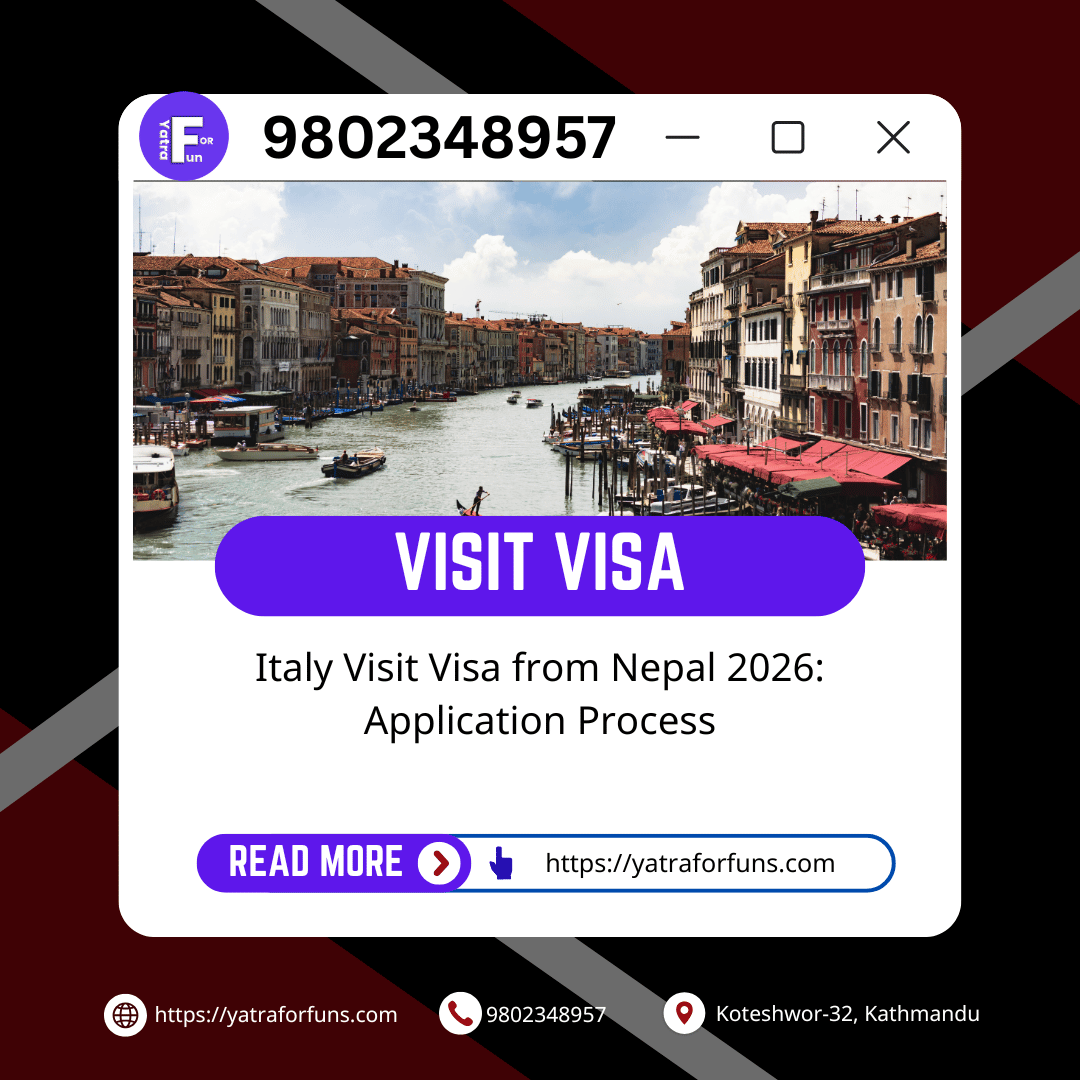
Italy is a favorite destination for Nepali travelers because of its historic cities, art and architecture, scenic countryside, coastal towns, and rich cultural heritage. In 2026, Nepalese passport holders planning to visit Italy for tourism, leisure, or visiting family and friends must apply for a Schengen Visit Visa (Type C) in advance. Italy does not offer visa-free or visa-on-arrival access for Nepali citizens, and all applications are assessed under the Schengen Visa Code.
An Italy Visit Visa allows a stay of up to 90 days within a 180-day period in Italy and other Schengen countries. Once issued, the visa generally permits travel across the Schengen Area, provided Italy is the main destination or the first point of entry.
Application Process (2026)
Under the updated 2026 procedures, Italy processes visit visa applications through the designated Visa Application Centre (VAC) representing Italy in Nepal. Applicants are required to complete the Schengen visa application form (online or printed as instructed), book an appointment, and submit documents in person at the VAC. During the appointment, biometric data (fingerprints and photograph) is collected.
Eligibility Criteria
To qualify for an Italy Visit Visa, Nepali applicants must clearly demonstrate that their visit is temporary and for tourism or personal purposes only. Applicants must show sufficient financial resources to cover travel and stay and provide evidence of strong ties to Nepal—such as employment, business ownership, family responsibilities, property ownership, or academic enrollment—to prove their intention to return after the visit.
Required Documents
A valid passport is mandatory and should generally be valid for at least six months beyond the return date, with a minimum of two blank pages. Applicants must submit photocopies of the passport bio-data page and previous visas or travel stamps, if available.
Applicants must complete and sign the Schengen visa application form accurately. Recent passport-size photographsmeeting Schengen specifications (plain background, correct size, clear facial visibility) are required.
A clear travel itinerary must be submitted, including round-trip flight reservations, hotel bookings covering the entire stay in Italy, and a day-by-day travel plan. All travel details should be consistent across documents.
Proof of financial means is essential. Applicants may submit recent bank statements (typically last 3–6 months), salary slips, income certificates, savings or fixed deposit records, or sponsorship documents if someone else is funding the trip.
A mandatory requirement is travel medical insurance covering at least €30,000, valid for all Schengen countries and for the full duration of the stay. Insurance documents must clearly state coverage amount and validity dates.
Applicants must also submit evidence of strong ties to Nepal, such as employment letters, business registration documents, property ownership papers, family records, or academic enrollment letters. These documents are critical for visa approval.
If visiting family or friends in Italy, an invitation letter along with proof of the host’s legal status and proof of relationship may be required. Italian authorities may request additional documents or clarification depending on the applicant’s profile.
Biometrics & Appointment
All eligible applicants must provide biometric data (fingerprints and photograph) at the VAC during the scheduled appointment. If biometrics were previously provided for a Schengen visa and are still valid, they may be reused.
Visa Fees & Processing Time
The Schengen visa fee must be paid at the time of application submission and is non-refundable, even if the visa is refused. Standard processing time is usually around 15 calendar days, but it may extend to 30–60 days during peak seasons or if additional checks are required. Applicants are strongly advised to apply 8–12 weeks before their intended travel date.
Visa Grant & Conditions
Once approved, the Schengen visa sticker is placed in the passport. Entry into Italy is subject to border checks, and travelers may be asked to present accommodation proof, return tickets, insurance, and evidence of sufficient funds. Visitors must strictly respect the 90/180-day rule and are not permitted to work or overstay.
Professional Visa Assistance
Italy’s Schengen visa application process involves detailed documentation and strict timelines. To avoid errors and delays, many Nepali travelers choose professional guidance. Yatra For Fun Pvt. Ltd. provides complete Italy Visit Visa assistance, including eligibility assessment, document checklist preparation, application guidance, appointment booking, and follow-up until the final decision.
For trusted Italy visa assistance, visit https://yatraforfuns.com.
Contact Yatra For Fun Pvt. Ltd.:
Phone / WhatsApp: +977-9802348957, +977-9708072951, +977-9709066745, +977-9709066517
Landline: +977-01-4110514
Email: [email protected], [email protected]
Office Location: Koteshwor-32, Kathmandu, Nepal, near Rastriya Banijya Bank, Koteshwor Branch
By following this Italy Visit Visa application process for 2026 and preparing complete, accurate documentation, Nepali travelers can improve approval chances and plan a smooth, memorable visit to Italy and the Schengen Area.
Advertisement
Written by
Sandeep Chaudhary