Tourism Meet 2026
Karnali Pushes for Global Tourism Recognition Through ‘Tourism Meet 2026’
Whether Karnali can successfully transform that vision into reality will ultimately depend on policy continuity, infrastructure development, and the ability to convert cultural and natural authenticity into a globally competitive tourism experience.
Dipesh Ghimire
3 min read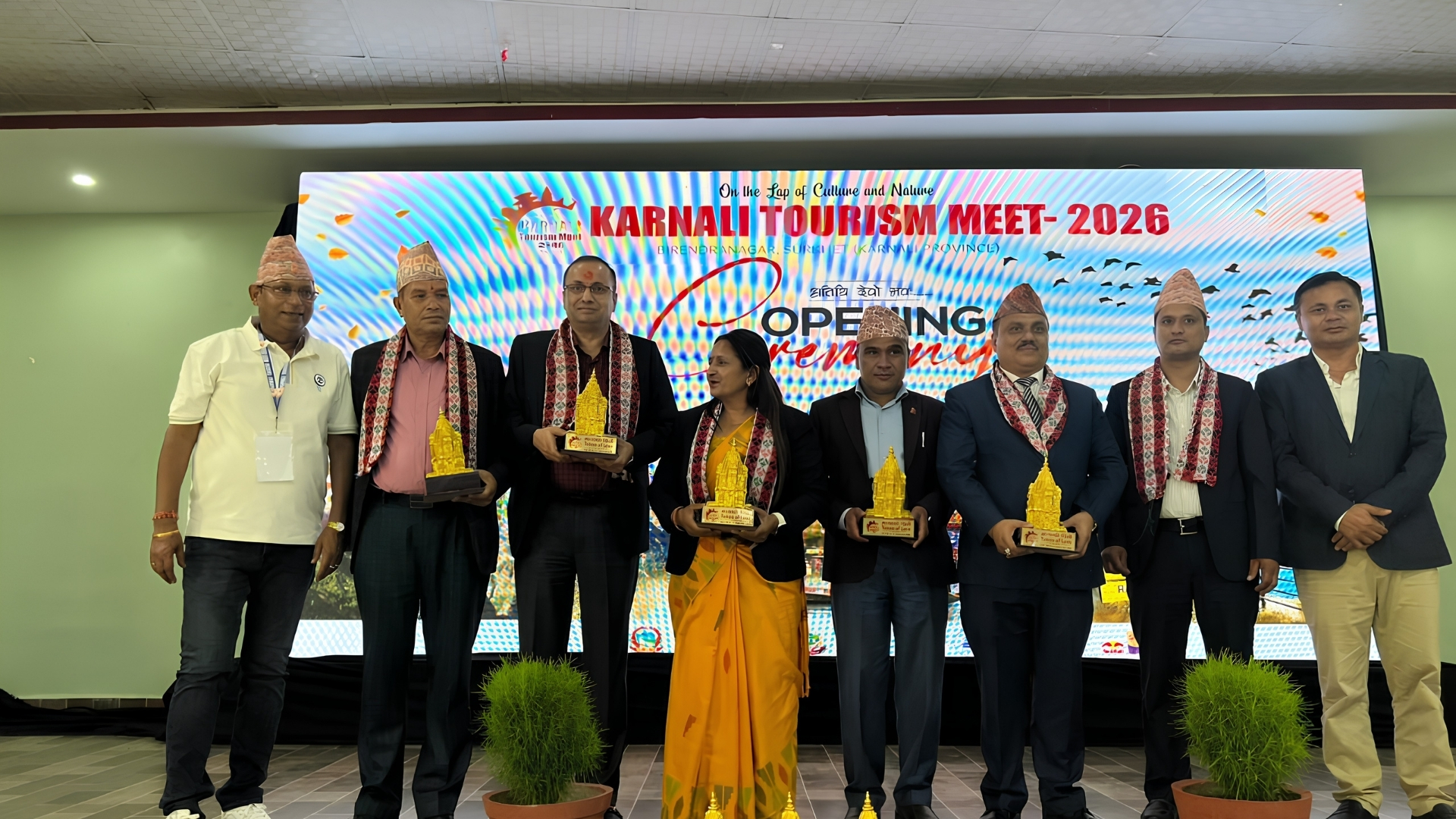
Karnali Province, long associated with remoteness and limited infrastructure, is now attempting to reposition itself as one of Nepal’s most promising high-value tourism destinations. The “Karnali Tourism Meet–2026,” organized in Surkhet under the slogan “In the Lap of Nature and Culture,” has emerged not only as a tourism promotion event, but also as a strategic effort to redefine Karnali’s national and international image.
The conference, jointly organized by the Nepal Tourism Board and Birendranagar Municipality with coordination from tourism entrepreneurs and local governments, brought together government officials, tourism experts, private sector representatives, and Indian tourism entrepreneurs. Discussions during the event focused on how Karnali’s natural landscapes, cultural heritage, biodiversity, and indigenous lifestyle could be transformed into sustainable economic opportunities through tourism.
For decades, Karnali has largely remained outside Nepal’s mainstream tourism economy despite possessing some of the country’s most unique destinations, including Rara Lake, Shey-Phoksundo, Dolpa, Humla, and Gurans. Poor connectivity, limited infrastructure, and weak international branding have historically prevented the region from fully benefiting from tourism growth. However, policymakers and tourism stakeholders now appear increasingly convinced that global tourism trends may finally be shifting in Karnali’s favor.
Speaking at the event, Karnali Province Minister for Industry, Tourism, Forest and Environment Suresh Adhikari argued that Karnali should no longer be viewed merely through the lens of geographical hardship. Instead, he described the province as a destination capable of offering experiences that modern travelers increasingly seek — untouched nature, authentic culture, spiritual depth, and community-based lifestyles. His statement reflects a broader shift in tourism thinking, where destinations are no longer competing only through luxury infrastructure, but through originality and meaningful experiences.
Tourism Secretary Mukunda Prasad Niraula reinforced that narrative by describing Karnali as a “living museum” of Nepali civilization and Himalayan culture. His remarks highlighted a growing reality within the global tourism industry: international travelers are gradually moving away from artificial tourism products and are instead searching for authentic local experiences, ecological tourism, and cultural immersion. In that context, Karnali’s isolation, once considered its biggest weakness, is now increasingly being presented as its greatest competitive advantage.
The emphasis on Indian tourists during the conference also reveals the practical economic strategy behind the event. Nepal’s tourism industry has traditionally relied heavily on long-haul international visitors, but rising regional tourism trends have made the Indian market increasingly important. Nepal Tourism Board CEO Hikmat Singh Air pointed out that Karnali is only a few hours away from the Nepal–India border despite not being a border province itself. That proximity, combined with Karnali’s cooler climate and natural beauty, could make the region particularly attractive to Indian tourists seeking alternative summer destinations.
The participation of Indian tourism entrepreneurs in the event appears to have been strategically designed to build cross-border tourism partnerships and package-based tourism promotion. Their positive response suggests that Karnali is gradually beginning to attract interest beyond Nepal’s domestic tourism sector. Planned familiarization trips to Dailekh, Gurans, Gothikanda, and other destinations are expected to function as soft marketing tools aimed at introducing Karnali directly to Indian travel operators and media representatives.
However, beneath the optimism, structural challenges remain significant. Tourism stakeholders repeatedly acknowledged that Karnali still lacks sufficient infrastructure, quality accommodation, air connectivity, and organized tourism services. Even local leaders admitted that despite having “immense tourism potential,” the region has failed to effectively market itself over the years. The success of Karnali’s tourism ambitions will therefore depend not only on conferences and branding campaigns, but also on sustained investment in roads, airports, hospitality training, digital promotion, and environmental conservation.
Another important theme emerging from the event is the growing attempt to position tourism as a tool for local economic transformation rather than simply visitor attraction. Speakers repeatedly emphasized that tourism must create employment opportunities for local youth, generate markets for local products, and improve community livelihoods. This reflects a broader understanding that tourism in Karnali cannot succeed if local communities remain disconnected from economic benefits.
The conference also carries symbolic importance for Nepal’s overall tourism strategy. Traditionally, Nepal’s tourism promotion has remained heavily concentrated around Kathmandu, Pokhara, Chitwan, and Everest. Karnali’s emergence as a potential “high-value tourism destination” signals an attempt to diversify Nepal’s tourism geography and reduce dependency on a limited number of crowded destinations.
In many ways, the “Karnali Tourism Meet–2026” represents more than a tourism event. It reflects a growing realization that regions once considered economically peripheral may hold some of Nepal’s strongest future opportunities in sustainable tourism. Whether Karnali can successfully transform that vision into reality will ultimately depend on policy continuity, infrastructure development, and the ability to convert cultural and natural authenticity into a globally competitive tourism experience.
Advertisement
Written by
Dipesh Ghimire