NEPSEtrading

Make smarter moves backed by machine learning. Join thousands of traders leveraging AI to maximize profits.

nepsetrading.com is an online news portal that provides insights into trading and investment by analyzing the stock market and the global economy. We create charts based on the analysis of various indicators. Please do not rely solely on this information for investment decisions. Self-study is crucial. Use this information only as an educational and informational resource.

Marketminds Investment Group Private Limited

DOIB Registration certificate no. :

4680-2081/2082

Chairman: Bishal Bikram Bimali

Director and Editor-in-chief:

Dipesh Ghimire

(

9802363868,

9851119988

)

Koteshwor 32 , Kathmandu

01-5253221

+977 9709066745

Contact support

Subscribe to our newsletter

Weekly insights from the NEPSE market in your inbox.

Market

StocksSectors

Company

About UsOur TeamTerms of UseOur PolicyTrainingContact Us

Help

SupportReportFAQ

© 2026 nepsetrading.com. All rights reserved.
This website is owned and operated by Marketminds Investment Group Private Limited.

Charts are powered byTrading View

NEPSEtrading

  • Home
  • Market
  • Charts
  • News
  • Blogs
  • Training
  • Pricing
  1. Blogs
  2. T-Bills
  3. Nepal T-Bills Rates Show Continued Decline in 2024 Amid Easing Liquidity Pressure
T-Bills

Nepal T-Bills Rates Show Continued Decline in 2024 Amid Easing Liquidity Pressure

Nepal's Treasury bill (T-bill) rates have declined in FY 2024/25, reflecting improved liquidity and stable monetary policy. The 91-day T-bill rate dropped to 2.95% and the 364-day rate to 3.03% as of mid-May 2025. This continues a downward trend from the peak rates seen in FY 2021/22. The fall in T-bill rates indicates easing inflation pressures, reduced government borrowing costs, and a stable financial outlook.

SCSandeep Chaudhary
Published on June 12, 20251 min read
Nepal T-Bills Rates Show Continued Decline in 2024 Amid Easing Liquidity Pressure

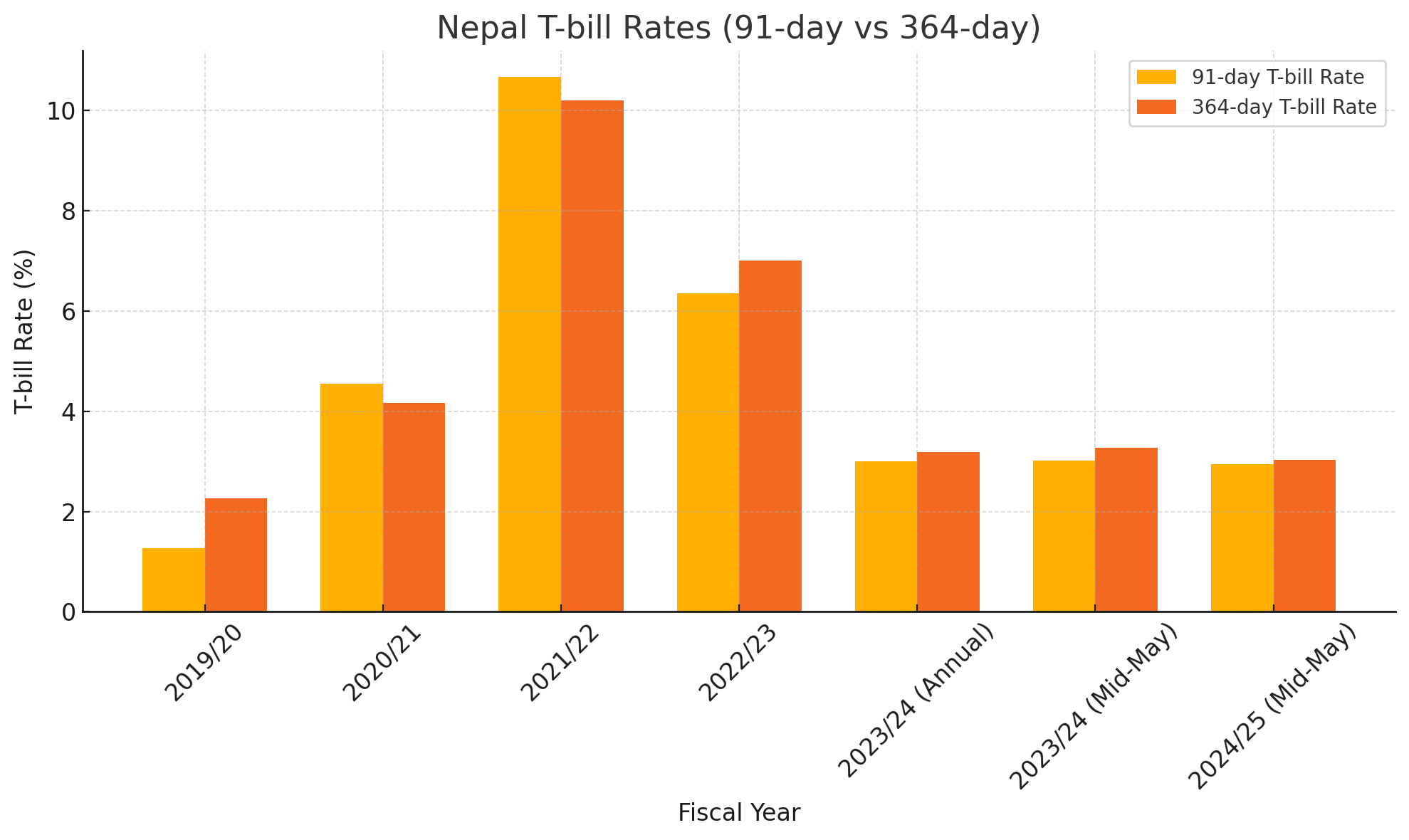
Nepal’s Treasury bill (T-bill) rates have shown a consistent downward trend in the fiscal year 2024/25, reflecting easing liquidity constraints and a cautious monetary stance by the Nepal Rastra Bank (NRB). As of mid-May 2025, the 91-day T-bill rate stands at 2.95%, down slightly from 3.02% in mid-May 2024. Similarly, the 364-day T-bill rate has also declined to 3.03% from 3.27% during the same period last year.

Historically, T-bill rates had spiked during FY 2021/22 due to tight liquidity and heightened inflationary expectations, with the 91-day rate peaking at 10.66% and the 364-day rate hitting 10.19%. However, since FY 2022/23, both rates have seen a steep decline. The 91-day T-bill dropped from 6.35% in FY 2022/23 to just 3.00% in FY 2023/24, while the 364-day T-bill followed a similar trajectory, falling from 7.00% to 3.19%.

This decreasing trend indicates a reversal in monetary tightening and suggests improved banking sector liquidity. It also signals investors' reduced expectations of inflation or monetary shocks in the near term. The marginal drop from mid-May 2024 to mid-May 2025 also implies a relatively stable interest rate environment.

The moderation in T-bill rates could potentially lower government borrowing costs and encourage investment by reducing returns on risk-free assets. However, it may also pressure savings rates, prompting banks to rebalance their deposit and lending strategies.

Overall, the sustained easing in T-bill rates reflects a more balanced and stable macro-financial outlook for Nepal, supported by moderated inflation, improved external sector performance, and proactive monetary management by the central bank.

SC

Written by

Sandeep Chaudhary

Nepal T-Bills Rates Show Continued Decline in 2024 Amid Easing Liquidity Pressure

Related News

View all
  • Tourism Earnings Slip While Education Spending Abroad Climbs: Nepal's Services Account Remains in Deficit at Rs.68 Billion
    Nepal’s Economy

    Tourism Earnings Slip While Education Spending Abroad Climbs: Nepal's Services Account Remains in Deficit at Rs.68 Billion

    10 Jun, 2026

  • Nepal's Terms of Trade Deteriorate by 16.9 Percent: Import Prices Surge 24 Percent While Export Prices Crawl at 3.1 Percent
    Nepal’s Economy

    Nepal's Terms of Trade Deteriorate by 16.9 Percent: Import Prices Surge 24 Percent While Export Prices Crawl at 3.1 Percent

    10 Jun, 2026

  • Trade Deficit Crosses Rs.1,443 Billion: Exports Grow But Imports Outpace Them, China-Bound Exports Collapse by 41 Percent
    Nepal’s Economy

    Trade Deficit Crosses Rs.1,443 Billion: Exports Grow But Imports Outpace Them, China-Bound Exports Collapse by 41 Percent

    10 Jun, 2026

Related News