Nepal's Economy
Nepal's Economy Grows at 3.85 Percent — But the Numbers Tell Two Very Different Stories
It shows a country with genuine strengths and genuine weaknesses, navigating a difficult global environment with uneven domestic tools. What happens next depends less on the numbers in the survey and more on whether the people responsible for acting on those numbers are prepared to do something different from what they have done before.
Dipesh Ghimire
9 min read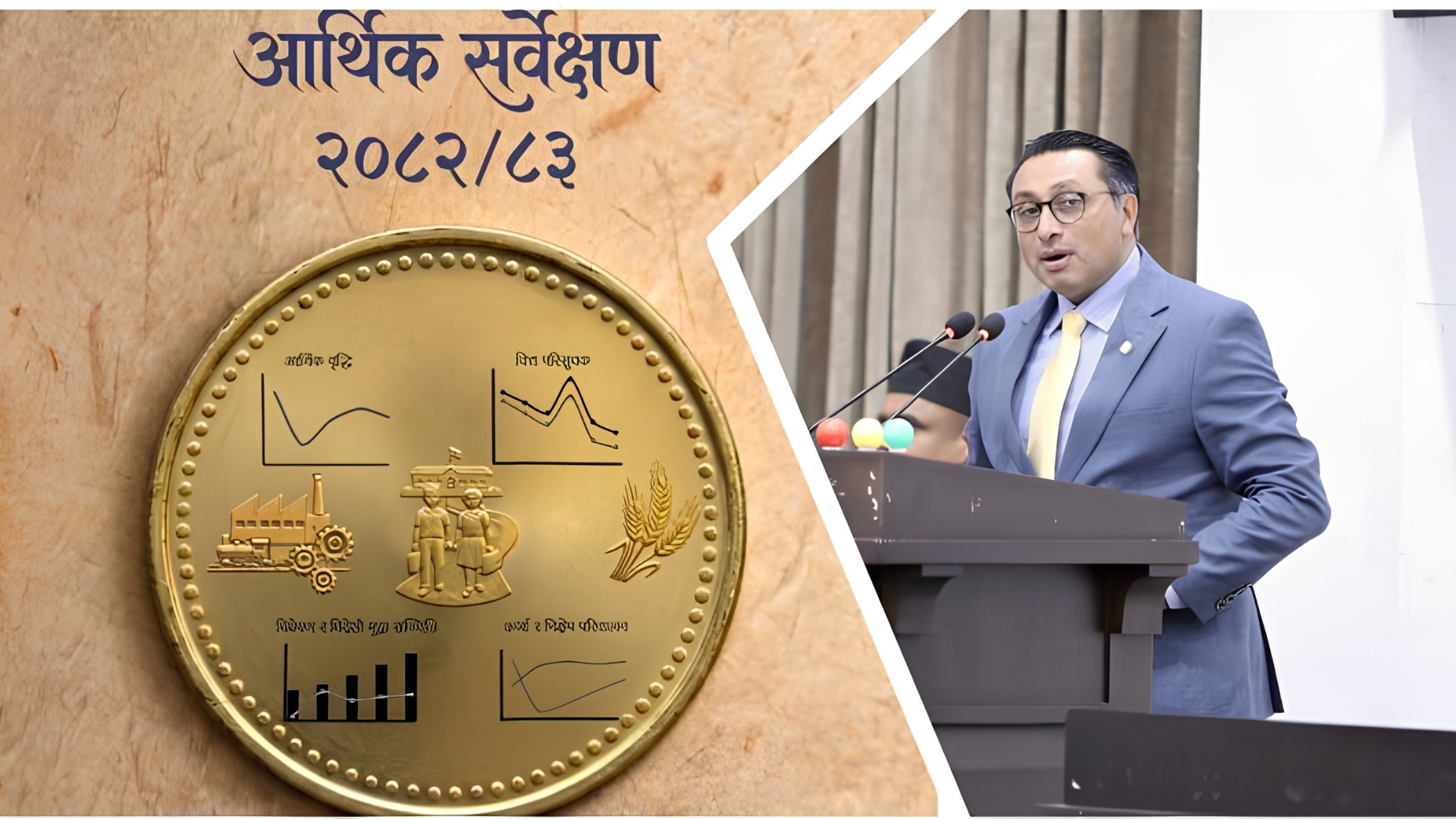
KATHMANDU — When Finance Minister Dr. Swarnima Wagle stood before parliament this week to present the Economic Survey 2082/83, he carried with him a document that reflects, in almost equal measure, what Nepal has managed to hold together and what it has failed to build. The survey projects that Nepal's economy will expand by 3.85 percent in the current fiscal year — a number that is neither a crisis nor a celebration. It is, rather, a number that describes a country running on borrowed strength: a strong external position built on remittance, foreign exchange reserves at historic highs, inflation admirably controlled — and underneath all of it, weak capital spending, sluggish private investment, a contracting agricultural base and a trade deficit that grows larger with every passing month. The economy's total size is projected to reach NPR 66 trillion. The question the survey cannot answer, and that the budget must now begin to address, is what that economy is actually producing and for whom.
The growth figure itself deserves to be placed in context before it is either dismissed or praised. Last fiscal year, Nepal posted a growth rate of 4.43 percent. The slide to 3.85 percent this year represents a measurable deceleration, and it comes at a moment when the government had publicly committed itself to reversing the trend of underperformance. Global conditions have not been cooperative — the world economy is projected to grow at just 3.1 percent in 2026, constrained by geopolitical tensions, trade disruptions and the lagging effects of monetary tightening in major economies. Nepal, as a small, open, import-dependent economy with limited export capacity and deep exposure to migrant labor markets, feels those global headwinds more acutely than many of its neighbors. But global conditions explain only part of the story. The other part is domestic, structural and well within the government's ability to influence — if it chooses to.
Finance Minister Wagle acknowledged in parliament what observers had already been saying for months: capital expenditure has once again failed to meet expectations. This is not a new confession. It is an annual one. Year after year, Nepal's government announces ambitious infrastructure spending targets, and year after year, the actual disbursement falls short — caught in the familiar tangle of procurement delays, bureaucratic bottlenecks, political interference in contractor selection and a public administration that is not designed to move money quickly or efficiently. The consequence is that the government's own spending, which should be stimulating construction activity, generating employment and building the physical foundation for future productivity, instead remains trapped in the pipeline. Revenue collection grew by 3.2 percent through Falgun, and total government expenditure rose by 10.4 percent — but when that spending is disproportionately recurrent rather than capital in nature, it sustains the machinery of the state without building the infrastructure the economy needs.
Public debt has reached NPR 28.78 trillion — equivalent to 43.6 percent of GDP. Within the current year alone, the government mobilized NPR 3 trillion in public borrowing. These figures are not, by international standards, at crisis levels. The 43.6 percent debt-to-GDP ratio remains within bounds that many development economists would consider manageable for a country at Nepal's stage. But context matters enormously here. Nepal's debt is manageable only as long as GDP grows at a pace that gradually reduces the ratio, as long as the borrowed money is invested in activities that generate future revenue and as long as external conditions — exchange rates, remittance flows, donor disbursements — remain broadly favorable. If capital spending continues to underperform, the debt pile grows without producing commensurate productive capacity. The ratio then becomes less comfortable, and the government finds itself borrowing more to service what it has already borrowed — a trajectory that, while not imminent, is worth watching with greater seriousness than the current political discourse suggests.
The survey's treatment of agriculture is one of its most sobering sections. The sector contributes 24 percent of GDP, employs a large share of the rural population and directly determines the food security and income stability of millions of households outside the major urban centers. Yet agricultural growth this year is estimated at just 1.58 percent — a figure that barely keeps pace with population growth and falls far short of what would be needed to meaningfully improve rural living standards. Rice production — the crop that most directly reflects Nepal's food sufficiency — declined by 4.20 percent to reach 5.705 million metric tons. This is not a minor fluctuation. It is a signal of structural fragility in a sector that has for decades been underfunded, underequipped and left to manage increasingly erratic monsoons without adequate irrigation, storage, market access or insurance. The fact that 97.8 percent of children are enrolled in basic education and yet the farming that feeds their families grows at 1.58 percent captures precisely the gap between social investment and productive investment that defines Nepal's development challenge.
The contrast between agricultural performance and the external sector could not be more stark. Nepal's foreign exchange reserves have reached NPR 34.13 trillion — a historic high, sufficient to cover 18.5 months of goods and services imports. The balance of payments recorded a surplus of NPR 6.58 trillion through Falgun. The current account is in positive territory. Nepal's sovereign credit rating carries a stable outlook as of 2025. Inflation has been held to an average of 2.13 percent — a genuinely impressive achievement in an environment of global price volatility. These are real accomplishments, and they reflect disciplined monetary management by Nepal Rastra Bank alongside the sustained inflow of remittances that underpins virtually every positive external indicator Nepal can report. But the durability of these accomplishments depends on conditions that Nepal does not control and has not yet found a way to reduce its dependence on.
Remittances grew by 37.7 percent through Falgun to reach NPR 14.50 trillion. This is an extraordinary number — a volume of money entering Nepal that dwarfs what the country earns from exports, foreign direct investment or tourism. It is the financial lifeline that keeps the balance of payments in surplus, the foreign exchange reserves at record highs and the banking system comfortably liquid. It is also, when examined honestly, a measure of how many Nepalis found it necessary to leave the country to earn what they could not earn at home. The survey does not present this as a problem — it presents it as a strength. And in the narrow sense that large remittance inflows stabilize the external sector, it is. But remittance is not income that Nepal's economy generated. It is income that Nepal's people generated elsewhere, in conditions that the government cannot monitor or protect. When geopolitics shifts Gulf labor markets, when automation reduces demand for the categories of work that Nepali migrants perform, when immigration policy tightens in Malaysia or South Korea, Nepal's entire external position becomes vulnerable in ways that no amount of foreign exchange reserve accumulation can fully insulate against.
The trade deficit has widened by 11.2 percent to reach NPR 10.98 trillion. Nepal imports far more than it exports — a structural condition that remittance has allowed the country to sustain without a balance of payments crisis, but that represents a deep and growing vulnerability in the productive structure of the economy. The country's exports remain narrow, low-value and incapable of competing internationally at scale. Meanwhile, the consumption that remittance enables pulls in imports — petroleum, food products, electronics, vehicles, manufactured goods — creating a cycle in which foreign earnings flow in, only to flow back out almost immediately as payment for goods that Nepal cannot produce domestically. The survey notes that private consumption accounts for 91 percent of GDP — a ratio that reflects not prosperity but a consumption economy without a production base to match it.
The geographic distribution of economic activity deserves more attention than it typically receives. The survey confirms that Bagmati Province alone contributes 36.7 percent of national GDP. Only Bagmati and Gandaki provinces are projected to grow above the national average this year. Every other province — Koshi, Madhesh, Lumbini, Karnali, Sudurpashchim — will grow below the national average. This is not a statistical anomaly. It is the spatial expression of an economy that is concentrating economic opportunity, infrastructure investment and institutional capacity in a narrow geographic corridor around Kathmandu while the provinces that contain the majority of Nepal's population, its agricultural land, its natural resources and its rural poor continue to fall further behind. A country that grows at 3.85 percent nationally while five of its seven provinces grow below that average is not experiencing shared prosperity — it is experiencing concentrated growth that worsens regional inequality even as the national headline improves.
The banking sector data in the survey reinforces what financial analysts have been observing directly in the market. Deposits in banks and financial institutions grew by 6.64 percent through Falgun to NPR 77.45 trillion — but credit flow to the private sector grew by only 4.4 percent. The system holds money. It does not move it. Non-performing loans have reached an average of 5.42 percent — a level that signals accumulating stress in loan portfolios and will require banks to provision more heavily, reducing their profitability and tightening their appetite for new lending precisely at the moment when the economy most needs credit to flow. The disconnect between deposit growth and credit growth is the banking sector's version of the same paradox that characterizes the wider economy: the resources exist, but the conditions for deploying them productively do not.
The survey's genuinely encouraging data on digital finance and electricity access points to what Nepal has managed to build at the infrastructure layer even while the productive economy has struggled. QR code transactions surpassed NPR 1.25 trillion through Falgun — a figure that would have seemed implausible five years ago and reflects a real transformation in how ordinary Nepalis conduct commerce. Electricity access has reached 99 percent of the population. Installed generation capacity stands at 4,105 megawatts, and Nepal exported 2,918 gigawatt-hours to India during the current year — a meaningful and growing source of foreign exchange that, unlike remittance, is generated by domestic productive capacity. The Human Development Index has reached 0.622. Average life expectancy is 71.3 years. Maternal mortality has fallen to 151 per 100,000 live births. These numbers matter and should not be dismissed. They reflect decades of investment in health and education that have genuinely improved the quality of Nepali lives, and they provide the human capital foundation on which a more productive economy could eventually be built.
What the Economic Survey 2082/83 ultimately presents is a portrait of an economy at a structural inflection point that has not yet been resolved in either direction. The positive indicators — remittance, reserves, inflation control, digital finance, electricity access, human development — reflect real achievements. The negative indicators — slow growth, weak capital spending, sluggish private investment, agricultural stagnation, widening trade deficit, rising NPLs, geographic concentration, consumption dependence — reflect real failures. And the relationship between the two sets of indicators is not coincidental. The achievements are largely the product of what Nepalis have done for themselves, often in spite of rather than because of state action. The failures are largely the product of what the state has not done: built institutions that work, invested capital efficiently, created conditions for domestic production, reduced the incentives that make leaving Nepal more rational than staying and building.
Finance Minister Wagle told parliament that the challenges identified by the survey would be addressed through the upcoming budget. That statement has been made, in various formulations, by various finance ministers, before various budget presentations, for the better part of two decades. The question that parliament, civil society and the Nepali public should be asking as the budget is prepared is not whether the government intends to address these challenges — it almost certainly does, in the rhetorical sense — but whether it has the institutional capacity, political will and policy coherence to translate intention into the kind of structural change that would make next year's Economic Survey tell a meaningfully different story. The survey is an honest document. It shows a country with genuine strengths and genuine weaknesses, navigating a difficult global environment with uneven domestic tools. What happens next depends less on the numbers in the survey and more on whether the people responsible for acting on those numbers are prepared to do something different from what they have done before.
Advertisement
Written by
Dipesh Ghimire