Top
Nepal’s Economy Stronger Than Expected Despite Political Uncertainty, Says Finance Minister Rameshwor Khanal
Nepal’s Economy Stronger Than Expected Despite Political Uncertainty, Says Finance Minister Rameshwor Khanal Nepal’s macroeconomic indicators remain far more resilient than commonly perceived, even amid political turbulence and widespread public anxiety, Finance Minister Rameshwor Khanal has asserted. In a detailed analytical commentary published in the SEJON Smarika 2082, Khanal argues that the economy’s fundamentals are stronger than public sentiment suggests, and that recent policy decisions have helped stabilize key financial indicators despite disruptive national events. Khanal notes that citizens naturally desire faster economic growth, more jobs, and a more vibrant private sector, but emphasizes that Nepal’s current external sector performance is “far from weak.” Imports of raw materials used by domestic industries have risen—an indicator of expanding production capacity. Exports too have improved modestly. Together, these trends reflect a healthier external sector position compared to two or three years ago, he observes.
Dipesh Ghimire
4 min read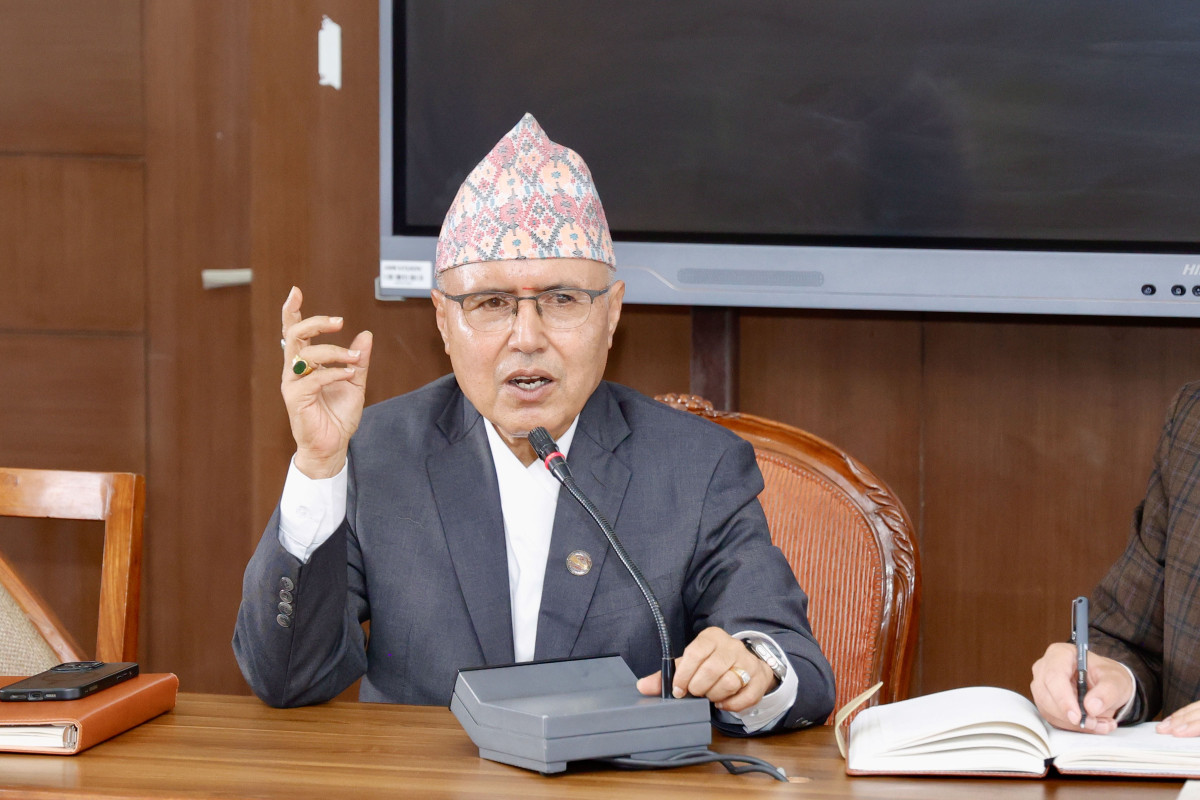
Nepal’s macroeconomic indicators remain far more resilient than commonly perceived, even amid political turbulence and widespread public anxiety, Finance Minister Rameshwor Khanal has asserted. In a detailed analytical commentary published in the SEJON Smarika 2082, Khanal argues that the economy’s fundamentals are stronger than public sentiment suggests, and that recent policy decisions have helped stabilize key financial indicators despite disruptive national events.
Khanal notes that citizens naturally desire faster economic growth, more jobs, and a more vibrant private sector, but emphasizes that Nepal’s current external sector performance is “far from weak.” Imports of raw materials used by domestic industries have risen—an indicator of expanding production capacity. Exports too have improved modestly. Together, these trends reflect a healthier external sector position compared to two or three years ago, he observes.
According to Khanal, credit growth of 8–9 percent—often dismissed as sluggish—is actually respectable in the current global and domestic environment. More importantly, he highlights a structural shift: this year’s credit expansion has largely flowed into productive sectors, rather than into the real estate and asset markets as in previous years. This redirection of lending suggests a healthier pattern of economic activity.
Inflation, which had remained a major concern in previous years, has stabilized at an average of around 2 percent since Shrawan, which Khanal describes as a highly satisfactory outcome. However, government capital expenditure has slowed, largely due to the Jen-Ni movement, severe flooding, and disruptions caused by political protests. These events delayed project preparedness and temporarily reduced the pace of infrastructure spending.
Despite these constraints, revenue collection has shown impressive momentum. Compared to the previous year, customs revenues grew by nearly 13 percent, value-added tax (VAT) by 10 percent, and excise duty by 13.84 percent. These increases, Khanal argues, signal rising consumption and expanding domestic production. Excise duty growth—14 percent on domestic goods and 13.5 percent on imports—indicates that both domestic manufacturing and demand have strengthened.
Income tax performance, however, remained weak. The decline in bank interest rates resulted in a 15 percent drop in tax collected from interest income. Institutional income tax also fell by nearly 5 percent, leading to an overall decline in income tax revenue by 7.6 percent. Even so, the strong VAT, excise, and customs performance compensated for this shortfall.
Khanal points to another major development: Nepal’s sovereign credit rating. The international ratings agency Fitch has maintained Nepal’s rating at BB-, the same as last year, describing the country as suitable for low-risk investment. The stable rating reaffirmed that Nepal’s debt-carrying capacity remains intact, though political instability continues to weigh on investor perception.
Political uncertainty remains high—ranging from the fallout of the Jen-Ni movement to debates on the constitutionality of recent government decisions and pending cases at the Supreme Court. Yet, despite these concerns, macroeconomic data has outperformed expectations. International institutions predicting significantly lower growth may be underestimating Nepal’s resilience, Khanal suggests. He expects growth to hover around 4.2 percent, with some institutions estimating up to 4.6 percent.
In response to the Jen-Ni movement, the government has reprioritized spending, suspending unprepared and low-impact projects. The strategy focuses on funneling resources toward large, strategic infrastructures that generate economic and employment benefits. The government aims to avoid wasteful spending on scattered, low-return projects—even if such projects may appear politically attractive.
Khanal explains that the government is committed to clearing legacy liabilities and improving the financial system’s credibility. Around Rs 10 billion in overdue interest subsidies—promised in the past but never paid—has now been settled. This has supported medium-sized enterprises and strengthened the balance sheets of banks and financial institutions, enabling more lending capacity.
Additionally, the government is reallocating funds from abandoned or low-priority projects toward ministries responsible for high-impact sectors such as physical infrastructure, energy, irrigation, and drinking water. The goal, he says, is to ensure that already initiated projects receive adequate funding and reach completion.
Despite adequate liquidity and low interest rates, Khanal warns that the government cannot borrow beyond its fiscal limits. Instead of using cheap borrowing for low-value projects, he argues that Nepal should strategically borrow—even at higher rates—if the investment results in significant long-term economic benefits. For example, expanding the road from Pokhara to Bhairahawa would boost tourism and economic activity, justifying borrowing even at 8 percent interest.
Conversely, using low-interest borrowing merely to pave local roads or build cosmetic infrastructure offers little meaningful contribution to economic growth or job creation. Productive infrastructure—such as roads connecting mines, hydropower stations, and industrial hubs—must be prioritized to generate real economic returns.
Khanal also highlights ongoing reforms in revenue administration, digital governance, and anti-corruption measures. The government has introduced online PAN registration, automated customs valuation, and reduced bureaucratic layers to curb discretionary behavior and minimize opportunities for graft. Internal revenue and money laundering investigation departments have been brought under the Finance Ministry, resulting in a significant increase in high-value investigations and court filings.
Furthermore, the government is enforcing stricter qualification standards for new officers entering customs and revenue services, requiring a background in economics or commerce to improve technical competency in tax administration.
Tourism reforms have also been introduced. Travelers can now make visa payments online, reducing disputes at airport counters and simplifying the arrival process.
Khanal underscores that private sector confidence and security are essential. He warns against unnecessary hostility toward businesses, reiterating that the private sector generates employment, tax revenue, and economic growth. The government, he says, remains fully committed to safeguarding private investment. The violent incidents of August 23–24, which affected several business establishments, were an exception—not a reflection of the state’s ability or willingness to protect enterprise.
He concludes that the government and private sector must move forward as partners, not adversaries. Nepal’s economic indicators, though imperfect, are not weak. With political stability and better policy implementation, the country could achieve significantly stronger outcomes.
Advertisement
Written by
Dipesh Ghimire