Nepal's Private Sector
Nepal's Private Sector Demands Constitutional Rethink — "Stop Calling Us Profiteers, Call Us Partners"
That demand, at its core, is less about economic ideology than about respect. And how Nepal's constitution answers it will say something important about the kind of country Nepal intends to become.
Dipesh Ghimire
7 min read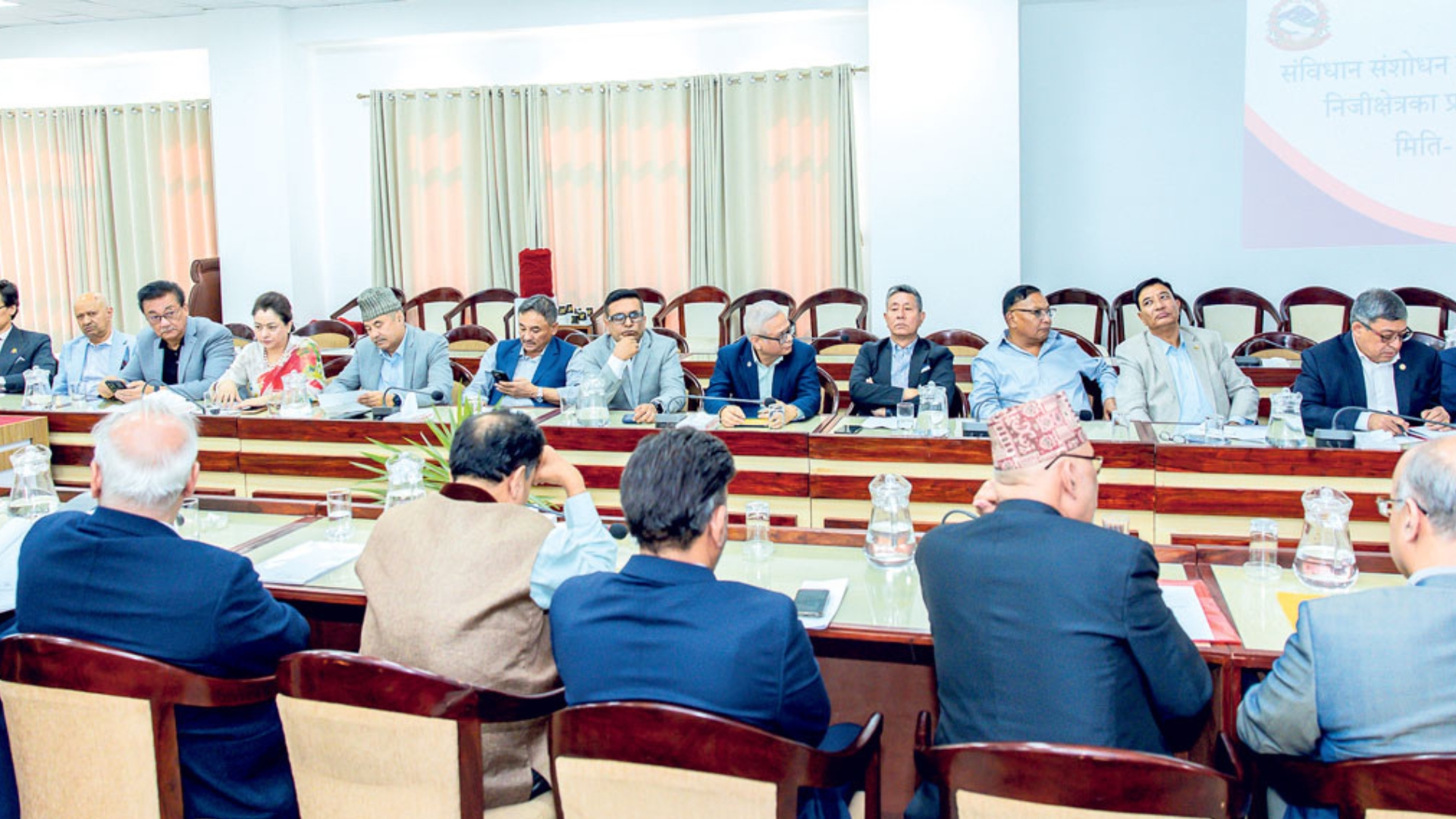
KATHMANDU — The word "socialism" has sat quietly inside Nepal's constitutional preamble for years, largely undisturbed by the political debates swirling around it. On Tuesday, that quiet ended. In a consultation session held at Singhadurbar for gathering constitutional amendment suggestions, Nepal's business community walked into the room with a unified message — the economic philosophy written into the nation's founding document no longer reflects the country they are trying to build, and it is time to change it.
Thirty-four industrialists and entrepreneurs, including Nepal Chamber of Commerce and Industry President Anjan Shrestha, alongside prominent figures Divyamani Bhandari, Arun Chaudhary, Dr. Upendra Mahato, Bhawani Rana, and Suraj Vaidya, gathered to place their collective vision before the government's constitutional amendment task force. Their demands ranged from specific textual changes in the constitution to broader calls for systemic reform. But at the heart of every argument was a single, long-held frustration — that the state has never fully decided whether it sees the private sector as a partner or a problem.
The opening demand was the most symbolically charged. The business representatives argued that the phrase "socialism-oriented system" in the constitutional preamble is not merely ideologically inconvenient — it is, in their view, functionally ambiguous and economically damaging. A constitution that sends mixed signals about the role of markets, they argued, creates an environment where investors cannot plan with confidence, where regulatory behavior becomes unpredictable, and where the private sector operates under a cloud of implicit suspicion.
In its place, they proposed language that reflects the economic model Nepal actually needs — a "competitive, open, and innovation-oriented market economy." This is not a trivial distinction. Constitutional language shapes policy culture, judicial interpretation, and the instincts of bureaucrats. When the founding document gestures toward socialism without defining it, the result is a policy environment where any government, at any time, can invoke that ambiguity to justify interventions that private enterprise finds arbitrary or hostile.
The demand went further than language. Business leaders argued that the constitution must formally recognize the private sector not as a tolerated presence within an otherwise state-directed economy, but as an active partner in national development and the primary engine of economic growth. This is a distinction that matters in practice. Countries where constitutional and legal frameworks explicitly protect and define the role of private enterprise tend to attract more investment, sustain longer periods of growth, and build stronger institutional relationships between business and government.
Nepal, the assembled entrepreneurs suggested, is at a constitutional crossroads — and the amendment process represents a rare historical opportunity to get the foundational framework right. Constitutional reform, they argued, should not be viewed exclusively as a political exercise driven by questions of federal structure or identity. It is equally an economic moment, a chance to signal to domestic and foreign investors alike that Nepal is serious about becoming a place where capital is protected, contracts are honored, and enterprise is valued.
Asim Shah, the Prime Minister's political advisor and convenor of the task force responsible for preparing the constitutional amendment discussion paper, listened to the business community's concerns and offered a response that was notably direct. He stated that the government is moving forward with a private sector-friendly policy orientation and encouraged entrepreneurs to invest and operate without fear.
His most striking assertion concerned what has become one of the private sector's deepest anxieties — the fear of targeted legal action. Shah categorically stated that the government has not ordered, and will not order, the arrest of any business person for political or retaliatory purposes. "No directive has been issued from the Prime Minister's Office, the Home Ministry, or any other body regarding detaining or not detaining anyone," he said. "The system is doing its work impartially."
He went further, offering what amounted to an open channel for reporting abuse. If any party official or government functionary is pressuring businesses for donations in exchange for the freedom to operate, Shah said, the government wants to know about it. "You do not need to give money to anyone to run your business," he told the assembled entrepreneurs. "Work honestly, work with confidence."
These assurances, while welcomed, carry weight only if they are followed by institutional action. The private sector has heard sympathetic words from government officials before — the history of Nepal's business-government relationship is rich with promises of a better environment that dissolved quietly once the political pressures of the moment shifted. What makes Shah's statements worth watching closely is the specific context in which they were made: a formal constitutional amendment process, on record, with named participants. The accountability attached to these assurances is higher than in an ordinary press conference or policy announcement.
Shah also acknowledged something that the government rarely admits openly — that past policy instability has caused real harm to businesses operating in Nepal. This acknowledgment is significant. It frames the damage not as the result of individual business failures or market forces, but as a consequence of policy choices that the state made and could have made differently. Having accepted that premise, Shah signaled that the upcoming budget may include tax relief and incentive programs designed to address at least some of the accumulated damage.
On the structural side, Shah outlined several concrete directions the government is considering. A single-window system for administrative processes is being prepared, aimed at reducing the bureaucratic friction that adds cost and time to every business transaction in Nepal. Build-Operate-Transfer and Public-Private Partnership models are being developed for large infrastructure projects, which would open significant new space for private investment in areas that have historically been state monopolies.
These are not new ideas in Nepal's policy vocabulary — both concepts have appeared in government documents for years. What matters is whether they are implemented with genuine commitment or quietly shelved once the immediate political moment passes. The business community's decision to raise them in the context of constitutional amendment consultations suggests a strategic calculation: if these commitments are embedded in the constitutional framework rather than left to ordinary legislation, they become harder to reverse with each change of government.
One of the more pointed grievances raised during the session concerned Nepal's multi-layered tax system. Federal, provincial, and local governments each impose their own tax requirements on businesses, and the lack of coordination among these three tiers has produced a system that is simultaneously duplicative, contradictory, and administratively burdensome. A business operating across provinces can find itself navigating three different regulatory environments with three different sets of compliance requirements — all theoretically operating under the same national constitution.
The demand for transparent tax administration and the elimination of conflicting regulations across tiers of government is not simply about reducing the cost of compliance, though that cost is real and significant. It is about the basic legibility of the system — whether a business owner can understand what is required of them, plan accordingly, and trust that the rules will be applied consistently. When tax administration is opaque and multi-tiered regulations contradict each other, the space for discretionary enforcement expands, and with it the opportunity for corruption.
An unusual note was struck when entrepreneurs raised concerns about their reputations. Several participants pointed to what they described as a coordinated pattern of social media attacks targeting business figures — content designed, they argued, to damage their public standing without legal basis or factual grounding. They requested government protection against this form of reputational harm.
This demand sits in complex territory. Nepal's social media environment is chaotic and often irresponsible, and legitimate grievances about misinformation are not unique to the business community. But the line between protecting business reputations from deliberate disinformation and shielding wealthy individuals from legitimate public scrutiny is one that any democratic government must draw carefully. The government's response to this specific demand — and how it balances the concerns of entrepreneurs with the rights of citizens to speak critically about concentrated economic power — will be worth watching closely.
Shah concluded the session by committing to incorporate the private sector's suggestions as a priority in the constitutional amendment discussion paper his task force is preparing. It was a diplomatic close to what had been, by the standards of Nepal's usual business-government interactions, a notably frank exchange.
The constitutional amendment process in Nepal has thus far been dominated by political conversations about federalism, representation, and the structure of government. Tuesday's session served as a reminder that economics belongs in that conversation too — that the words a constitution uses to describe the role of markets, enterprise, and private capital are not decorative but functional, shaping the environment in which millions of Nepalis build their livelihoods.
Whether the task force and the political forces behind the amendment process take that argument seriously remains to be seen. But the private sector has made its position clear — it does not want to be defined as a necessary evil in the national charter. It wants to be recognized, explicitly and without ambiguity, as a builder of the nation. That demand, at its core, is less about economic ideology than about respect. And how Nepal's constitution answers it will say something important about the kind of country Nepal intends to become.
Advertisement
Written by
Dipesh Ghimire