Top
Nepal’s Road to a USD 100 Billion Economy: What Growth Rate Is Required?
Nepal’s Road to a USD 100 Billion Economy: What Growth Rate Is Required? Nepal has increasingly been discussing the possibility of expanding its economy to USD 100 billion, a milestone that would significantly transform the country's economic landscape. With the current gross domestic product estimated at around USD 45 billion, reaching this ambitious target requires sustained economic expansion over the coming years. However, the pace of growth required depends heavily on the time frame within which policymakers aim to achieve this goal. Economic calculations show that if Nepal intends to reach a USD 100 billion GDP within five years, the country would need to maintain an annual economic growth rate of approximately 17.3 percent. Such a growth rate is extraordinarily high by global standards and would require rapid expansion across multiple sectors including hydropower, tourism, manufacturing, digital services, and infrastructure development. For comparison, very few economies in the world have been able to sustain such high growth rates over a continuous five-year period.
Dipesh Ghimire
2 min read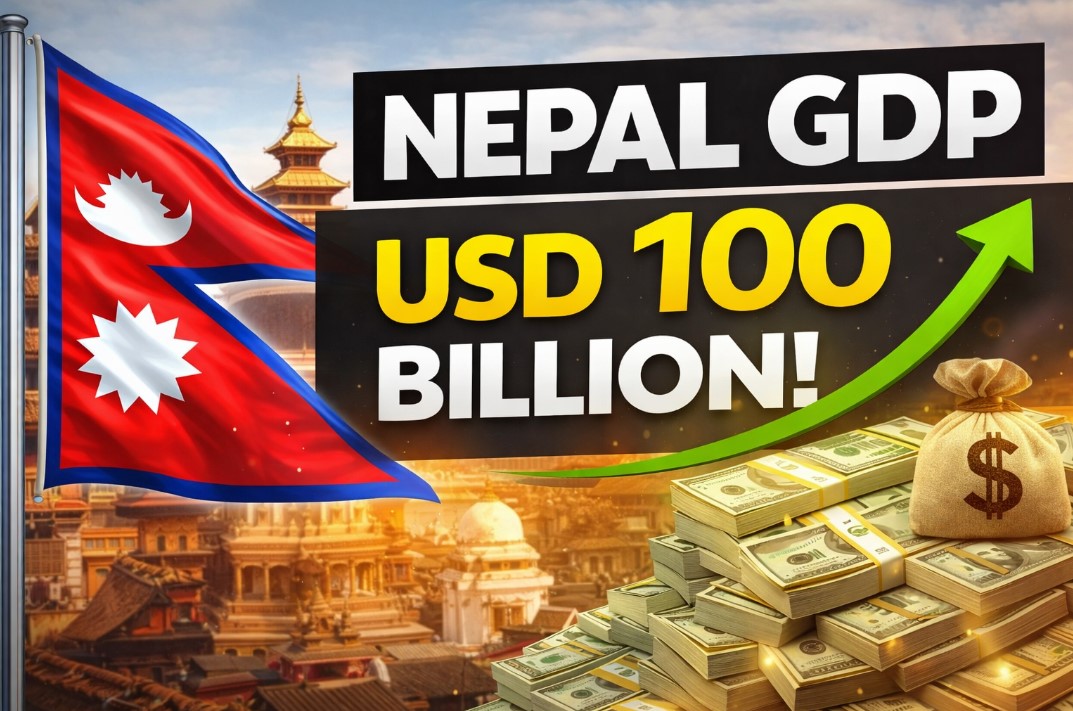
Nepal has increasingly been discussing the possibility of expanding its economy to USD 100 billion, a milestone that would significantly transform the country's economic landscape. With the current gross domestic product estimated at around USD 45 billion, reaching this ambitious target requires sustained economic expansion over the coming years. However, the pace of growth required depends heavily on the time frame within which policymakers aim to achieve this goal.
Economic calculations show that if Nepal intends to reach a USD 100 billion GDP within five years, the country would need to maintain an annual economic growth rate of approximately 17.3 percent. Such a growth rate is extraordinarily high by global standards and would require rapid expansion across multiple sectors including hydropower, tourism, manufacturing, digital services, and infrastructure development. For comparison, very few economies in the world have been able to sustain such high growth rates over a continuous five-year period.
If the same target is spread over a ten-year period, the required compound annual growth rate drops significantly to about 8.3 percent. This level of growth, while still ambitious, is considerably more achievable. Many emerging economies in Asia have historically maintained growth rates in this range during periods of strong industrial expansion and investment inflows. For Nepal, achieving this trajectory would require consistent policy stability, increased capital investment, expansion of export sectors, and improvements in productivity.
However, economic growth figures must also be viewed in the context of inflation, which reduces the real purchasing power of economic output. Assuming an average inflation rate of around 5 percent, the real growth rate required changes considerably. Under the five-year scenario, the real GDP growth required would be roughly 12.3 percent, which remains extremely challenging. Under the ten-year scenario, the real growth requirement drops to around 3.3 percent, suggesting that a longer timeline provides a far more realistic pathway for economic expansion.
Economists note that Nepal’s ability to approach a USD 100 billion economy will depend not only on growth rates but also on structural reforms and sectoral transformation. Hydropower exports, tourism recovery, digital services, financial market expansion, and improved industrial capacity could play crucial roles in accelerating economic activity. At the same time, strengthening governance, improving infrastructure, and attracting foreign direct investment will be essential to sustain long-term growth momentum.
The discussion around a USD 100 billion economy also reflects a broader ambition to elevate Nepal’s economic standing in South Asia. If achieved, such an expansion would significantly increase income levels, government revenue, and investment capacity. However, experts caution that the target should be approached with careful planning and realistic timelines, as rapid growth without structural preparation could create economic imbalances.
Ultimately, the calculations indicate that while the five-year scenario demands an almost unprecedented economic acceleration, a ten-year roadmap appears far more attainable. With consistent reforms, investment in productive sectors, and political stability, Nepal could gradually move toward this milestone and reshape its economic future.
Advertisement
Written by
Dipesh Ghimire