NEPSE
NEPSE Slips Again as Weak Turnover Deepens Investor Uncertainty
Shrinking Liquidity, Repeated Resistance Rejections and Fading Momentum Push Market Into a Critical Consolidation Phase
Dipesh Ghimire
3 min read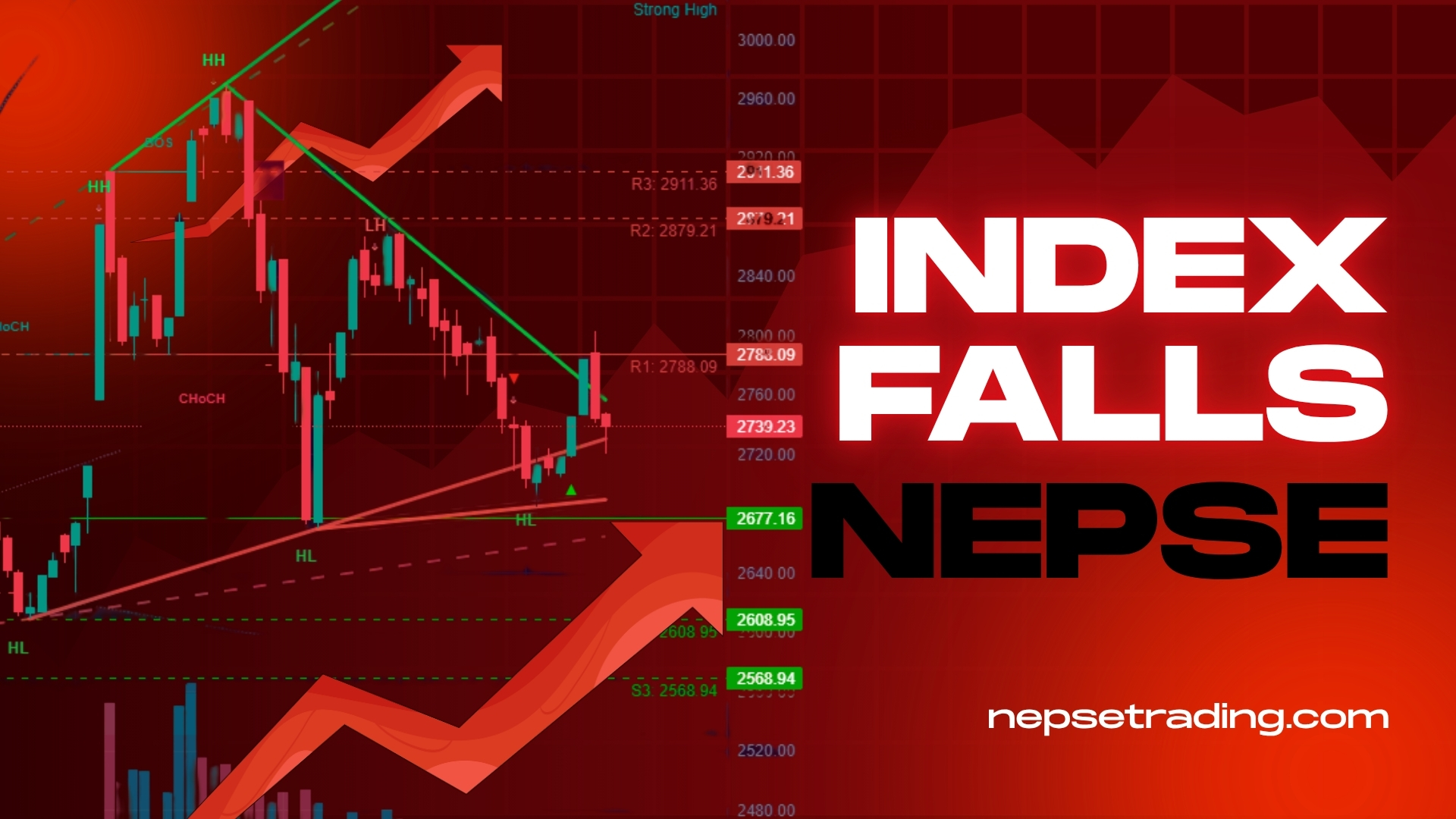
Nepal’s stock market closed lower for a second straight session on Wednesday, but the bigger concern for investors was not the modest decline in the benchmark index — it was the sharp collapse in turnover and the growing signs of weakening market conviction. While the NEPSE index fell only 4.15 points to settle at 2740.25, the steep drop in daily trading volume suggested that buyers are gradually stepping back from the market after weeks of volatile movement and fading bullish momentum.
Turnover dropped dramatically from over NPR 4.66 billion in the previous session to just NPR 2.80 billion, highlighting a significant slowdown in fresh capital inflow. Analysts say the falling liquidity is becoming one of the market’s biggest warning signals. Despite more than 42,000 transactions and over 5.64 million shares traded, the lower value turnover indicates that investors are trading cautiously and avoiding aggressive positions at current levels.
The broader market structure now appears increasingly fragile. In recent weeks, the market had attempted multiple rebounds fueled by optimism surrounding policy reforms, improving liquidity conditions and expectations of market-friendly government measures. However, the inability of the index to sustain rallies near key resistance zones has weakened investor confidence. Market participants say many short-term traders who entered during the earlier rally are now shifting toward profit-booking, creating repeated selling pressure whenever the index moves upward.
Technical analysis also paints a cautious picture. Wednesday’s daily candlestick formed a bearish small-body candle with an upper wick, reflecting failed attempts to push higher during the session. This pattern generally signals weakening bullish strength and active supply at higher levels. The market’s repeated inability to break above the 2879–2911 resistance zone has further strengthened the argument that the ongoing rally is losing momentum.
At the same time, the chart structure shows the index continuing to form “Lower Highs,” a pattern often associated with weakening buyer dominance. Earlier bullish formations such as Higher Highs and Higher Lows had hinted at a possible trend reversal in favor of buyers, but recent sessions suggest that momentum is fading before the market can retest previous highs. Analysts believe this indicates that large institutional money still remains largely absent from the market.
One of the most important observations from the current chart is the sharp divergence between price stability and volume weakness. Although the index itself has not collapsed significantly, turnover has continued to shrink rapidly. Historically, such conditions often reflect uncertainty rather than confidence. Markets can remain stable for some time during low-volume consolidation phases, but the eventual breakout — either upward or downward — tends to become more powerful once liquidity returns.
Sector-wise, weakness remained broad-based. Out of 13 sectoral indices, 11 closed in negative territory, suggesting that selling pressure is no longer limited to a few overheated stocks. Banking, hydropower, insurance and microfinance sectors all remained under pressure, reflecting the absence of strong institutional accumulation. However, selective activity in stocks such as Asian Hydropower and SY Panel Nepal indicates that speculative interest has not disappeared entirely from the market.
Another technical concern is the repeated appearance of “Change of Character” (CHoCH) signals on the chart, indicating unstable market direction and frequent shifts in short-term trend behavior. Analysts interpret this as evidence that the market currently lacks a dominant side. Buyers are unable to generate sustainable momentum, while sellers also have not yet triggered panic-driven breakdowns. As a result, the market remains trapped in a zone of uncertainty.

For the coming sessions, technical analysts are closely watching the 2677 support level. As long as the index remains above this zone, the broader bullish structure cannot be considered fully broken. However, if this support fails, selling pressure could accelerate toward 2608 and potentially even 2568 points. On the upside, the market requires a strong breakout and close above 2788 points to regain bullish confidence and reopen the path toward the major resistance zone near 2911.
Overall, Wednesday’s session reflected a market that is not collapsing, but gradually losing momentum and confidence. The combination of declining turnover, repeated resistance failures and weakening chart structure suggests that the market is entering a decisive phase. Investors now appear to be waiting for a stronger catalyst — whether from the upcoming national budget, monetary policy decisions, regulatory reforms or institutional participation — before making large directional bets again.
Advertisement
Written by
Dipesh Ghimire