Skilled Workers
Quantity Over Quality: Highly Skilled Workers Account for a Dismal 0.14% of Nepal's Outbound Labor Force
Labor market analysts and economic observers suggest that this dismal statistic is a direct indictment of the country's weak technical and vocational education systems. To shift this narrative, the state must immediately pivot from a 'numbers-driven' migration policy to a 'value-driven' one. Without aggressive nationwide investments in technical education, internationally recognized skill certifications, and strategic diplomatic lobbying to open doors for high-paying global jobs, Nepal's foreign employment sector will remain stagnant—continuing to supply cheap labor to the world while gaining minimal economic leverage in return.
Dipesh Ghimire
2 min read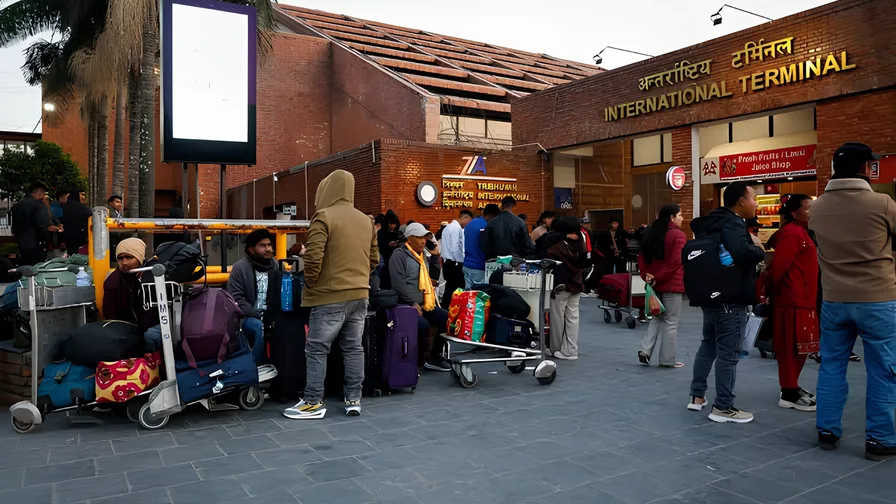
KATHMANDU — While the volume of Nepalis flying abroad for foreign employment continues to surge, a glaring structural weakness in the country's labor export economy has been laid bare: the near-total absence of highly skilled professionals. Out of a staggering 792,187 labor permits issued in the fiscal year 2082/83, an insignificant fraction of just 1,096 individuals fell under the 'highly skilled' category. This stark data, sourced from the Department of Foreign Employment and recently publicized by the Nepal Bankers’ Association, underscores a sobering reality—Nepal is predominantly exporting physical labor rather than specialized, high-yielding expertise.
A critical analysis of the skill categorization reveals a deeply disproportionate labor structure. Highly skilled workers (801 men and 295 women) constitute a microscopic 0.14 percent of the total outbound workforce. Even when combining this demographic with the 'professional' tier—which saw 3,570 departures—the cumulative share of top-tier talent barely touches 0.59 percent, amounting to just 4,666 individuals. In stark contrast, the vast majority of the migrant workforce remains anchored in the middle to lower tiers. The general 'skilled' category absorbed the lion's share with 482,643 permits, while the 'unskilled' and 'semi-skilled' groups accounted for a massive 190,264 and 114,614 departures, respectively.
The demographic and procedural breakdown further highlights entrenched patterns in the national migration trend. The sector remains overwhelmingly male-dominated, with men securing approximately 88 percent (697,096) of the total labor permits, leaving women with a mere 12 percent (95,091) share. Moreover, the data exposes the cyclical trap of Nepali migration. Over 385,000 permits were issued for 're-entry,' indicating that nearly half of the workforce is caught in a continuous loop of returning to the same foreign jobs rather than upgrading their careers. Institutional manpower agencies facilitated over 268,000 departures, while a negligible 8,197 individuals secured employment through secure Government-to-Government (G2G) channels.
From a macroeconomic perspective, this overwhelming reliance on low-to-mid-tier labor represents a colossal missed opportunity for the national economy. While the current data lacks granular details regarding destination countries and specific wage differentials, the global economic consensus is clear: highly skilled professionals command exponentially higher wages and better working conditions. By failing to penetrate the high-skill segments of the international labor market, Nepal is essentially capping its own remittance potential, forcing millions of its youth to settle for lower financial returns despite enduring the hardships of migration.
Labor market analysts and economic observers suggest that this dismal statistic is a direct indictment of the country's weak technical and vocational education systems. To shift this narrative, the state must immediately pivot from a 'numbers-driven' migration policy to a 'value-driven' one. Without aggressive nationwide investments in technical education, internationally recognized skill certifications, and strategic diplomatic lobbying to open doors for high-paying global jobs, Nepal's foreign employment sector will remain stagnant—continuing to supply cheap labor to the world while gaining minimal economic leverage in return.
Advertisement
Written by
Dipesh Ghimire