Remittance
Remittance Growth Boosts Nepal's Economy in FY 2024/25
Nepal's workers' remittances reached NPR 1,356.6 billion by mid-May FY 2024/25, up from NPR 1,198.6 billion in the same period last year. Annual remittance inflows have steadily grown from NPR 875 billion in 2019/20 to a record NPR 1,445.3 billion in 2023/24. This upward trend strengthens Nepal’s economy, supports foreign reserves, and boosts household income. With continued growth, remittances are set to remain a key pillar of Nepal’s financial stability
Sandeep Chaudhary
1 min read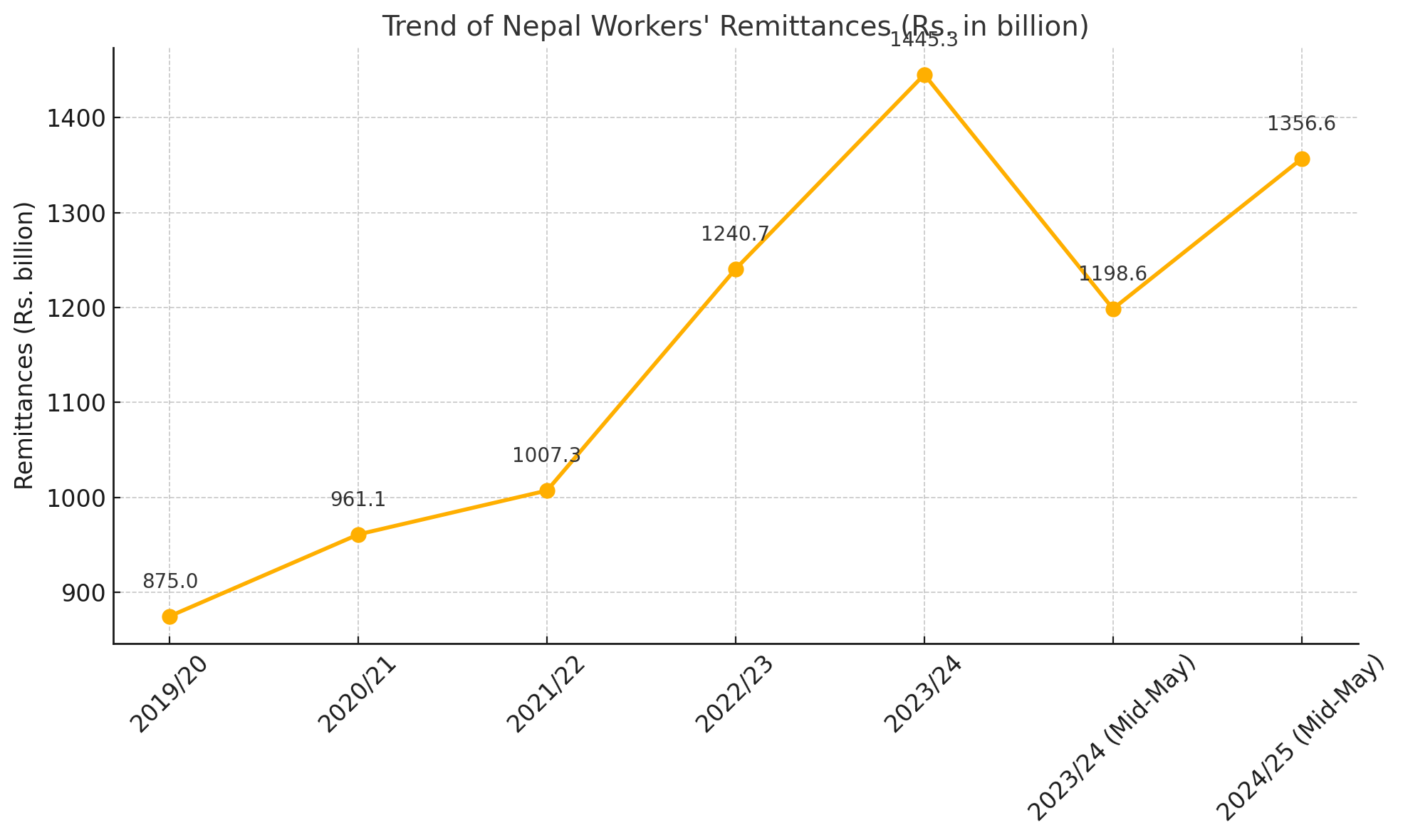
Nepal has witnessed a steady rise in workers' remittances over the past six fiscal years, with a significant boost recorded in the current fiscal year 2024/25. According to the latest mid-May data, remittances have surged to NPR 1,356.6 billion, up from NPR 1,198.6 billion during the same period in 2023/24. This represents an increase of NPR 158 billion, reflecting improved global economic conditions and a stronger outflow of Nepali migrant workers.
Annual remittance inflows have consistently grown since 2019/20, when they stood at NPR 875 billion. They rose to NPR 961.1 billion in 2020/21 and crossed the NPR 1 trillion mark in 2021/22, reaching NPR 1,007.3 billion. In 2022/23, the figure jumped significantly to NPR 1,240.7 billion, and in 2023/24, annual remittances peaked at NPR 1,445.3 billion.
This growing inflow of remittances has been a lifeline for Nepal’s economy, supporting household consumption, foreign exchange reserves, and economic stability. With remittances continuing to increase in the current fiscal year, it signals sustained financial support from overseas workers despite global uncertainties.
The mid-May data also suggests that the final annual remittance figure for 2024/25 may surpass the record set in the previous fiscal year. Policymakers and economists view this trend as a positive signal for the country’s external sector, though they caution that over-reliance on remittance income may also pose long-term risks.
Nepal's government is expected to introduce further measures to channel these inflows into productive sectors and encourage returnee migrant workers to invest in entrepreneurship and small businesses, boosting domestic job creation and economic diversification.
Advertisement
Written by
Sandeep Chaudhary