Shock After Bhotekoshi Floods
Shock After Bhotekoshi Floods: A New '6-Point Safety Doctrine' to be Implemented in Development Projects
However, formulating policies in Nepal has always been much easier than implementing them honestly. Will the appointment of 'safety officers' remain restricted to paper? Will contractors sincerely abide by the '30-day ration' rule? The real test will take place right at the project sites. If this concept is implemented to the letter, Nepal's hydropower projects are bound to transform from mere 'energy-generating machines' into stellar international models of 'safe workplaces'.
Dipesh Ghimire
3 min read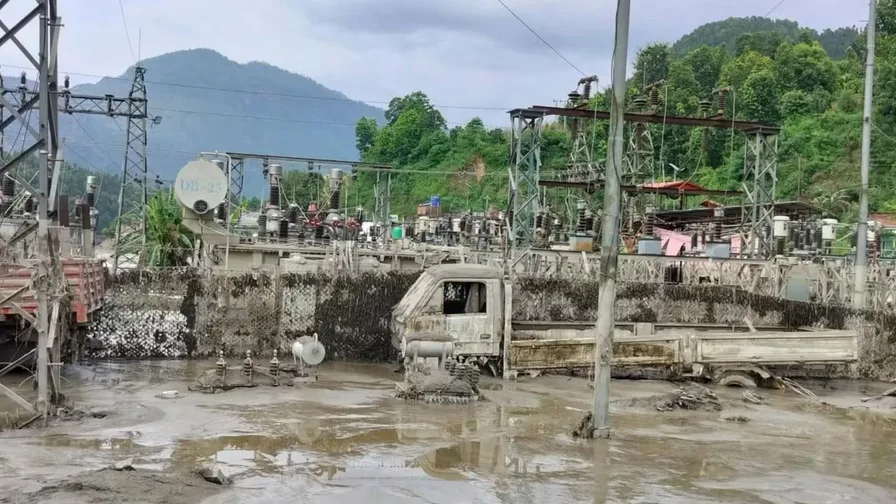
Natural disasters like floods, landslides, and earthquakes have repeatedly dealt severe blows to the history of Nepal's hydropower and infrastructure development. The government's eyes have finally opened only after an unimaginable flood in the Bhotekoshi River in Rasuwa recently destroyed billions of rupees worth of hydropower structures and infrastructure. Shifting away from the traditional and 'reactive' style of begging for rescue only after a disaster strikes, the Ministry of Energy, Water Resources, and Irrigation has taken steps toward a 'pro-active' (preventive) strategy of staying prepared before a disaster occurs. The result of this is the ‘6-point new safety concept’ brought forward by the ministry.
Viewed through the analytical lens of mainstream media outlets like Kantipur, this policy represents a massive ‘paradigm shift’ in the infrastructure construction sector. Moving away from the trend of centering solely on profit and cost-cutting, it seeks to legally bind the long-term safety of human life and structures.
Many small and medium-sized projects in Nepal have a fatal tendency to avoid full insurance of their structures or engage in 'under-insurance' under the guise of saving expenses. The Bhotekoshi flood showed that a natural disaster can wipe out the entire capital of investors and the banks financing them in a split second. Taking this seriously, the ministry has proposed making 'mandatory structural insurance' (CAR/EAR) compulsory for the physical structures of every development project. This will ensure that the financial burden of future project damages is not limited solely to the promoter (operator), but is safely cushioned through the insurance system.
In large projects, safety is often treated as a hassle. To counter this, under the leadership of Energy Minister Biraj Bhakta Shrestha, the ministry has advanced a strict policy of 'one project, one safety officer'. Now, there will be a dedicated safety officer at every site whose sole job will not just be checking whether workers are wearing helmets or boots, but identifying the overall geological and seasonal risks of the project. This officer will bear the complete responsibility of coordinating with relevant bodies during emergency situations.
We have repeatedly witnessed tragic scenarios where workers starve or are forced to wait for helicopter rescues when roads are blocked by landslides at powerhouses or project sites located in remote gorges and riverbanks. To put an end to this, the ministry has introduced a highly practical rule: every power house must now mandatorily store food supplies and essential goods sufficient for at least 30 days under a 'Minimum Requirement List' (MRL).
Additionally, the new concept includes regular rescue training (mock drills) for workers on escape routes and safety protocols during floods or fires. This is a scientific step designed to mentally and physically prepare workers beforehand to face disasters, rather than panicking only after they occur.
Tunnels haphazardly excavated while ignoring the fact that Nepal's geological condition is extremely fragile and sensitive often turn into 'death traps' during disasters. Acknowledging this, the ministry has prioritized the 'restructuring' of tunnels, access roads, and underground structures by conducting comprehensive safety assessments. Furthermore, every project is subjected to a mandatory obligation to formulate a clear written 'contingency plan' outlining how to protect machinery, relocate workers, and maintain business continuity during disasters.
Analyzing the overall picture, this 6-point safety doctrine introduced by the Ministry of Energy has the potential to prove a 'milestone' in Nepal's infrastructure construction sector. It is a highly commendable step by the government to translate the expensive lesson taught by the Bhotekoshi flood into a policy framework for long-term solutions.
However, formulating policies in Nepal has always been much easier than implementing them honestly. Will the appointment of 'safety officers' remain restricted to paper? Will contractors sincerely abide by the '30-day ration' rule? The real test will take place right at the project sites. If this concept is implemented to the letter, Nepal's hydropower projects are bound to transform from mere 'energy-generating machines' into stellar international models of 'safe workplaces'.
Advertisement
Written by
Dipesh Ghimire