#NepalExports #SoybeanOil #Tra
Soybean Oil Dominates Nepal’s Exports With 44.7% Share in 2025/26
Soybean oil contributed 44.7% of Nepal’s total exports in FY 2025/26, reaching Rs. 10.69 billion in just one month. While cardamom, jute goods, and noodles grew strongly, traditional items like carpets, tea, and zinc sheets declined sharply, leaving exports heavily dependent on soybean oil.
Sandeep Chaudhary
1 min read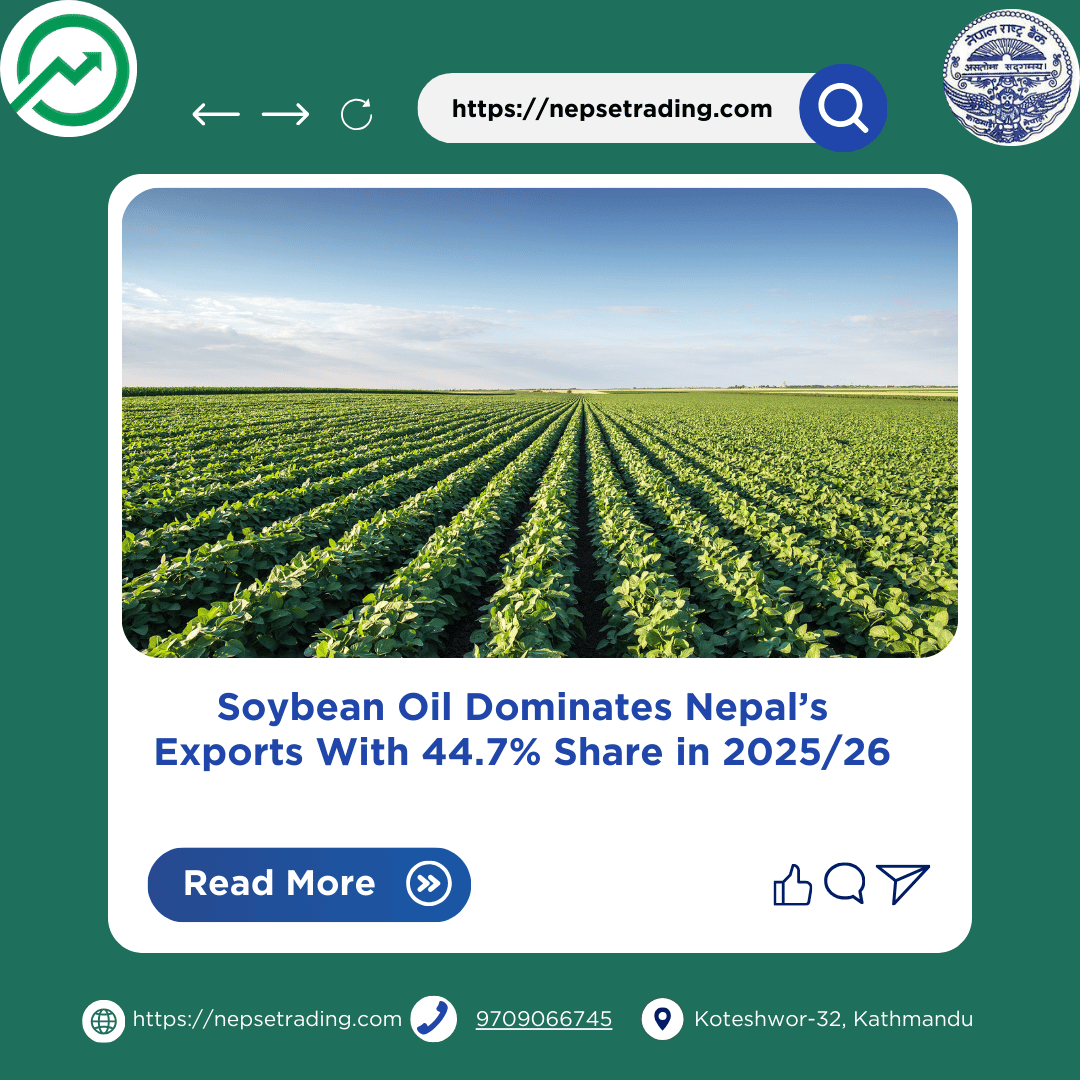
In FY 2025/26, soybean oil emerged as the single most dominant export commodity of Nepal, accounting for an extraordinary 44.7 percent of total exports. Nepal exported Rs. 10.69 billion worth of soybean oil in just one month of the review period, maintaining the record levels achieved in the previous fiscal year (Rs. 106.79 billion annually). This sector has become the backbone of Nepal’s merchandise exports, heavily driven by demand from India.
However, this heavy reliance on a single commodity raises structural concerns. While soybean oil exports surged, several traditional export items underperformed. Woolen carpets (-26.6%), tea (-30.9%), particle board (-56.6%), oil cakes (-42.4%), and zinc sheets (-69.4%) all recorded sharp declines, showing weak competitiveness. Even readymade garments, one of Nepal’s long-standing export strengths, slipped by -1.1 percent.
On the brighter side, cardamom exports nearly doubled (+99.5%), noodles expanded by 59.7%, and jute goods rose by 31.3%, showing that some agricultural and light manufacturing sectors are still growing. Nonetheless, the dominance of soybean oil means that any disruption in Indian demand or trade policy could severely impact Nepal’s export earnings.
Advertisement
Written by
Sandeep Chaudhary