Top
State Bears Full Burden as Uninsured Government Properties Suffer Repeated Destruction
State Bears Full Burden as Uninsured Government Properties Suffer Repeated Destruction Nepal’s failure to insure government-owned buildings and public infrastructure has once again forced the state to shoulder the entire financial responsibility for reconstruction after widespread destruction during recent political unrest. The pattern of losses—first during the arson and vandalism incidents in late March last year and again during the Genji movement in Bhadra—has exposed a systemic negligence in the management of state assets, leaving taxpayers to bear billions in avoidable costs.
Dipesh Ghimire
3 min read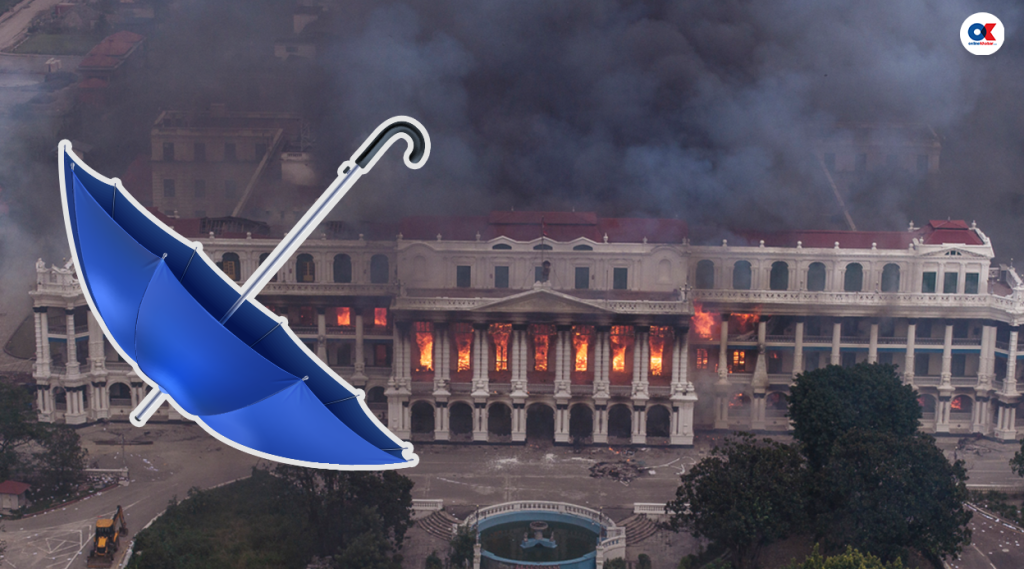
Nepal’s failure to insure government-owned buildings and public infrastructure has once again forced the state to shoulder the entire financial responsibility for reconstruction after widespread destruction during recent political unrest. The pattern of losses—first during the arson and vandalism incidents in late March last year and again during the Genji movement in Bhadra—has exposed a systemic negligence in the management of state assets, leaving taxpayers to bear billions in avoidable costs.
In March, a series of violent incidents had destroyed offices, administrative buildings, vehicles and public utilities across several districts. Since the majority of these structures were not insured, every component of the damage—from repairing burnt offices to replacing equipment—was financed directly by the government. Barely six months later, the cycle repeated itself when the Genji movement erupted, causing even larger losses and raising serious questions about the government’s preparedness and financial risk-management systems.
The protests on Bhadra 23 and 24 inflicted severe damage on Nepal’s most sensitive and historic state institutions. Iconic landmarks such as Singha Durbar, the central administrative headquarters bearing the country’s political legacy, were partially destroyed. The Federal Parliament Building faced significant damage, while the official residences of both the Prime Minister and the President also suffered from fire and vandalism. Several provincial offices and hundreds of local government buildings were either burnt or ransacked, leaving a trail of destruction across the nation.
Experts argue that the blow to public heritage is not merely financial but symbolic. Structures representing Nepal’s administrative continuity and civilizational history were left unprotected at a time when even private buildings maintain mandatory insurance coverage. If government assets had been insured, the financial burden would have been transferred to insurance companies. Instead, the treasury is now obligated to finance every stage of reconstruction—from assessment to rebuilding—further straining national resources.
The situation has drawn sharp contrast with the private sector. Businesses and industries affected by the unrest had insured their buildings, equipment and inventory. As a result, they have already filed insurance claims worth billions of rupees, and insurance companies have begun settling these claims according to policy guidelines. In stark opposition, government institutions—despite their scale and value—had no such protection. This discrepancy has highlighted a structural disparity in Nepal’s insurance culture where the state, ironically, remains the least insured entity.
Construction entrepreneurs explain that insurance coverage during the building phase is typically maintained only until project completion. Once a structure is handed over to the government, insurance lapses unless renewed by the respective authority. In most cases, such renewal does not take place. The absence of clear legal provisions, lack of budget allocation for insurance premiums and general administrative negligence have resulted in government buildings remaining uninsured for years. Consequently, when destruction occurs, the state is exposed to massive financial liabilities.
The latest incidents have prompted renewed calls for policy reform. Insurance experts, economists and infrastructure specialists argue that Nepal must adopt mandatory insurance coverage for all government-owned structures, including administrative buildings, schools, hospitals, bridges and major public utilities. They recommend creating a central insurance framework requiring periodic renewal and ensuring that insurance premiums are incorporated into annual government budgets. Without such reform, they warn, every future crisis—be it political unrest, natural disaster or accidental fire—will deepen the financial burden on the state.
In recent years, experts and business associations had repeatedly advised the government to insure major public infrastructure, including bridges and public buildings. Although some ministries acknowledged the suggestion, no concrete policy was implemented. The consequences of this oversight are now visible. The government must fund every element of reconstruction—structural repair, replacement of office equipment, restoration of heritage buildings and temporary relocation of administrative services. These costs will ultimately be borne by taxpayers.
The destruction triggered by the Genji movement has therefore become a costly reminder of long-standing policy inaction. While the private sector benefits from risk transfer through insurance, the government continues to absorb losses that could have been prevented with a minimal annual investment in premiums. As reconstruction begins across the country, Nepal faces a critical question: how long can the state continue to rebuild without a formal insurance mechanism for its own assets?
Until a nationwide insurance policy for government infrastructure is adopted, experts warn that the treasury will remain vulnerable. Every violent protest, fire, natural calamity or accidental damage will translate into another round of avoidable expenditure. The recent events have revealed not just financial losses but a deeper governance gap—a gap that Nepal can no longer afford to ignore.
Advertisement
Written by
Dipesh Ghimire