Top
Understanding RSI: How Traders Use Momentum to Read Market Behavior
Understanding RSI: How Traders Use Momentum to Read Market Behavior In modern financial markets, technical indicators have become essential tools for traders attempting to interpret price movements and market psychology. Among these indicators, the Relative Strength Index (RSI) remains one of the most widely used momentum indicators for analyzing market trends. Developed to measure the speed and strength of price changes, RSI helps traders understand whether a market is potentially overbought, oversold, or preparing for a trend shift.
Dipesh Ghimire
3 min read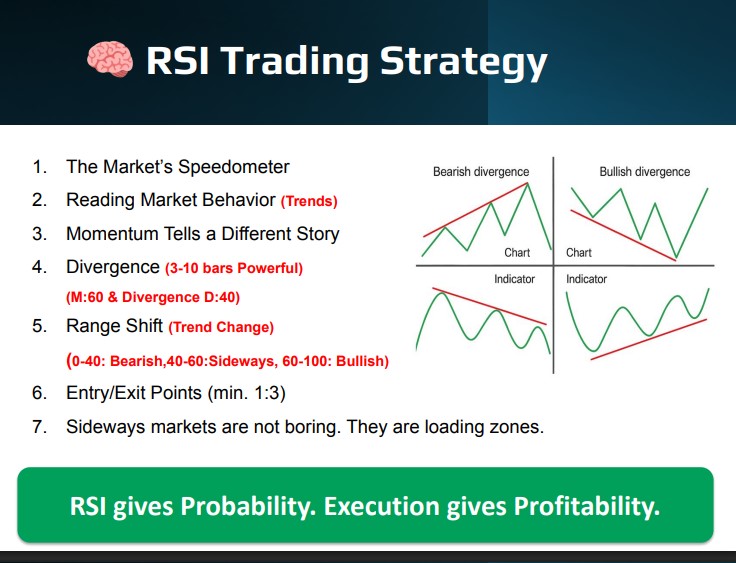
In modern financial markets, technical indicators have become essential tools for traders attempting to interpret price movements and market psychology. Among these indicators, the Relative Strength Index (RSI) remains one of the most widely used momentum indicators for analyzing market trends. Developed to measure the speed and strength of price changes, RSI helps traders understand whether a market is potentially overbought, oversold, or preparing for a trend shift.
Market analysts often describe RSI as the “speedometer of the market.” Just as a speedometer indicates how fast a vehicle is moving, RSI reflects the momentum behind price movements. When prices rise rapidly, RSI also moves higher, signaling strong buying pressure. Conversely, when selling pressure increases, the indicator declines. By observing these changes, traders attempt to identify whether the market’s current movement is sustainable or losing strength.
One of the key advantages of RSI is its ability to help traders interpret broader market behavior rather than focusing only on price movement itself. Price charts alone may show a rising or falling trend, but RSI provides insight into the strength of that movement. When price trends upward but momentum weakens, it may signal that the rally is slowing down. Similarly, when prices fall while momentum begins to improve, it can indicate that selling pressure may be fading.
A particularly important concept associated with RSI is divergence, a situation where price movement and momentum move in opposite directions. For example, in a bearish divergence, prices may continue to reach higher highs while the RSI indicator begins forming lower highs. This mismatch suggests that buying momentum is weakening even though prices are still rising. Conversely, a bullish divergence occurs when prices decline but RSI begins to rise, indicating that selling pressure may be losing strength and a potential reversal could develop.
Market practitioners often consider divergences especially powerful when they occur over several price bars. Analysts commonly observe patterns within three to ten price bars, as these periods often capture the transition between strong momentum and weakening trends. In many cases, divergence serves as an early warning signal that the current trend may soon slow down or reverse.
Another important feature of RSI analysis is the concept of range shifts, which helps traders identify broader changes in market trends. During bearish conditions, RSI typically fluctuates between 0 and 40, reflecting persistent selling pressure. In sideways markets, the indicator often moves within the 40 to 60 range, suggesting uncertainty and consolidation. When RSI consistently operates within the 60 to 100 range, it indicates strong bullish momentum, often associated with sustained upward trends.
For traders, identifying entry and exit points is a critical part of any strategy. RSI can assist in this process by highlighting moments when price momentum begins to strengthen or weaken. Many trading systems recommend maintaining a minimum risk-reward ratio of 1:3, meaning the potential profit should ideally be at least three times larger than the potential loss. This principle allows traders to remain profitable even if only a portion of their trades succeed.
Interestingly, market analysts often emphasize that sideways markets should not be viewed as unproductive periods. Instead, these phases represent consolidation zones where institutional investors may be accumulating positions before the next major price movement. For traders using RSI, these periods can provide valuable signals as momentum begins shifting from neutral to bullish or bearish territory.
Ultimately, the RSI indicator does not guarantee success but provides probability-based insights into market behavior. Successful trading still depends on disciplined execution, proper risk management, and clear strategy. As many market educators emphasize, indicators like RSI can guide traders toward better decisions, but profitability ultimately depends on how effectively those insights are applied in real market conditions.
In this sense, RSI serves not as a prediction tool but as a decision-support system, helping traders interpret the underlying momentum driving market trends. When combined with disciplined strategy and thoughtful execution, it can become a valuable component of a broader trading framework.
Advertisement
Written by
Dipesh Ghimire