Top
Why Most Traders Lose Money: The Hidden Psychological Battle of the Market
Why Most Traders Lose Money: The Hidden Psychological Battle of the Market In financial markets around the world, a common pattern repeatedly appears: a large majority of traders fail to generate consistent profits. While many beginners assume that trading losses occur mainly because of market volatility or lack of information, analysts increasingly argue that the real causes are psychological and strategic rather than technical. A closer look at trading behavior shows that misunderstanding the market itself is often the first and most fundamental mistake made by new traders.
Dipesh Ghimire
3 min read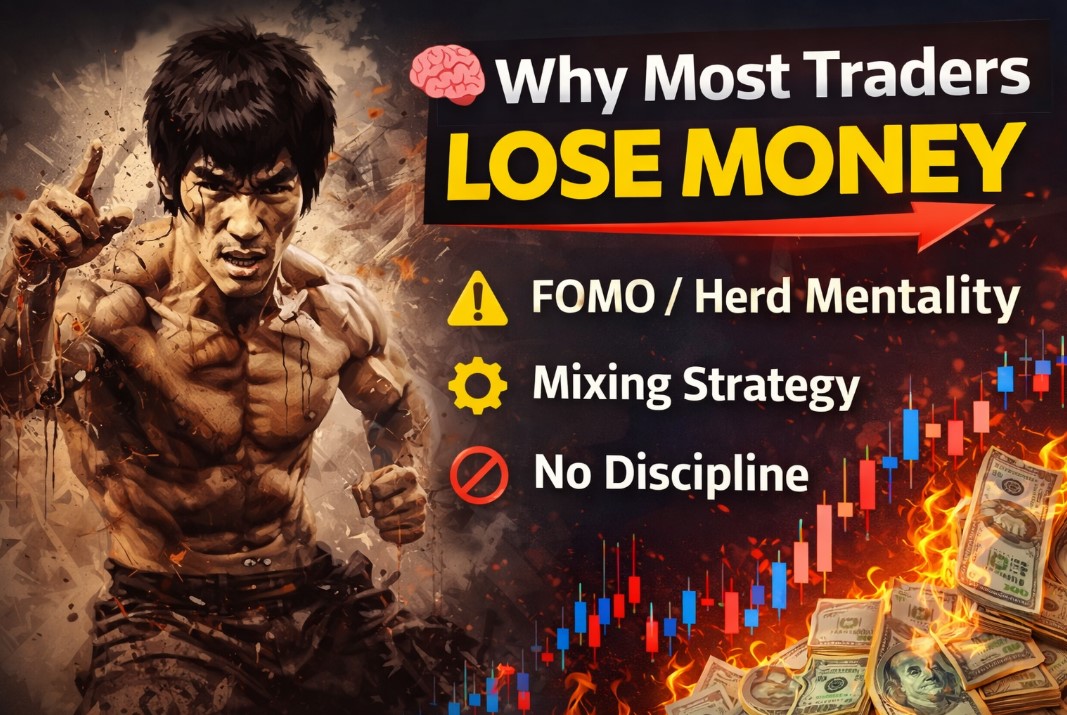
In financial markets around the world, a common pattern repeatedly appears: a large majority of traders fail to generate consistent profits. While many beginners assume that trading losses occur mainly because of market volatility or lack of information, analysts increasingly argue that the real causes are psychological and strategic rather than technical. A closer look at trading behavior shows that misunderstanding the market itself is often the first and most fundamental mistake made by new traders.
Many individuals enter financial markets believing that trading is a quick way to generate wealth. However, markets operate through complex cycles influenced by economic trends, liquidity, investor sentiment, and global developments. Traders who fail to understand these underlying dynamics tend to react emotionally to price movements instead of making disciplined decisions. As a result, they frequently buy assets during moments of excitement and sell them during periods of fear, a pattern that repeatedly leads to financial losses.
Another critical issue is lack of confidence in one’s own analysis and strategy. Even traders who spend time learning about the market often abandon their plans at the first sign of uncertainty. This behavior creates inconsistency in decision-making. Successful trading typically requires patience and conviction, but many traders shift between strategies without allowing any single approach enough time to prove effective.
Financial educators also point to the problem of mixing multiple trading strategies simultaneously. With the widespread availability of information on the internet, traders often attempt to combine different systems—technical indicators, short-term speculation, long-term investing, and social media tips—into one approach. Instead of improving performance, this mixture often creates confusion. When traders follow several conflicting signals, they lose clarity about why they are entering or exiting a position.
Psychological pressures such as FOMO (Fear of Missing Out) also play a powerful role in trading losses. When a stock or asset suddenly rises in price, many investors rush to buy it out of fear that they might miss a profitable opportunity. Conversely, JOMO (Joy of Missing Out)—the discipline to ignore unnecessary trades—is far less common among inexperienced traders. Emotional decision-making driven by excitement or anxiety frequently results in poor timing and unnecessary risk.
Another factor that influences trading behavior is herd mentality, where individuals blindly follow the actions of the majority. Instead of conducting independent analysis, many traders rely on rumors, social media discussions, or the actions of large groups of investors. While collective market behavior can sometimes indicate trends, blindly following the crowd often leads to entering the market too late, when prices have already peaked.
Experts also warn against becoming a “jack of all trades but master of none.” In trading, constantly switching between strategies—such as day trading, swing trading, long-term investing, and speculative momentum trading—can prevent traders from mastering any one method. Successful traders typically specialize in a specific approach and refine it through continuous practice and experience.
Financial mentors often emphasize the importance of discipline and focused learning. A common principle in trading education suggests that investors should follow one coach and one clear methodology rather than constantly searching for new systems. Consistency allows traders to evaluate results objectively and improve their decision-making over time.
This philosophy echoes a well-known principle popularized by martial arts legend Bruce Lee: mastery does not come from practicing many different techniques once, but from practicing a single technique thousands of times. Applied to trading, the lesson is clear—consistent strategy, disciplined mindset, and deep understanding of the market are far more important than chasing quick profits.
Ultimately, the data and observations suggest that financial markets are not merely arenas of numbers and charts but also tests of psychology and discipline. Traders who succeed over the long term are those who combine market knowledge with emotional control and strategic focus. Without these elements, even the most promising opportunities can quickly turn into costly mistakes.
Advertisement
Written by
Dipesh Ghimire