A 400 km claim, a 9.6 kWh batt
A 400 km claim, a 9.6 kWh battery — and the price tag that's missing
A new electric scooter has arrived in Nepal with a headline number engineered to stop shoppers in their tracks: up to 400 kilometres on a single charge. If accurate, the Sarathi ES6 — brought in by Zero Emission Ride N, the official distributor for the Chinese brand Luyuan — would offer several times the usable range of a typical electric two-wheeler and speak directly to the 'range anxiety' that has slowed electric adoption. But the figure rests on a very large battery and an idealised test, and the announcement is silent on the one number that will decide whether the pitch holds up: the price.
Dipesh Ghimire
5 min read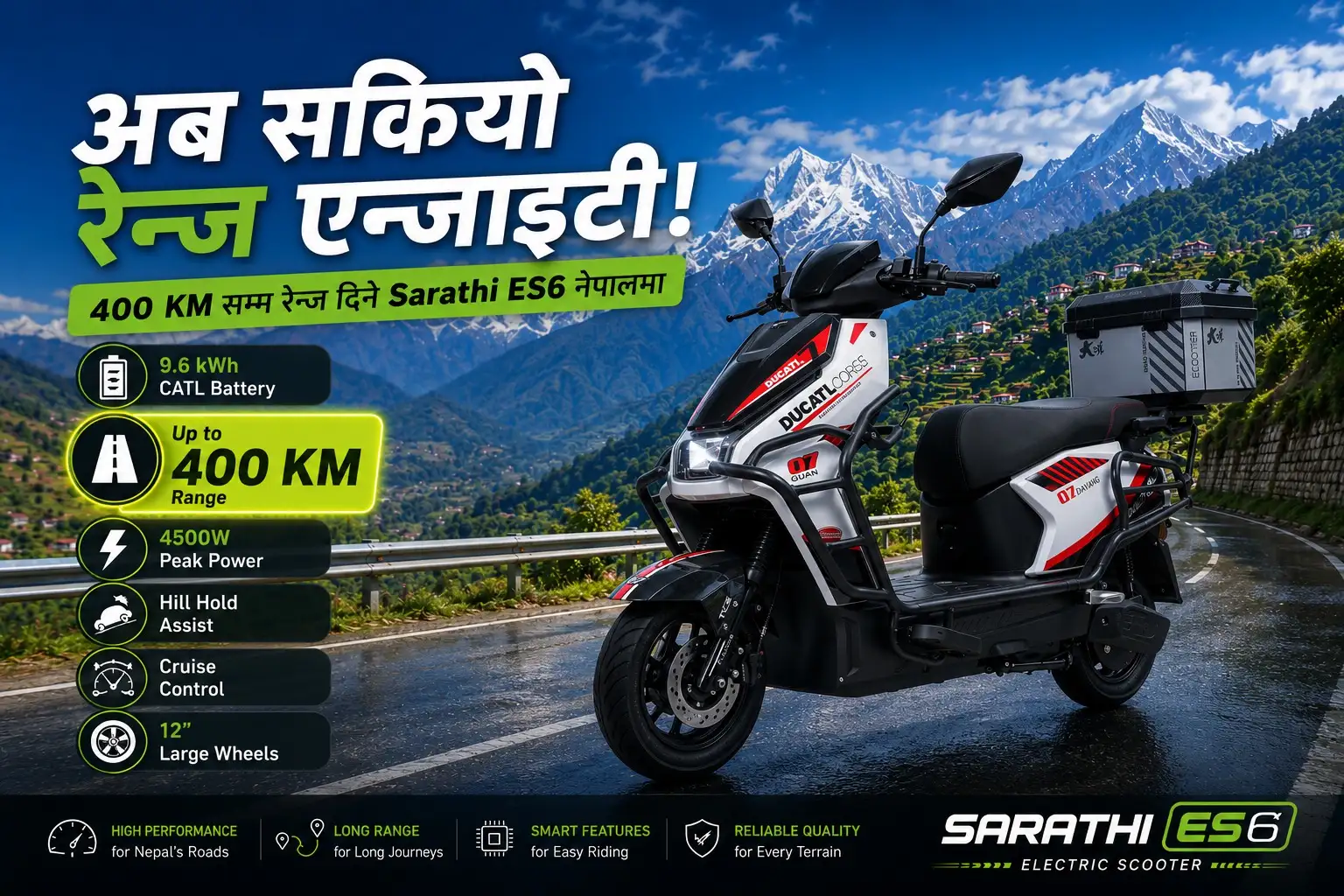
KATHMANDU — A new electric scooter has arrived in Nepal with a headline number engineered to stop shoppers in their tracks: up to 400 kilometres on a single charge. If accurate, the Sarathi ES6 — brought in by Zero Emission Ride N, the official distributor for the Chinese brand Luyuan — would offer several times the usable range of a typical electric two-wheeler and speak directly to the 'range anxiety' that has slowed electric adoption. But the figure rests on a very large battery and an idealised test, and the announcement is silent on the one number that will decide whether the pitch holds up: the price.
Some context first. The company says the 400 km figure is achieved under Standard Test Condition (STC) — a controlled benchmark, run at steady low speed on flat ground with a single light rider, that flatters every electric vehicle's range. In that sense the number is real but optimistic: it marks the ceiling, not the everyday experience. For perspective, most electric scooters on sale carry a battery a fraction of the ES6's size and deliver real-world range comfortably under 200 km — which is exactly what makes this claim stand out.
The company's own figures, helpfully, descend toward reality. On the flat roads of the Tarai, it says, the scooter can stretch even further; within the Kathmandu Valley, a test returned more than 350 km on a charge; and in steady commercial use on ride-hailing platforms, it puts real range above 250 km. That gradient — 400 in the lab, 350 in the city, 250 at work — is the useful one. A buyer should anchor expectations on the 250 km figure and read the rest as best-case.
What makes the range possible is the hardware beneath the seat: a 9.6 kWh CATL lithium battery. That is an unusually large pack for a scooter — many times the capacity of a conventional electric two-wheeler — and it is the single factor doing the heavy lifting here. A battery this big buys distance, but it also brings trade-offs the marketing does not dwell on: added weight, longer charging from empty, and, above all, cost. In any electric vehicle the battery is the most expensive component, and a 9.6 kWh pack is not cheap.
Which makes the absence of a price the announcement's most conspicuous gap. The ES6 is pitched, in part, as an escape from petrol bills — a total-cost-of-ownership argument. But that argument cannot be assessed without the upfront figure, and a large battery implies a premium one. For the cost-conscious riders the scooter targets, the question is straightforward: how many months or years of fuel savings would it take to justify the sticker price? Until that price is public, the value proposition is only half an equation.
The choice of audience, by contrast, is shrewd. By aiming the ES6 at drivers on Pathao, inDrive and Yango, Luyuan is targeting the users for whom long range is not a luxury but a livelihood. High-mileage commercial riders spend the most on fuel and lose the most to charging downtime; for them, a real-world range above 250 km can mean a full working day without stopping to charge — and therefore without lost earnings. It is precisely the segment in which a big, expensive battery makes the most economic sense.
That focus also puts the 'range anxiety' framing in perspective. Luyuan Nepal's sales and marketing head, Shankar Sharma, says the affliction is now on its way to being eliminated for good — that long trips once reserved for petrol scooters are within easy reach of electric ones. The anxiety is real, especially given Nepal's thin charging network outside the cities, and a genuinely long-range scooter does ease it. Yet most scooter owners are urban commuters covering perhaps 20 to 40 km a day; for them, 400 km is far more than they will ever use, and the practical benefit is the comfort of charging once a week rather than the ability to ride across the country. The ES6's range is a decisive advantage for the heavy user and a generous convenience for everyone else.
On equipment, the scooter is competitive without being singular. It offers hill-hold assist — useful on Kathmandu's gradients — cruise control, a digital display with a battery-percentage readout, 12-inch wheels, and a safety package of double disc brakes with a combined braking system. A 4,500-watt peak-power motor handles pickup. These are solid mid-to-upper features, but they are increasingly common across the segment; the ES6's real distinction remains its range, not its switchgear.
A less flashy claim may matter more in practice. Luyuan says it runs one of the largest service-centre networks among electric scooter brands in Nepal, with an emphasis on spare-part availability and repairs. In a market where several electric brands have launched strongly and then stumbled on after-sales support, that network — if it performs as advertised — is a substantive advantage rather than a slogan. For commercial riders especially, where every day off the road is income lost, service and parts can weigh as heavily as the spec sheet.
One question the launch leaves unanswered is the long game: how the battery ages. A 9.6 kWh pack cycled daily by a ride-hailing driver will degrade over time, and its eventual replacement is the largest single cost a commercial owner will face. Battery warranty terms, expected lifespan and replacement pricing sit at the heart of the total-cost story the scooter is selling — and, like the purchase price, they are not part of the announcement.
None of this detracts from the ambition. Nepal's electric two-wheeler market has grown quickly, propelled by high fuel prices, tax incentives and environmental concern, and a long-range entrant could nudge the whole category's expectations upward. Whether the ES6 sets the "new standard" its backers claim, however, will be decided not by the launch but by what follows: an independently verified real-world range, a competitive price, dependable batteries and a service network that holds up under load.
For now, the Sarathi ES6 is best understood as a bold specification answering a real need for a specific group of riders — the high-mileage and the commercial — rather than a finished verdict. Its 400 km headline is an invitation to look closer, and the closer look turns on numbers still missing from the page. The range is genuinely impressive on paper; the more telling figures will be the price it carries, the distance it actually covers in daily Nepali conditions, and how long its large battery keeps doing so.
Advertisement
Written by
Dipesh Ghimire