NEPSEtrading

Make smarter moves backed by machine learning. Join thousands of traders leveraging AI to maximize profits.

nepsetrading.com is an online news portal that provides insights into trading and investment by analyzing the stock market and the global economy. We create charts based on the analysis of various indicators. Please do not rely solely on this information for investment decisions. Self-study is crucial. Use this information only as an educational and informational resource.

Marketminds Investment Group Private Limited

DOIB Registration certificate no. :

4680-2081/2082

Chairman: Bishal Bikram Bimali

Director and Editor-in-chief:

Dipesh Ghimire

(

9802363868,

9851119988

)

Koteshwor 32 , Kathmandu

01-5253221

+977 9709066745

Contact support

Subscribe to our newsletter

Weekly insights from the NEPSE market in your inbox.

Market

StocksSectors

Company

About UsOur TeamTerms of UseOur PolicyTrainingContact Us

Help

SupportReportFAQ

© 2026 nepsetrading.com. All rights reserved.
This website is owned and operated by Marketminds Investment Group Private Limited.

Charts are powered byTrading View

NEPSEtrading

  • Home
  • Market
  • NEPSE Overview
  • Charts
  • News
  • Blogs
  • Training
  • Pricing
  1. Blogs
  2. Nepal's Supreme Court
  3. A Caution Could Now Cost the Corner Office: Supreme Court Ruling Rattles Nepal's Banks
Nepal's Supreme Court

A Caution Could Now Cost the Corner Office: Supreme Court Ruling Rattles Nepal's Banks

The longer-term stakes cut in two directions. If every caution now carries career-ending force, the central bank may grow hesitant to use its lighter supervisory tools at all — a chilling effect that could push enforcement either toward informal pressure or toward nothing. Alternatively, the ruling could harden governance discipline overnight, since a board seat or a CEO's office now carries genuine regulatory jeopardy. Either way, the cost of crossing the regulator has just risen sharply — and the next move belongs, by court order, to the central bank itself.

DGDipesh Ghimire
Published on June 4, 20264 min read
A Caution Could Now Cost the Corner Office: Supreme Court Ruling Rattles Nepal's Banks

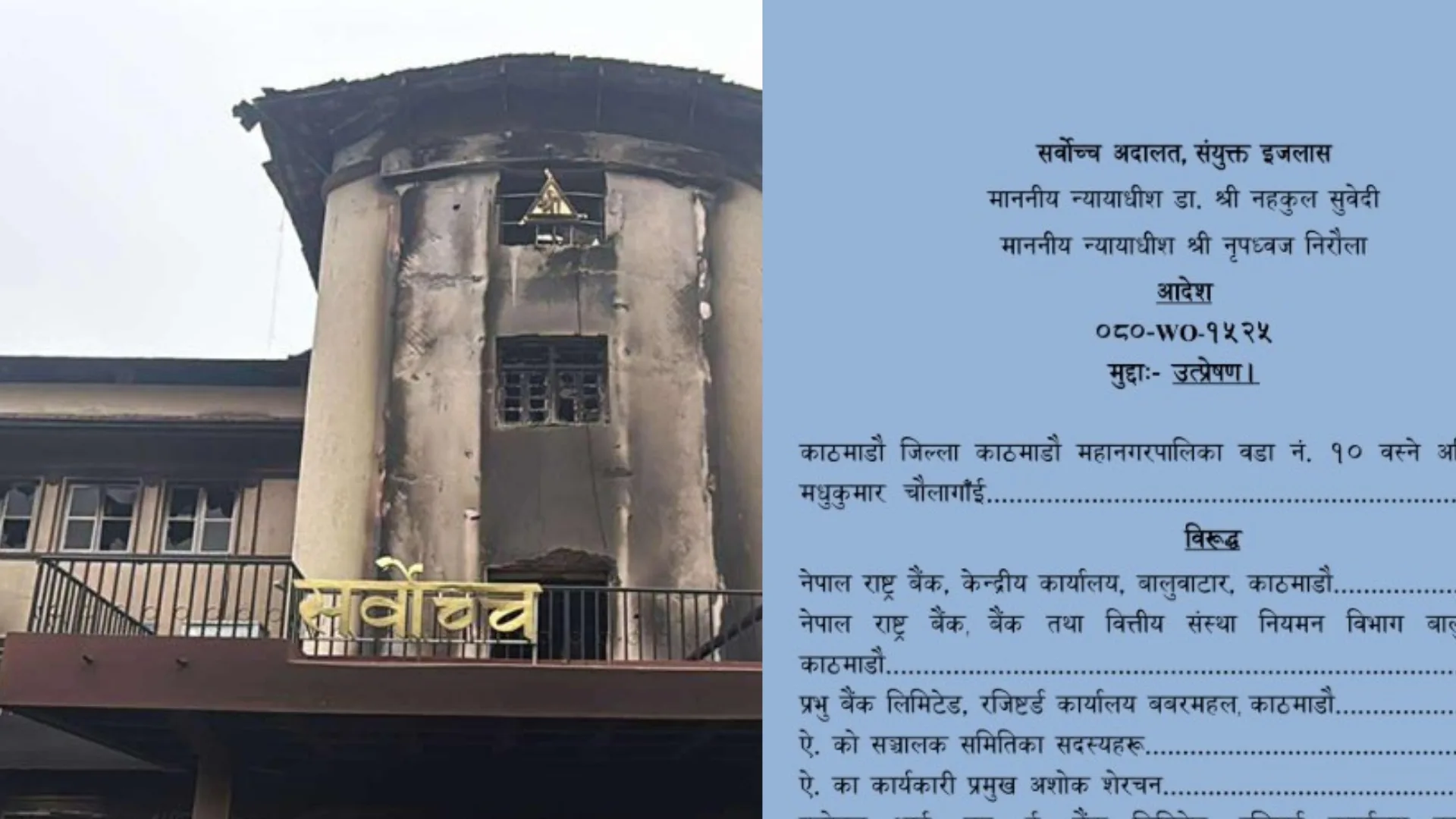
Nepal's Supreme Court has handed down a ruling with the potential to empty boardroom chairs across the banking industry. In a directive order issued in the name of Nepal Rastra Bank, the court has held that directors and chief executive officers of banks and financial institutions who have faced any penal action from the central bank stand automatically disqualified from their posts. The order has sent a tremor through the banking sector.

The ruling carries a twist that makes it more consequential, not less. The court actually dismissed the petitioner's principal demand — a mandamus ordering the immediate removal of penalized bank officials. Yet the legal interpretation it issued alongside that dismissal may achieve the very same outcome through the regulator. The petitioner, in effect, lost the writ but won the law.

The case turns on the interplay of two statutes. Section 100(2)(a) of the Nepal Rastra Bank Act, 2058 empowers the central bank to caution or reprimand directors, officials or employees of licensed banks and financial institutions who violate its orders and directives or act against the interests of depositors and the public. Separately, Section 18(1) of the Banks and Financial Institutions Act (BAFIA), 2073 declares ineligible for directorship any person against whom a regulatory body has taken action for acting contrary to law, until five years have passed since that action — and Section 29(5) extends the same bar to the post of chief executive officer.

Advocate Madhu Kumar Chaulagain went to the apex court arguing that the two provisions, read together, leave no room for penalized officials to stay on. His petition sought the removal of directors and executive chiefs at some of the country's largest commercial banks — Prabhu, Global IME, Himalayan, Nabil, NIC Asia, Kumari and Prime Commercial among them — who had been cautioned or reprimanded by the central bank at various points.

Hearing the writ, a joint bench of Justices Dr. Nahakul Subedi and Nripadhwaj Niraula agreed with the core legal proposition. A penalty imposed under Section 100(2) of the NRB Act, the bench reasoned, cannot be treated as anything other than the "action taken by a regulatory body for acting contrary to law" that BAFIA's disqualification clause describes. The consequence, in the court's reading, is automatic: such a person becomes ineligible to serve as a director under Section 18 and as a CEO under Section 29.

The truly explosive part of the interpretation lies in its refusal to draw distinctions. The court rejected the argument that a routine cautioning — the mildest instrument in the central bank's enforcement toolkit, and one it deploys frequently — is too minor to trigger disqualification. The law, the order states, does not classify regulatory action as "ordinary" or "special"; if the regulator has held that a person acted contrary to law and imposed any form of penalty, disqualification follows automatically. Read literally, that converts the central bank's lightest slap on the wrist into a five-year ban from the industry's top posts — with no materiality threshold in between.

Why, then, did the court refuse to sack anyone itself? Because, it held, the power to remove or retire a bank director or employee under the NRB Act belongs to the regulator alone. Deciding what penalty fits what lapse is the central bank's jurisdiction, and a court cannot step directly into the shoes of the executive or a regulatory body. It is a notable exercise in judicial restraint: the bench declined to wield the axe, but sharpened it and handed it to the regulator with instructions to use it.

Those instructions are specific. The directive order requires Nepal Rastra Bank to mandatorily enforce the disqualification provisions, investigate whether persons it has penalized are still occupying directorships or executive posts, write to the concerned banks to remove those found ineligible, and effectively monitor compliance with the order.

The industry's response so far is to wait on the regulator. The Nepal Bankers' Association convened a full meeting on Tuesday and decided to hold formal consultations with the central bank before taking any position, its president Santosh Koirala said, adding that the association's legal committee has been tasked with engaging the NRB's legal department. The bankers' unease is understandable: the order is addressed not to them but to their regulator, and how the central bank chooses to read and operationalize it remains, in their words, anything but certain.

That operationalization is where the hard questions now sit. Does the five-year lookback sweep in every caution and reprimand issued over the past half-decade, instantly disqualifying serving directors and CEOs? Do enforcement actions taken against institutions count, or only those naming individuals — a distinction that matters enormously, since much of the central bank's routine enforcement is directed at banks rather than persons? The answers the regulator gives will determine whether this ruling vacates a handful of chairs or reshapes boardrooms across the sector.

The longer-term stakes cut in two directions. If every caution now carries career-ending force, the central bank may grow hesitant to use its lighter supervisory tools at all — a chilling effect that could push enforcement either toward informal pressure or toward nothing. Alternatively, the ruling could harden governance discipline overnight, since a board seat or a CEO's office now carries genuine regulatory jeopardy. Either way, the cost of crossing the regulator has just risen sharply — and the next move belongs, by court order, to the central bank itself.

DG

Written by

Dipesh Ghimire

A Caution Could Now Cost the Corner Office: Supreme Court Ruling Rattles Nepal's Banks

Related News

View all
  • Built by the Storm: Why the Hardest Seasons Produce the Strongest Lives
    Top

    Built by the Storm: Why the Hardest Seasons Produce the Strongest Lives

    4 Jun, 2026

  • Rewarded While in Breach: Budget Hands Nepal Re a Captive Market as Its Governance Crumbles
    Nepal Reinsurance Company

    Rewarded While in Breach: Budget Hands Nepal Re a Captive Market as Its Governance Crumbles

    4 Jun, 2026

  • Excise Out, New Fee In: Nepal's EV Tax Overhaul Hits the Middle-Class Buyer Hardest
    Nepal's EV Tax

    Excise Out, New Fee In: Nepal's EV Tax Overhaul Hits the Middle-Class Buyer Hardest

    4 Jun, 2026

Related News

Built by the Storm: Why the Hardest Seasons Produce the Strongest Lives
Top

2 min read

Built by the Storm: Why the Hardest Seasons Produce the Strongest Lives

So when circumstances press down with all their weight, do not surrender to them. Hold your patience. Stay committed to your goal. Keep trying — not occasionally, but relentlessly, especially on the days when effort feels pointless. Because the person who can barely, painfully, stubbornly make it through the worst of times is precisely the person who carries within them the capacity to build the brightest, most successful and most honorable of futures.

Dipesh Ghimire

·

4 Jun, 2026

Rewarded While in Breach: Budget Hands Nepal Re a Captive Market as Its Governance Crumbles
Nepal Reinsurance Company

3 min read

Rewarded While in Breach: Budget Hands Nepal Re a Captive Market as Its Governance Crumbles

What stands out most is the sequencing. The budget rewarded first and demanded nothing in return. The 20 percent mandate and the pool leadership could easily have been conditioned on the company restoring compliance — publishing its overdue financials, convening its long-delayed AGM, filling its empty board seats. Until that happens, the special protection extended to Nepal Re will look less like industrial policy and more like what it currently is: a guaranteed income stream awarded to a company that answers to no one.

Dipesh Ghimire

·

4 Jun, 2026

Excise Out, New Fee In: Nepal's EV Tax Overhaul Hits the Middle-Class Buyer Hardest
Nepal's EV Tax

4 min read

Excise Out, New Fee In: Nepal's EV Tax Overhaul Hits the Middle-Class Buyer Hardest

NADA's Upreti argues the market can absorb the higher taxes — on one condition. "Consumer purchasing power has to grow. Capital spending must rise to get money circulating in the market," he says. "If the domestic market gets moving, it energizes the entire sector." In other words, whether this tax overhaul dents Nepal's EV boom or merely skims revenue off it will depend less on the rates themselves than on whether the government spends its budget fast enough to keep buyers walking into showrooms.

Dipesh Ghimire

·

4 Jun, 2026

Non-Life Insurance Stocks Rally as Budget Doubles Third-Party Motor Cover
Non-Life Insurance

3 min read

Non-Life Insurance Stocks Rally as Budget Doubles Third-Party Motor Cover

There is also a side of the equation the share market does not trade: the policy's real-world trade-off. Vehicle owners face renewals that could cost 30 percent more, while victims of road accidents gain access to a compensation pool twice as deep. Whether the budget provision proves a windfall for insurers, a burden for motorists or simply better protection for the public will become clear only once the rate committee puts a number on it.

Dipesh Ghimire

·

4 Jun, 2026

Visa Bets Long Term on Nepal as the Economy Inches Away from Cash
Global payments

4 min read

Visa Bets Long Term on Nepal as the Economy Inches Away from Cash

The real test, then, is maturity rather than momentum. By Visa's own yardstick, the market will have come of age when consumers transact digitally with full confidence, businesses accept payments without friction, and the system's records start translating into credit, formalization and deeper participation in the economy. If Nepal gets that right, the company argues, the payoff will reach well beyond the financial sector — stronger businesses, wider access and an economy more firmly connected to the world. The direction is promising; the hard part is the plumbing, and the trust.

Dipesh Ghimire

·

4 Jun, 2026

Nepal's Infrastructure Reckoning: Big Budget, Bigger Expectations
editorial

5 min read

Nepal's Infrastructure Reckoning: Big Budget, Bigger Expectations

The Rs 303 billion allocation is, by itself, neither a solution nor a guarantee. It is an opportunity. Whether Nepal converts it into durable highways, reliable electricity, functional irrigation, and connected cities — or watches it dissolve in administrative delays, monsoon-season shortcuts, and political deal-making — will depend on decisions made in the months ahead. The foundation of Nepal's economic future is being poured right now. The question is whether it will hold.

Dipesh Ghimire

·

3 Jun, 2026

Big Promises, Smaller Share: How the Budget Fell Short of the RSP's Education Pledges
Budget 2084/84

3 min read

Big Promises, Smaller Share: How the Budget Fell Short of the RSP's Education Pledges

The shortfall looks starker still against Nepal's own international commitments. The country has repeatedly pledged on global platforms to devote 20 percent of the national budget (or 5 percent of GDP) in education, but successive governments have failed to live up to the commitment. With the share stuck around 10-11 percent for years and now at roughly 10.28 percent — and amounting to less than 3 percent of the GDP — the new government has landed at about half of what it had promised the world, let alone its own voters.

Dipesh Ghimire

·

2 Jun, 2026

Why NEPSE's Optimism Keeps Flickering Out — and Why the Budget Couldn't Light It
NEPSE

5 min read

Why NEPSE's Optimism Keeps Flickering Out — and Why the Budget Couldn't Light It

Seen as a whole, the past few months describe a market whose direction is dictated by political and policy signals — arrests, ministerial reassurances, budget clauses — rather than by the performance of listed companies. Confidence stays brittle precisely because the recurring sources of fear, namely regulatory and legal risk on one side and tax uncertainty on the other, keep resurfacing just as optimism builds. The budget was meant to be the catalyst that finally lifted sentiment for good; instead it stacked a tax increase on top of an unresolved question, leaving the rally hostage to a clarity that has yet to fully arrive. Until that clarity comes — in unambiguous implementation of the final-tax provision and a steadier regulatory climate — NEPSE's enthusiasm looks set to keep flaring up and fading away.

Dipesh Ghimire

·

2 Jun, 2026

6,300 Savers, Rs 4.77 Billion: Kathmandu's Cooperative Distress Comes Into Focus
Cooperative

4 min read

6,300 Savers, Rs 4.77 Billion: Kathmandu's Cooperative Distress Comes Into Focus

In the end, the Kathmandu numbers are less a standalone event than a barometer. They show, in concentrated form, both the depth of public anxiety over cooperative savings and the slow, recovery-dependent nature of any fix. Whether confidence can be rebuilt will depend on the one thing these figures cannot yet demonstrate at scale: money actually moving back into depositors' hands.

Dipesh Ghimire

·

2 Jun, 2026