47 Glacial Lakes
A Ticking Time Bomb on the Nepal-China Border: 47 Glacial Lakes at High Risk as Diplomatic Efforts Lag
Concluding his assessment, Dr. Tuladhar delivered a stern message to Nepal’s political sphere: a crisis of this scale is no time for partisan politics. If the hundreds of thousands of youth and political cadres across the country are trained in first aid and emergency rescue, countless lives can be saved. Moving forward, Nepal's development and political discourse can no longer afford to turn a blind eye to the looming disaster in the Himalayas.
Dipesh Ghimire
3 min read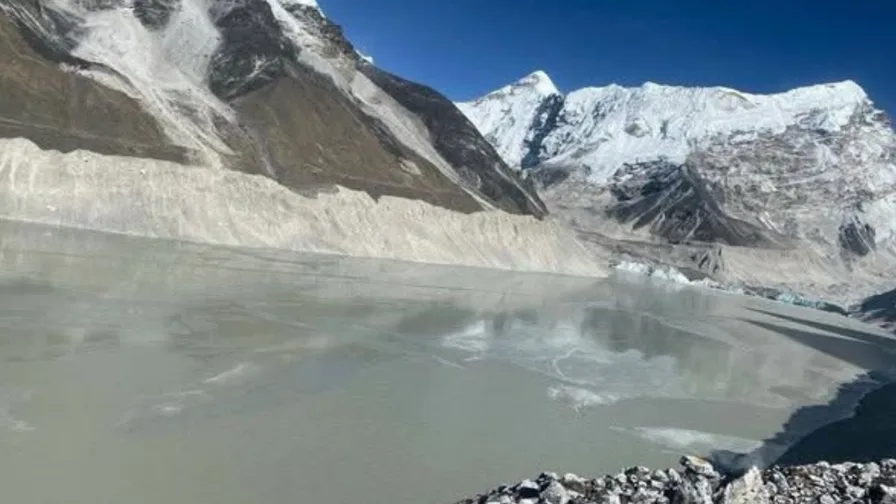
KATHMANDU — The northern Himalayan range, globally revered for its breathtaking beauty, is rapidly turning into an invisible ticking time bomb. With climate change accelerating the melting of glaciers, a catastrophic disaster looms over the Nepal-China border. Experts warn that the devastating Bhote Koshi flood in Rasuwa on August 26 was merely a "trailer" of the mega-disasters waiting to happen.
According to a recent report by Chinese state media CGTN, a massive 'Barrier Lake'—formed after a landslide blocked a river—has emerged along the border area. Covering an estimated 100,000 square meters, or the equivalent of 14 football fields, 'Barrier Lake-01' poses a severe threat. While monitoring up to August 29 indicated that this lake is currently under control, the danger is far from over. Just 5 kilometers upstream, another dangerous reservoir, 'Barrier Lake-02', has already formed. If these naturally dammed lakes burst or overflow, downstream areas in Nepal—including settlements, bridges, highways, and hydropower projects—could be wiped out in a matter of minutes.
47 Glacial Lakes in the 'Red Zone'
Data suggests the threat extends far beyond this single border region. Nepal is home to 2,069 glacial lakes. According to scientific studies, including those by the International Centre for Integrated Mountain Development (ICIMOD), 47 glacial lakes are currently in the 'red zone'—meaning they could burst at any moment. This includes 21 lakes in Nepal, 25 in the Tibet Autonomous Region of China, and one in India.
Since 1977, Nepal has witnessed 26 Glacial Lake Outburst Floods (GLOFs). Disaster risk reduction expert and former minister Dr. Gangalal Tuladhar warns that the bursting of these high-altitude lakes cannot be categorized as ordinary floods. "When a glacial lake bursts, it brings down millions of cubic meters of water, sludge, and massive boulders all at once. In technical terms, this is a 'Himalayan Tsunami'," he explained.
‘Sirens Alone Won’t Save Lives’
There is a widespread misconception that installing early warning sirens absolves the government of its responsibilities. Dr. Tuladhar views this as a critical flaw in Nepal's disaster preparedness. "We installed sirens, but we never trained the locals on where to run or how to save themselves once the alarm sounds," he said.
In the event of a glacial lake outburst or a barrier lake breach, downstream communities have a narrow window of just 30 to 40 minutes before the floodwaters hit. Because this half-hour is a matter of life and death, Dr. Tuladhar stresses the urgent need for regular, military-style evacuation drills so that locals know exactly which safe, elevated routes to take.
Urgent Need for Diplomatic Intervention
Because the source of this looming disaster lies in Tibet, Nepal’s Ministry of Home Affairs cannot mitigate the risk alone. Experts argue it is high time for "Joint Disaster Management" between the governments of Nepal and China through strong diplomatic channels.
China must share real-time data regarding the status of lakes and river flows within its territory. Disaster management experts emphasize that initiating this diplomatic dialogue cannot be left to lower-level bureaucrats; it requires immediate, Prime Minister-level intervention. Without real-time data sharing, proactive preparedness in Nepal is impossible.
Rescue Constraints and Post-Disaster Epidemics
Nepal's traditional rescue mechanisms are severely ill-equipped for a disaster of this magnitude. According to Dr. Tuladhar, the government’s limited fleet of helicopters can only cover 5 to 6 districts. A 'Himalayan Tsunami' would require the simultaneous mobilization of 28 to 30 helicopters. To address this, the government must adopt an 'air-lift' model by keeping private sector helicopters on standby.
Another terrifying aspect of such mega-disasters is post-flood epidemics. With thousands displaced, drinking water contaminated, and sanitation infrastructure washed away, outbreaks of cholera and severe diarrhea can claim more lives than the flood itself. Deploying 'mobile hospitals' and 'sanitation kits' to remote settlements is therefore an absolute necessity. Furthermore, instead of spending billions on post-disaster reconstruction, investments must be made now in disaster-resilient infrastructure.
A Call for Political Unity
Concluding his assessment, Dr. Tuladhar delivered a stern message to Nepal’s political sphere: a crisis of this scale is no time for partisan politics. If the hundreds of thousands of youth and political cadres across the country are trained in first aid and emergency rescue, countless lives can be saved. Moving forward, Nepal's development and political discourse can no longer afford to turn a blind eye to the looming disaster in the Himalayas.
Advertisement
Written by
Dipesh Ghimire