Top
Breakout Trading Strategy: Key Principles and Market Insights
Breakout Trading Strategy: Key Principles and Market Insights In the dynamic world of financial markets, breakout trading is a strategy that aims to capitalize on price movements when the market breaks out of established ranges or chart patterns. A Breakout Trading Strategy relies on understanding critical price points and using proper risk management to maximize returns. The image provided outlines some of the most essential guidelines for implementing this approach, offering valuable insights into the nuances of breakout trading. Key Rules for Breakout Trading
Dipesh Ghimire
4 min read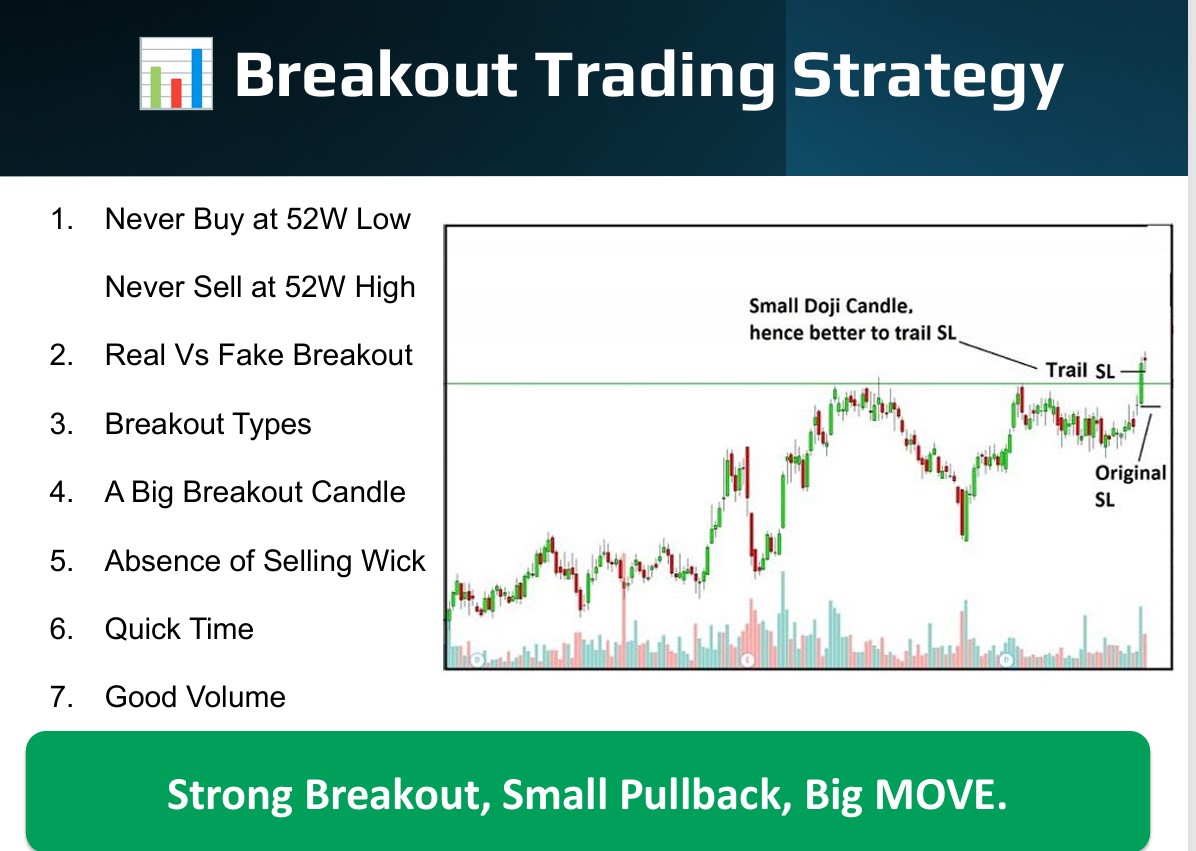
In the dynamic world of financial markets, breakout trading is a strategy that aims to capitalize on price movements when the market breaks out of established ranges or chart patterns. A Breakout Trading Strategy relies on understanding critical price points and using proper risk management to maximize returns. The image provided outlines some of the most essential guidelines for implementing this approach, offering valuable insights into the nuances of breakout trading.
Key Rules for Breakout Trading
Avoid Buying at 52-Week Lows, Never Sell at 52-Week Highs
A fundamental rule for breakout traders is to avoid purchasing at 52-week lows and selling at 52-week highs. These extreme points are usually signs of market indecision or false breakouts. At the low end, prices are often consolidating, and any "breakout" might turn out to be a false signal. Conversely, at the high end, a reversal is more likely. Traders are advised to wait for confirmation that the breakout is sustainable before entering the market.
Distinguishing Between Real and Fake Breakouts
One of the most significant challenges for traders is distinguishing between a real breakout and a fake breakout. Real breakouts happen when a price moves beyond a resistance or support level with momentum and significant volume. On the other hand, a fake breakout occurs when the price briefly exceeds a key level, only to reverse back inside the previous range. These false signals can trap traders, causing unnecessary losses.
Types of Breakouts
Breakouts can occur in various ways, such as through chart patterns like triangles, flags, or channels. Understanding the type of breakout pattern is essential for evaluating the potential of a price move. For instance, breakouts from a triangle pattern are often more reliable than a breakout from a random price level.
The Importance of a Big Breakout Candle
A big breakout candle is a strong signal that a price movement is likely to continue in the breakout direction. A large candlestick with little to no wicks indicates momentum, showing that there’s a significant commitment from buyers or sellers. On the other hand, small candles or candles with long wicks suggest hesitation in the market and might indicate the breakout is not as strong.
Absence of Selling Wicks
A selling wick refers to a candle with a long upper shadow, indicating that selling pressure has emerged at a particular price level. For a breakout to be considered robust, the absence of selling wicks is preferable. A breakout candle without this wick means that the price is moving freely in one direction, without encountering significant resistance at higher levels.
Quick Timeframes for Breakouts
Speed is crucial in breakout trading. Breakouts that happen quickly and decisively are often more reliable, signaling strong momentum in the market. A slow, drawn-out breakout may indicate uncertainty and reduce the reliability of the price move. The faster the breakout, the higher the likelihood that it will sustain momentum.
Volume as Validation
One of the most critical factors for validating a breakout is good volume. A breakout accompanied by strong trading volume suggests that the move is supported by a significant number of traders, which increases the likelihood of the breakout being sustained. Without volume, breakouts are less trustworthy, and the price could quickly reverse.
Interpreting the Chart
The chart included in the image shows a breakout scenario where a small doji candle appears, indicating a brief period of indecision in the market. The strategy suggests trailing the stop loss (SL) as the price continues to move upward, thereby locking in profits while minimizing risk. The initial stop loss is placed at a certain level, but as the price advances, the stop loss is adjusted upwards to protect gains. The doji candle suggests that momentum may be slowing, making it wise to move the stop loss to secure profits before a potential reversal.
Strong Breakout, Small Pullback, Big Move
The overall message of the strategy is clear: strong breakouts with small pullbacks lead to big moves. This approach emphasizes entering the market when the price breaks out of a significant level with strength, followed by a small retracement. Such setups tend to offer high rewards while minimizing risks, as the initial pullback after the breakout acts as a confirmation of the market’s willingness to continue in the breakout direction.
Conclusion: A Reliable Strategy for High Potential Trades
Breakout trading offers one of the highest potential rewards in financial markets, but only when approached with caution and discipline. By adhering to the rules outlined above—such as avoiding extreme price levels, confirming breakouts with volume, and trailing the stop loss—traders can significantly improve their chances of success. As the strategy emphasizes, a strong breakout, followed by a small pullback, is often the best scenario for capturing large moves in the market.
For traders looking to master this strategy, it’s crucial to stay patient, waiting for the right conditions, and making sure to monitor volume and momentum closely. With practice, breakout trading can become a powerful tool in any trader's toolkit.
Advertisement
Written by
Dipesh Ghimire