Top
Experts Call for Policy Reforms to Boost Energy Investment at South Asia (BIN) Power Summit 2025
Experts Call for Policy Reforms to Boost Energy Investment at South Asia (BIN) Power Summit 2025 At the South Asia (BIN) Power Summit 2025 held in New Delhi, energy experts and industry leaders stressed that policy-level reforms are critical for accelerating cross-border investment in the region’s energy sector. The summit, organized by the Confederation of Indian Industry (CII), brought together high-ranking government officials and private-sector representatives from Bhutan, India, and Nepal. Nepal’s private sector delegation — led by Mohan Kumar Dangi, Senior Vice-President of the Independent Power Producers Association Nepal (IPPAN) — joined a five-member team attending the event. From the government side, a delegation led by Joint Secretary Nutan Kumar Sharma, who also serves as Deputy Director General of the Department of Electricity Development, represented Nepal in key discussions.
Dipesh Ghimire
3 min read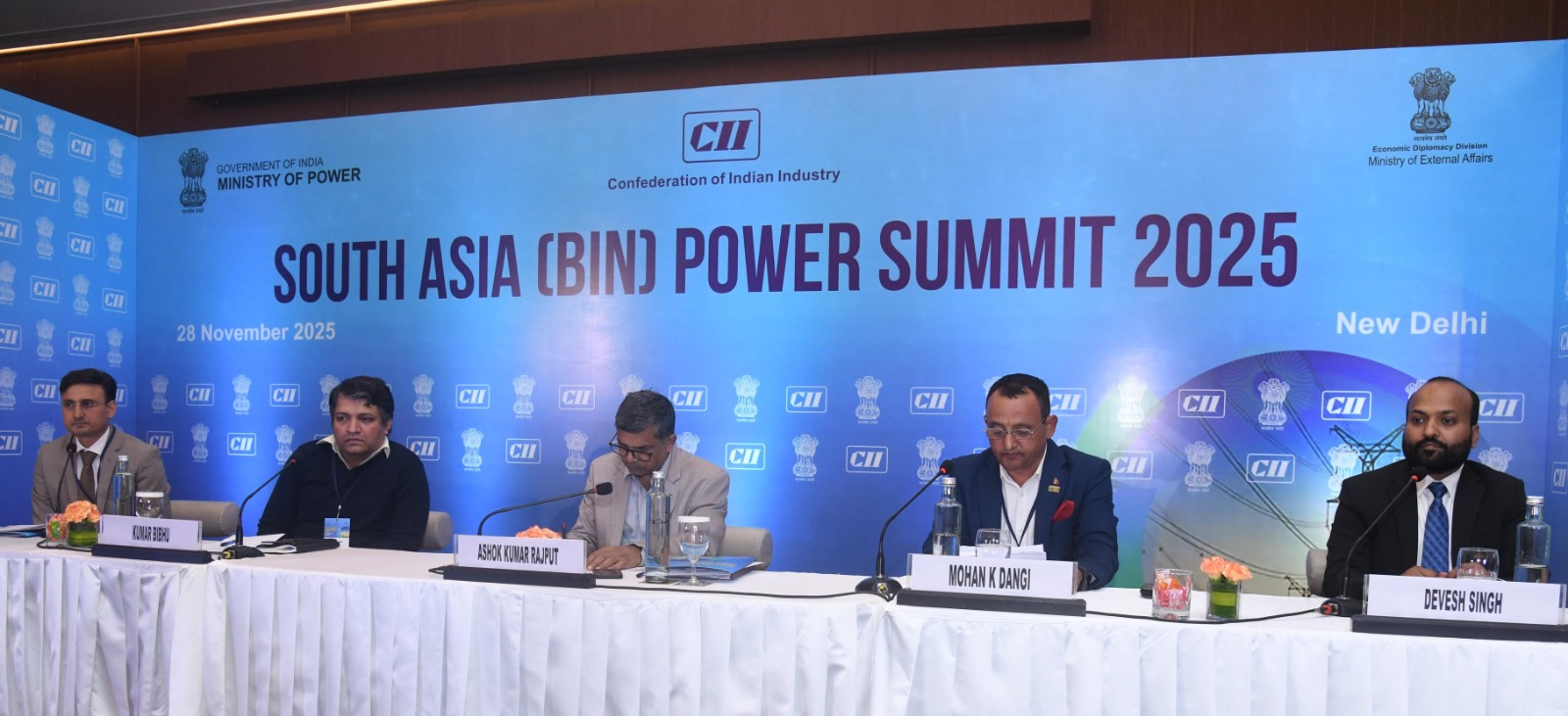
At the South Asia (BIN) Power Summit 2025 held in New Delhi, energy experts and industry leaders stressed that policy-level reforms are critical for accelerating cross-border investment in the region’s energy sector. The summit, organized by the Confederation of Indian Industry (CII), brought together high-ranking government officials and private-sector representatives from Bhutan, India, and Nepal.
Nepal’s private sector delegation — led by Mohan Kumar Dangi, Senior Vice-President of the Independent Power Producers Association Nepal (IPPAN) — joined a five-member team attending the event. From the government side, a delegation led by Joint Secretary Nutan Kumar Sharma, who also serves as Deputy Director General of the Department of Electricity Development, represented Nepal in key discussions.
Speaking during the summit’s inaugural session, Sharma stated that Nepal is well positioned to meet the growing demand for clean, renewable electricity in South Asia. He emphasized that with supportive policies, Nepal could significantly contribute to the region’s energy security through hydropower-driven export potential.
During the thematic sessions, Senior Vice-President Dangi highlighted that long-term and short-term investments in hydropower infrastructure remain crucial for all BIN countries. He argued that structural policy adjustments — particularly in project approvals, transmission coordination, and open-access frameworks — are necessary to scale up energy production and encourage private-sector participation.
Dangi reminded delegates of Nepal’s national ambition to reach 28,500 MW of electricity generation by 2035, requiring an estimated USD 46.5 billion in investment. He encouraged international investors to explore “business-to-business” (B2B) partnerships that support hydropower development, grid enhancement, open-access transmission, and cross-border energy trading.
He noted that Nepal currently has an installed capacity of around 4,000 MW, with nearly 5,500 MW of projects under construction and an additional 3,000 MW of projects preparing to enter the construction phase after securing financial closure. Beyond that, the private sector is studying hydropower projects totaling 20,000 MW, indicating strong long-term prospects for large-scale energy expansion.
In another session, IPPAN Vice-President Ashish Garg emphasized that regional electricity demand has surged in the past two years, particularly in India and Bangladesh. He suggested that South Asian nations prioritize cross-border electricity trading by strengthening transmission connectivity and operational coordination.
Responding to concerns raised in the session, Subhash Kumar Mishra, Deputy Executive Director of the Nepal Electricity Authority (NEA), said that although challenges persist in BIN-level power trade — including regulatory hurdles, infrastructure gaps, and market entry barriers — these can be resolved with strategic planning and country-specific frameworks. Mishra expressed confidence that Nepal could greatly expand its energy exports if long-term cooperation mechanisms were formalized.
Garg further argued that large-scale cross-border electricity trade requires synchronized regulatory reforms, commercially viable transmission models, and modern grid infrastructure. He called for BIN nations to jointly develop policy instruments that support forward contracts, spot-market participation, and harmonized grid operations.
Addressing the evolving trade landscape, IPPAN Vice-President Uttam Bhlon Lama highlighted that electricity trade in South Asia is rapidly shifting from long-term Power Purchase Agreements (PPAs) to more flexible market-based models. Under India’s new Cross-Border Electricity Trade Guidelines, daily transactions through the Day-Ahead Market (DAM) have become possible — creating new opportunities for Nepal’s surplus power.
Nepal currently exports over 1,000 MW of electricity to India and 40 MW to Bangladesh. Lama explained that Nepal earns stable revenue from exports to Bangladesh, while the Indian market allows both long-term and day-ahead trading, giving Nepal greater flexibility in pricing and volume management.
Lama also mentioned that although private companies in Nepal are ready to trade electricity internationally, the Nepalese government is still the sole entity authorized to do so at the moment. He urged policymakers to expedite regulatory reforms that would allow private-sector players to participate in cross-border trading, increasing competition and overall export capacity.
Despite the progress, Lama said that the region’s cross-border electricity exchanges remain at an early stage. To strengthen the system, South Asian countries must adopt clear strategies to integrate more electricity exchange platforms and facilitate easier market access for energy producers.
The summit concluded with experts urging BIN nations to develop aligned policies, strengthen transmission corridors, and remove administrative bottlenecks. Participants agreed that South Asia’s clean-energy transition depends on accelerated hydropower investment, improved regulatory coordination, and long-term regional cooperation.
Advertisement
Written by
Dipesh Ghimire