#UnileverNepal #UNLDividendPol
From 100% to 1842%: The Evolution of Unilever Nepal’s Dividend Policy and Market Valuation
From a modest 100% dividend to a record 1842%, Unilever Nepal’s journey epitomizes the power of consistency and corporate prudence. Its evolution shows how stable earnings, disciplined management, and shareholder focus can transform a manufacturing company into Nepal’s most trusted blue-chip asset. For investors, UNL is less about chasing growth and more about owning certainty, credibility, and continuous rewards.
Sandeep Chaudhary
2 min read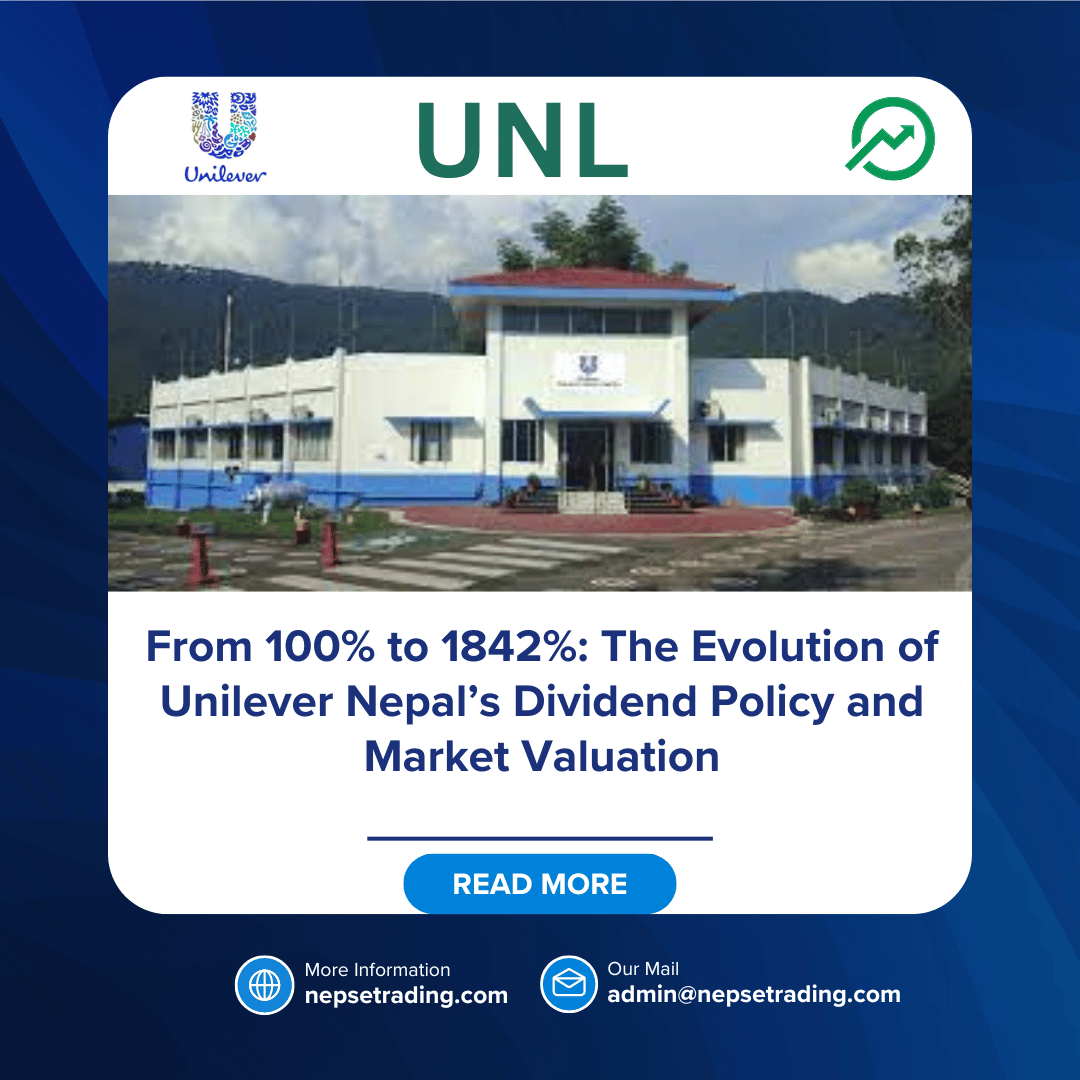
Unilever Nepal Limited (UNL) — the undisputed powerhouse of Nepal’s consumer goods industry — has become synonymous with sustained profitability, shareholder generosity, and valuation premium. Over the past 13 years, its dividend policy has evolved from a modest 100% payout in FY 2077/78 to an astounding 1842% cash dividend in FY 2081/82, reflecting the company’s journey from conservative growth to confident financial maturity.
UNL’s dividend history tells the story of a company that has mastered stability in a volatile market. Starting with single- and triple-digit payouts in the early 2070s, it gradually transitioned into a four-digit dividend regime, consistently rewarding shareholders while maintaining balance-sheet strength. Key milestones along this path include 650% in FY 2078/79, 1215% in FY 2079/80, 1580% in FY 2080/81, 1714% in FY 2081/81, and the recent record-breaking 1842%. Few listed firms in South Asia exhibit such a long, uninterrupted streak of rising dividends, especially without resorting to bonus share dilution.
The reason UNL can sustain this payout model lies in its business model efficiency. Operating with minimal debt, strong cash reserves, and stable margins, the company’s cash flow generation easily supports large dividends. Its revenue base, primarily from household brands such as Lux, Dove, Sunsilk, Pepsodent, Wheel, and Surf Excel, offers predictability — people buy these essentials regardless of economic cycles. Unlike banks or hydropower firms, UNL’s profitability isn’t driven by regulatory or seasonal shifts, but by brand loyalty and operational discipline.
As dividends rose, so did the company’s market valuation. UNL’s share price, once hovering around Rs. 10,000–15,000 a decade ago, now trades near Rs. 48,000–50,000, with little volatility. Its P/E ratio (~23) and P/B ratio (~8.5)reflect how the market views UNL not as a speculative growth play but as a premium defensive asset. Investors pay this premium because they see UNL as the closest equivalent to a “Nepali dividend bond” — one that provides steady cash income and capital protection. The current dividend yield of 3.6–4%, though moderate in percentage, translates into one of the largest rupee-value payouts in the entire NEPSE index.
From a policy standpoint, UNL’s dividend evolution illustrates a strategic shift — from reinvestment-oriented to distribution-driven capital allocation. In its early years, the company focused on capacity enhancement and market expansion. Now, with its market dominance secure and growth opportunities limited by Nepal’s small consumer base, UNL channels profits back to shareholders rather than expanding aggressively. This policy has built immense trust among investors, making UNL a model of financial discipline and transparency.
In the long term, UNL’s approach represents maturity over momentum. Its evolution from 100% to 1842% isn’t just about higher dividends; it’s about a company that has reached operational equilibrium — where profit predictability allows near-automatic distributions. The premium valuation reflects not irrational exuberance, but a rational appreciation for stability, brand power, and governance excellence.
Advertisement
Written by
Sandeep Chaudhary