Top
International Support Strengthens Nepal’s Election Management, but Raises Questions on Long-Term Capacity
International Support Strengthens Nepal’s Election Management, but Raises Questions on Long-Term Capacity Nepal’s upcoming House of Representatives election, scheduled for Falgun 21, is being backed by logistical, financial, and technical assistance from India, Japan, and the development partner United Nations Development Programme (UNDP). According to the Ministry of Finance, Nepal, this international support is expected to play a key role in ensuring smooth election management and strengthening administrative efficiency. One of the major components of this assistance is India’s provision of vehicles for election operations. The Ministry of Home Affairs had initially requested 750 vehicles, considering the geographical challenges and security requirements across the country. After reviewing practical needs, the number was revised to 650. So far, India has delivered 538 vehicles in different phases, mainly in the form of cabin pickup vans, which are being used for transportation, logistics, and field coordination.
Dipesh Ghimire
3 min read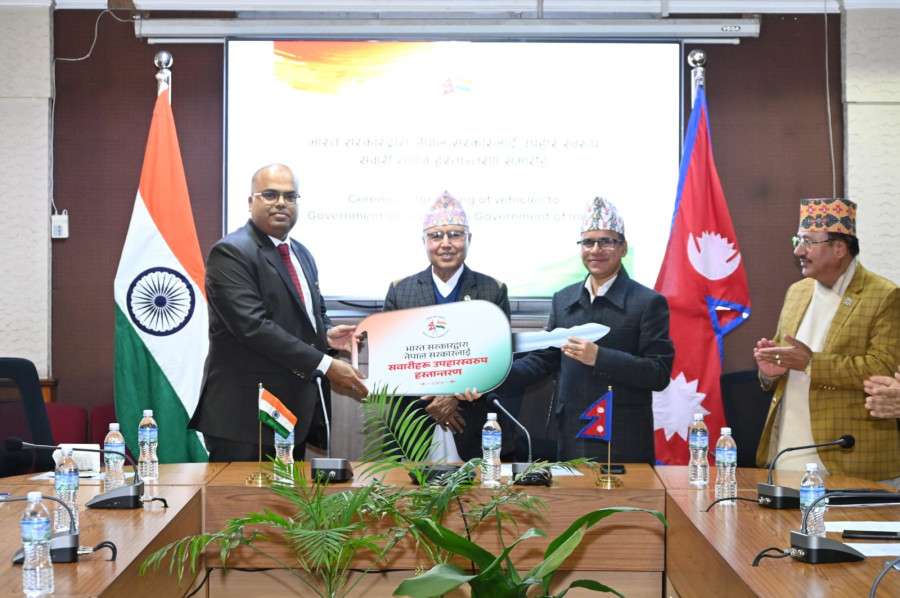
Nepal’s upcoming House of Representatives election, scheduled for Falgun 21, is being backed by logistical, financial, and technical assistance from India, Japan, and the development partner United Nations Development Programme (UNDP). According to the Ministry of Finance, Nepal, this international support is expected to play a key role in ensuring smooth election management and strengthening administrative efficiency.
One of the major components of this assistance is India’s provision of vehicles for election operations. The Ministry of Home Affairs had initially requested 750 vehicles, considering the geographical challenges and security requirements across the country. After reviewing practical needs, the number was revised to 650. So far, India has delivered 538 vehicles in different phases, mainly in the form of cabin pickup vans, which are being used for transportation, logistics, and field coordination.
The phased delivery system reflects a structured approach to cooperation. India first handed over 60 vehicles in early 2081 BS, followed by 250 vehicles in the second phase in 2082 BS. Additional vehicles have been delivered gradually since then. According to government officials, another 112 vehicles are yet to arrive, along with larger trucks equipped for security purposes. This indicates that India’s support extends beyond logistics to strengthening election security arrangements.
Officials say the availability of vehicles has reduced operational pressure on local administrations, especially in remote and mountainous regions. In past elections, transportation shortages often delayed ballot distribution and staff deployment. This time, improved mobility is expected to minimize such risks and ensure timely execution of election procedures.
Alongside logistical support, Japan has committed to providing NPR 400 million in financial assistance. According to the Ministry of Finance, discussions with the Japanese government are in the final stage, and the agreement is expected to be completed soon. This funding is likely to be used for operational costs, voter education, materials procurement, and administrative management.
Economic analysts note that foreign financial assistance has become increasingly important for Nepal’s election process, as rising costs and limited domestic resources strain the national budget. While such support helps maintain quality standards, it also highlights the government’s continuing dependence on external funding for major democratic exercises.
Meanwhile, UNDP is providing direct technical and institutional support to the Election Commission of Nepal through a separate agreement. Under this arrangement, UNDP will support training programs for election officials and provide essential equipment such as computers, printers, IT tools, and stationery.
Election experts believe this technical assistance is crucial for improving professionalism and transparency. Training programs help standardize procedures, reduce human error, and strengthen accountability at polling centers. The use of modern equipment also enhances data management and reporting efficiency, which are critical for maintaining public trust in election results.
The government views this combined international support as a foundation for conducting free, fair, and credible elections. Officials argue that assistance in logistics, finance, security, and technology will help minimize administrative weaknesses and improve service delivery to voters. They also say that such cooperation reflects international confidence in Nepal’s democratic institutions.
However, some analysts caution that growing reliance on foreign support raises long-term policy concerns. While short-term assistance improves efficiency, it may discourage investment in domestic capacity building. Without sustained internal reforms and budgetary commitment, Nepal may continue to depend on external partners for future elections.
Political observers also point out that the dominance of bilateral and multilateral donors in election management requires careful coordination. Transparency in fund utilization, clear accountability mechanisms, and institutional oversight are necessary to prevent misuse and maintain sovereignty in electoral affairs.
Another concern relates to sustainability. Vehicles and equipment provided by foreign partners require proper maintenance and management. If these assets are not integrated into long-term administrative systems, their usefulness may decline after a few election cycles. Experts emphasize the need for a comprehensive asset management policy.
Despite these challenges, most stakeholders agree that the current support package is timely and necessary. With increasing voter expectations and rising logistical complexity, international cooperation has helped stabilize the election environment and reduce operational risks.
Overall, the assistance from India, Japan, and UNDP reflects both an opportunity and a responsibility for Nepal. While it strengthens election management in the short term, it also underscores the need for long-term institutional reform and financial self-reliance. Balancing external support with domestic capacity development will remain a key challenge for Nepal’s democratic process in the years ahead.
Advertisement
Written by
Dipesh Ghimire