NAIMA Mobility Expo
NAIMA Mobility Expo Opens with 55 Brands as EVs Take Centre Stage in Nepal’s Festive Auto Market
NAIMA Mobility Expo It is a snapshot of an automobile market undergoing one of the fastest technological shifts in Nepal’s recent economic history—while the infrastructure and regulatory system surrounding it are still struggling to catch up.
Dipesh Ghimire
10 min read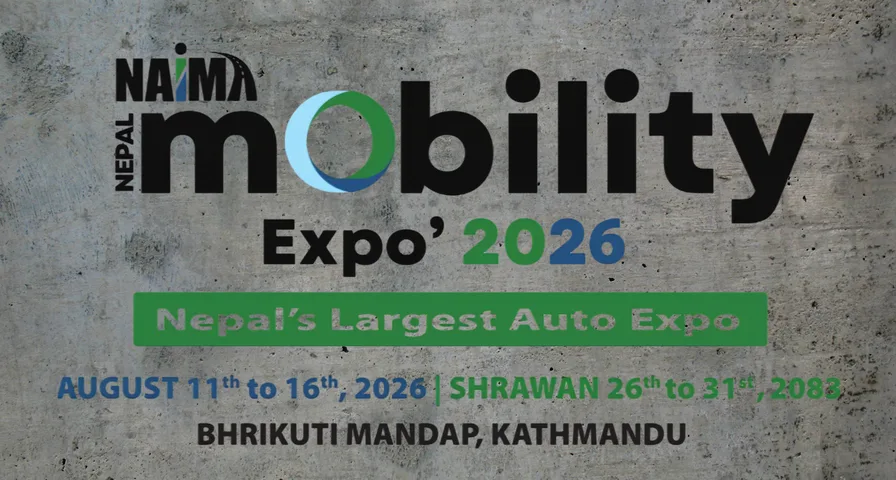
Kathmandu — Nepal’s automobile industry is making one of its biggest product pushes ahead of the Dashain buying season, with the second edition of the NAIMA Nepal Mobility Expo opening at Bhrikutimandap on Tuesday with more than 55 automobile and mobility brands and over 40 new product launches.
The six-day exhibition, organised by the Nepal Automobile Importers and Manufacturers Association, will continue until August 16. Organisers had initially announced 51 stalls, while opening-day information showed the exhibition expanding to 53 automotive stalls. Participation has increased sharply from 42 brands in last year’s inaugural edition, suggesting that companies are attaching greater importance to Nepal’s increasingly competitive mobility market.
Electric vehicles are expected to dominate the exhibition, with passenger cars, two-wheelers and commercial EVs forming a large part of the new product line-up. Hybrid and conventional vehicles will also be present, alongside batteries, charging technology, automotive components, financing, insurance and other mobility-related services.
The growth of the expo, however, comes at an unusual time for Nepal’s automobile business. Consumer interest in electric vehicles remains strong, but vehicle imports have recently weakened because of disruptions along the northern border, changes in taxes and continuing uncertainty over automobile policy.
This makes the expo more than a display of new models. It is also emerging as a test of whether Nepal’s automobile market can regain sales momentum before the country enters its most important festive buying period.
Dashain season raises expectations
Automobile distributors traditionally place considerable importance on the period leading up to Dashain and Tihar because households often make large purchases during the festive season.
The timing of the NAIMA exhibition therefore gives importers an opportunity to present new products before consumers finalise their buying decisions.
Instead of visiting individual showrooms, prospective buyers will be able to compare dozens of brands, vehicle categories, specifications and financing options at one venue.
Companies are also expected to use booking discounts and promotional packages to convert exhibition visitors into actual customers. Promotional offers have already been announced by participating businesses, according to organisers.
But the number of visitors or vehicle launches alone will not determine whether the expo succeeds commercially.
The more important indicator will be how many inquiries translate into bookings and eventual deliveries.
Nepal’s vehicle market has become increasingly price-sensitive, particularly after changes in customs and tax structures affected the cost of several categories of vehicles.
That means discounts, financing costs, battery warranties, resale expectations and after-sales networks may matter as much to buyers as the excitement surrounding a new launch.
EVs become the defining feature
The strongest underlying trend at this year’s exhibition is Nepal’s continuing transition toward electric mobility.
EVs ranging from relatively affordable models to high-end vehicles are being displayed at the expo. Opening-day information indicated prices stretching from roughly Rs 2 million to as high as Rs 35 million, showing how widely the electric segment has expanded across consumer categories.
The growth in brands is equally significant.
NAIMA President Ritu Singh Vaidya has said participation has increased from 42 brands last year to 55 this year. She also indicated that the number of EV brands present in Nepal’s wider market has expanded rapidly.
The transition is visible in customs data as well.
Nepal imported 17,688 four-wheel vehicles worth Rs 40.44 billion in the last fiscal year. Of them, 13,004 were electric vehicles worth Rs 31.32 billion. China alone supplied 9,640 of those EVs and accounted for Rs 23.55 billion of the total EV import value.
Those figures illustrate why Chinese electric vehicles now have such a visible presence in Nepalese automobile exhibitions.
Manufacturers and distributors are competing aggressively across price segments, particularly in compact and mid-range electric sport utility vehicles and passenger cars.
The competition has benefited consumers by expanding choice, but it also creates a more difficult market for distributors.
With dozens of brands competing for a relatively small customer base, success increasingly depends on after-sales service, spare parts, charging support, warranties and long-term brand credibility rather than simply introducing a new vehicle.
EV imports fell despite strong consumer interest
The expansion of brands should not be confused with uninterrupted growth in imports.
Electric four-wheeler imports fell by about 24 percent in the last fiscal year, while overall four-wheeler imports declined by around 19 percent. Industry representatives have attributed part of the decline to prolonged disruption at the Rasuwagadhi and Tatopani border routes, along with inventory adjustments and tax changes.
This creates an interesting contrast.
The number of brands competing in Nepal is rising, yet the volume of imported vehicles has recently declined.
That suggests the market has entered a more competitive phase.
Importers are no longer operating in an environment where rapid expansion in EV demand automatically guarantees rising sales for every distributor. More brands are competing for buyers whose purchasing decisions are increasingly influenced by price and policy changes.
Recent tax increases have also affected the upper end of the EV market.
Dealers say some consumers who previously considered vehicles priced between Rs 4 million and Rs 5 million have shifted toward models below Rs 4 million, while demand for more expensive EVs has weakened.
The expo will therefore provide an early indication of which price segments are currently attracting the strongest buyer interest.
Hybrids remain on the sidelines
Although electric vehicles have gained strong policy and market support, hybrid vehicles have not achieved a comparable position in Nepal.
Industry representatives argue that the policy framework has generally favoured fully electric vehicles rather than creating similar incentives for hybrids.
That difference matters because hybrid technology could potentially serve consumers who want lower fuel consumption but remain concerned about charging availability or long-distance travel.
However, hybrids occupy an awkward position in Nepal’s current tax and mobility structure.
They do not receive the full fiscal advantages available to EVs, while they still carry an internal combustion engine and therefore cannot compete with electric vehicles on operating costs in the same way.
The limited presence of hybrids at major exhibitions is consequently not just a marketing issue. It also reflects how government taxation can shape technology adoption.
Nepal’s transition is therefore developing less as a gradual movement from petrol to hybrid to electric, and more as a direct shift from conventional vehicles toward battery-electric models.
Tatopani disruption exposes supply-chain weakness
The biggest immediate challenge surrounding the expo has come from Nepal’s northern trade routes.
Recurring landslides and poor road conditions around Tatopani have disrupted the movement of vehicles imported from China, with several vehicles intended for exhibition or customer delivery stranded near the border.
The disruption is especially important because China has become Nepal’s dominant source of electric vehicles.
When a large proportion of EV imports depends on a limited number of northern corridors, a landslide or customs disruption can quickly become a nationwide automobile supply problem.
This exposes a structural weakness in Nepal’s EV boom.
The country has successfully created strong consumer demand for electric vehicles, but the logistics infrastructure supporting that demand has not developed at the same pace.
The Tatopani and Rasuwagadhi routes remain vulnerable to weather, road conditions and cumbersome border procedures.
Importers say vehicles may need to be unloaded, inspected and handled again during customs processing, adding time and cost to imports.
For consumers, such inefficiencies eventually appear in two forms: delayed delivery and higher prices.
The issue therefore goes well beyond whether a few exhibition vehicles arrive in Kathmandu on time.
It concerns the resilience of Nepal’s entire automobile supply chain.
Nepal’s EV transition now requires infrastructure beyond cars
The large number of electric models at the expo also raises a second question: can Nepal’s supporting infrastructure keep pace with vehicle adoption?
Charging stations are expanding, but electric mobility requires more than chargers.
It needs technicians trained in high-voltage systems, reliable spare-parts networks, battery diagnostics, accident-response procedures, battery reuse and recycling systems, and clear rules for handling batteries at the end of their useful life.
These issues are receiving greater attention at this year’s expo, where sessions on road safety and lithium-ion battery management and recycling are also planned.
This represents an important development.
Nepal’s initial EV debate was dominated by import duties and vehicle prices. As the fleet expands, the conversation is gradually moving toward lifecycle management.
What happens to an EV battery after eight or ten years is becoming as relevant as how much tax is charged when the vehicle enters the country.
Industry representatives have proposed several approaches, including domestic recycling, reusing degraded vehicle batteries for stationary energy storage, and developing procedures for exporting batteries to specialised recycling facilities.
Without such arrangements, the environmental advantage of electric mobility could eventually create a new waste-management challenge.
Public transport remains the missing part of the EV transition
Another weakness in Nepal’s electric mobility story is that the transition has been driven predominantly by private vehicles.
Electric passenger cars have attracted substantial investment and consumer interest, but electric mass transit has not expanded at the same pace.
Industry leaders have argued that private electric cars and motorcycles alone cannot produce a comprehensive clean-transport transition and that the government needs a clearer framework for electric public transportation.
This is particularly relevant in the Kathmandu Valley.
Replacing petrol cars with electric cars reduces petroleum consumption and tailpipe emissions, but it does not necessarily reduce congestion.
A road occupied by 100 electric cars can remain just as congested as a road occupied by 100 petrol cars.
For Nepal, the larger mobility policy question is therefore not simply how to sell more EVs.
It is how to combine electric private vehicles with cleaner buses, organised public transport, better roads and more effective traffic management.
Financing will determine how much demand converts into sales
Banks, financial institutions and insurance providers are also part of the expo, giving potential buyers access to vehicle financing and insurance information alongside the vehicles themselves.
This is commercially important because the sticker price is only one component of vehicle affordability.
Loan-to-value limits, interest rates, repayment periods and insurance costs determine the monthly financial burden on buyers.
A vehicle may appear attractively priced at the exhibition, but weak financing conditions can still prevent a booking.
This means the automobile industry has a direct interest in monetary and credit policies.
Industry representatives have already called for greater flexibility in vehicle financing, particularly for EVs.
The interaction between attractive models and affordable financing will therefore be one of the factors determining whether the festive season generates a meaningful recovery in sales.
Parking and digital ticketing expanded
NAIMA has also made changes to visitor management this year.
Parking space has been arranged at the Nepal Police Club in addition to facilities around the exhibition area, responding to one of the most persistent logistical problems associated with major events at Bhrikutimandap.
Online ticketing has also been introduced, with cashback offers attached to selected digital payment arrangements. Earlier event information listed ticket prices of Rs 100 for students and Rs 200 for the general public.
The organisers are also attempting to broaden the expo beyond a conventional vehicle showroom by incorporating learning sessions and discussions on financing, insurance, battery management, road safety, entrepreneurship and future mobility.
That shift is noteworthy because the automobile industry itself is changing.
A modern mobility exhibition is no longer only about engines, body design and horsepower.
Software, batteries, charging, connectivity, financing and energy systems are increasingly becoming part of the product.
Lack of a permanent exhibition centre remains a constraint
Despite the expansion of the expo, organisers have pointed to the lack of a permanent international-standard exhibition facility in Kathmandu as a structural limitation.
Bhrikutimandap remains the main venue for major commercial exhibitions, but organisers argue that Nepal needs a modern exhibition centre capable of handling larger events and more sophisticated displays.
The issue extends beyond automobiles.
Trade exhibitions can play an important role in product launches, business networking, tourism and business-to-business sales.
As Nepal’s consumer and industrial markets grow, the absence of a large purpose-built exhibition facility could increasingly limit the scale of such events.
Bigger expo does not automatically mean a stronger market
The most important interpretation of this year’s NAIMA Mobility Expo is that participation is expanding faster than the underlying market.
More than 55 brands are now competing for attention at a time when EV imports have actually declined from the previous fiscal year.
That does not necessarily signal weakness.
It may instead indicate that global manufacturers and their Nepalese distributors believe the country’s long-term electric mobility market remains attractive despite short-term disruption.
But it also means competition will become tougher.
New brands will have to prove that they can provide spare parts, servicing, warranties and resale support after the initial excitement of a launch disappears.
The companies that survive Nepal’s increasingly crowded EV market may not necessarily be those with the lowest introductory prices.
They are more likely to be those able to build trust and maintain a reliable ownership ecosystem.
Expo becomes a test of festive demand
The second NAIMA Mobility Expo therefore arrives at a revealing moment for Nepal’s automobile sector.
The exhibition is larger than its first edition, electric vehicles have become the dominant attraction and dozens of new products are entering the market. At the same time, border disruptions, tax uncertainty, financing constraints and infrastructure gaps continue to complicate the industry’s expansion.
The immediate question is whether the combination of new launches, festive discounts and financing offers will be enough to revive vehicle demand ahead of Dashain.
The longer-term question is more fundamental.
Nepal has already demonstrated that consumers are willing to adopt electric vehicles quickly. The challenge now is to build the roads, charging networks, repair skills, battery-management systems, customs infrastructure and stable policies required to support that transition.
In that sense, the 55-brand exhibition at Bhrikutimandap is not simply a showcase of new cars and motorcycles.
It is a snapshot of an automobile market undergoing one of the fastest technological shifts in Nepal’s recent economic history—while the infrastructure and regulatory system surrounding it are still struggling to catch up.
Advertisement
Written by
Dipesh Ghimire