Nepal Rastra Bank
Nepal Rastra Bank Pushes Digital Literacy as Financial Services Move Deeper Online
The success of Nepal’s digital financial transformation will therefore depend not only on how many people use mobile banking or QR payments, but also on how safely and confidently they use them.
Dipesh Ghimire
8 min read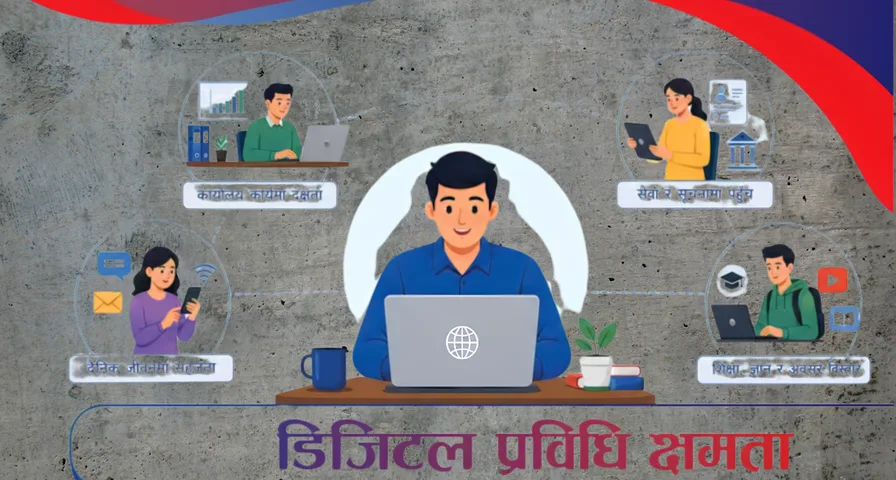
Kathmandu — Nepal Rastra Bank has urged the public to strengthen digital literacy as banking and financial transactions become increasingly dependent on mobile phones, internet platforms and other digital tools, warning that wider use of technology must be matched by stronger awareness of privacy, personal data and financial security.
The central bank has said digital literacy should no longer be understood simply as the ability to use a smartphone or operate an application. Instead, it involves a broader set of skills that allow people to use technology confidently, responsibly and securely in financial transactions, education, the workplace and everyday life.
The emphasis comes at a time when Nepal’s financial sector is rapidly shifting toward digital delivery. Mobile banking, internet banking, QR payments, digital wallets and online financial services have become increasingly common, reducing the need for customers to visit bank branches for routine transactions.
But the expansion of digital finance has also increased exposure to new risks.
As more financial activity moves online, consumers are being required to manage passwords, digital identities, transaction alerts, personal information and online accounts more carefully than before. A person who can make a digital payment but cannot identify a suspicious link, protect credentials or evaluate the authenticity of online information may still remain financially vulnerable.
That is why Nepal Rastra Bank is increasingly linking digital literacy with financial literacy and consumer protection.
Digital literacy now extends beyond basic device use
According to the central bank, digital literacy includes the ability to identify what information is needed, locate it through digital channels and assess whether the information is reliable and relevant.
This is becoming particularly important in the financial sector.
Consumers now receive investment advice, loan offers, banking information, payment requests and promotional material through websites, social media, messaging platforms and mobile applications.
The volume of information has increased, but so has the risk of misinformation.
A digitally literate consumer therefore needs to do more than simply access information. The individual must be able to judge whether a message comes from a legitimate institution, whether a payment request is genuine and whether financial information is supported by credible sources.
This ability to evaluate information is becoming a basic component of financial safety.
Digital identity has become a financial asset
Nepal Rastra Bank has also drawn attention to the responsible management of digital identity.
In the digital economy, a person’s identity is increasingly represented through mobile numbers, email accounts, usernames, passwords, biometric information and financial credentials.
If those details are compromised, the consequences can extend beyond social media accounts and directly affect bank deposits, payment wallets and other financial assets.
Protecting digital identity is therefore becoming as important as protecting physical financial documents.
The central bank’s message reflects a wider change in the nature of financial risk.
In the past, financial security was largely associated with protecting cash, cheques, passbooks and physical documents. Today, a significant part of financial security depends on protecting information.
A stolen password, one-time password or login credential can potentially be as damaging as losing cash.
Privacy is becoming central to digital finance
The central bank has also urged users to understand the importance of personal data and privacy.
Digital financial services generate large amounts of information about customers. These records may include transaction histories, identity details, account information and other personal data.
Consumers therefore need to understand which information should be shared, with whom it should be shared and under what circumstances.
This is especially important because fraud increasingly relies on social engineering rather than purely technical attacks.
Fraudsters may attempt to obtain personal information by impersonating banks, payment companies, government offices or trusted individuals.
A technically advanced financial system can still be unsafe if users are easily persuaded to disclose confidential information.
For that reason, digital literacy must include both technical skills and behavioural discipline.
Responsible online behaviour is part of financial protection
Nepal Rastra Bank has also emphasised responsible participation in digital spaces.
This includes careful use of social media and online communication platforms, management of digital identity and awareness of copyright and licensing rules when creating or sharing digital content.
At first glance, such issues may appear unrelated to banking.
But they are increasingly connected.
Social media platforms are now commonly used to promote financial products, investment opportunities and online businesses. They are also used by fraudsters to imitate legitimate institutions or persuade individuals to transfer money.
The boundary between digital communication and financial activity has therefore become increasingly blurred.
A user who lacks basic awareness of responsible digital behaviour may face not only reputational risk but financial loss.
Cyber hygiene is becoming a household skill
The central bank’s emphasis on digital security also signals that cybersecurity can no longer be treated solely as the responsibility of banks and technology companies.
Financial institutions have an obligation to secure their systems, but customers also play an important role in protecting the final point of access.
Weak passwords, unsecured devices, suspicious applications and careless sharing of information can undermine even well-designed security systems.
This makes basic cyber hygiene an increasingly important household skill.
Users need to understand device security, account protection, privacy controls and the risks associated with unknown links or software.
As digital finance expands, these capabilities are likely to become as fundamental as understanding interest rates, loan repayments or savings products.
Financial inclusion without literacy can create new risks
The rapid expansion of digital banking is often presented as a major tool for financial inclusion.
That is correct, but only partly.
Digital platforms can allow customers in areas with limited branch networks to access banking and payment services. They can reduce travel costs, lower transaction time and make financial services more widely available.
However, greater access does not automatically mean greater protection.
If people are brought into digital finance without sufficient knowledge of fraud, privacy and safe transaction practices, inclusion can create new vulnerabilities.
The policy challenge is therefore not simply to increase the number of digital users.
It is to ensure that those users understand the systems they are entering.
This is why Nepal Rastra Bank’s approach to digital literacy has broader significance for financial inclusion.
A person who can confidently and safely use digital financial services is more likely to remain within the formal financial system over time.
Digital literacy also matters for productivity
The central bank has linked digital competence with broader economic productivity.
According to its assessment, digital skills can improve workplace performance, expand access to information and services, support education and create new opportunities.
This argument is especially relevant as more government and private-sector services move online.
Employees increasingly need to use digital communication, data systems and online service platforms.
Students depend on digital tools for learning and research.
Small businesses use social media, digital payments and online platforms to reach customers.
As a result, digital literacy is becoming part of basic economic capability rather than a specialised technical skill.
Knowing how to solve problems matters as much as knowing how to use apps
The central bank has also stressed the importance of identifying and solving technical problems.
This is an important distinction.
A user may know how to make a payment when everything works normally but may struggle when a transaction fails, an account is locked or a device behaves unexpectedly.
Digital competence therefore requires some ability to diagnose basic problems, seek reliable assistance and adapt to changing technology.
The central bank has also encouraged users to recognise gaps in their own digital skills and improve them continuously.
That is particularly relevant because digital systems change rapidly.
Applications are updated, security practices evolve and new forms of fraud emerge.
Digital literacy is therefore not a one-time skill.
It requires continuous learning.
The challenge is behavioural, not only technological
Nepal’s digital transition has often focused on infrastructure: internet access, mobile networks, banking applications and payment platforms.
But the central bank’s latest emphasis highlights another side of the transition.
Technology alone cannot guarantee safe digital finance.
User behaviour matters.
A sophisticated payment system can still produce losses if customers repeatedly disclose passwords, respond to fraudulent messages or fail to secure their devices.
Conversely, even relatively simple digital platforms can operate more safely when users understand basic protection practices.
This suggests that the next phase of digital finance in Nepal will require investment not only in technology but also in public education.
Financial literacy programmes may need to change
Traditional financial literacy programmes have generally focused on savings, borrowing, interest rates, budgeting and banking services.
Those topics remain important, but digital finance is changing the content of financial education.
Consumers now also need to understand authentication, privacy, online fraud, digital contracts, suspicious payment requests and account security.
Financial literacy and digital literacy are therefore increasingly overlapping.
For Nepal Rastra Bank, integrating these two areas could become important as more financial services move away from physical branches.
A customer may understand a bank loan well but still be vulnerable if they do not know how to protect the mobile banking account through which the loan is managed.
Digital literacy also has a social dimension
The central bank has further noted that digital competence includes the ability to exchange information and ideas through digital platforms and participate in social and public activities.
This gives digital literacy a broader role beyond finance.
Citizens increasingly access government information, public notices, educational material and social services online.
Those unable to navigate digital platforms may therefore face disadvantages not only in banking but also in education, employment and public participation.
The digital divide can consequently become an economic and social divide.
This is particularly significant for older users, people in rural areas and those with limited formal education.
Expanding digital services without providing adequate support to such groups could deepen inequality in access.
Consumer protection is becoming more important
Nepal Rastra Bank’s financial consumer protection mechanism provides a formal channel for customers who face problems related to financial services.
Consumers can register complaints through the central bank’s online grievance portal.
The existence of such a mechanism is important because the growth of digital financial services changes the nature of customer disputes.
Problems may now involve failed electronic transactions, unauthorised transfers, delayed settlements, account restrictions or disputes involving digital service providers.
Consumers need to know not only how to use financial services but also where to seek redress when those services fail.
An effective complaint system can therefore strengthen confidence in digital finance.
A safer digital economy will depend on users as well as institutions
Nepal’s financial sector is likely to become increasingly digital in the years ahead.
That transition can reduce transaction costs, improve access and make services more efficient.
But it also transfers part of the responsibility for financial security directly to users.
Customers now have to manage devices, passwords, identities and personal information in ways that were far less important in conventional branch banking.
This makes digital literacy a form of financial risk management.
For Nepal Rastra Bank, the policy message is becoming clear: expanding digital finance is not enough.
The country also needs users who can identify reliable information, protect their data, recognise online risks, manage digital identities and respond appropriately when problems arise.
The success of Nepal’s digital financial transformation will therefore depend not only on how many people use mobile banking or QR payments, but also on how safely and confidently they use them.
Advertisement
Written by
Dipesh Ghimire