Top
Nepali Business Leaders Urge India to Lift Trade Barriers, Boost Investment at New Delhi Roundtable
Establishing a joint FNCCI–CII task force provides an institutional mechanism to address these commercial disputes before they escalate into diplomatic deadlocks. If backed by political will from both New Delhi and Kathmandu, streamlining BIS approvals, upgrading rail cargo corridors, and easing port access could significantly reduce logistics costs and help narrow Nepal's chronic trade deficit with its southern neighbor.
Dipesh Ghimire
4 min read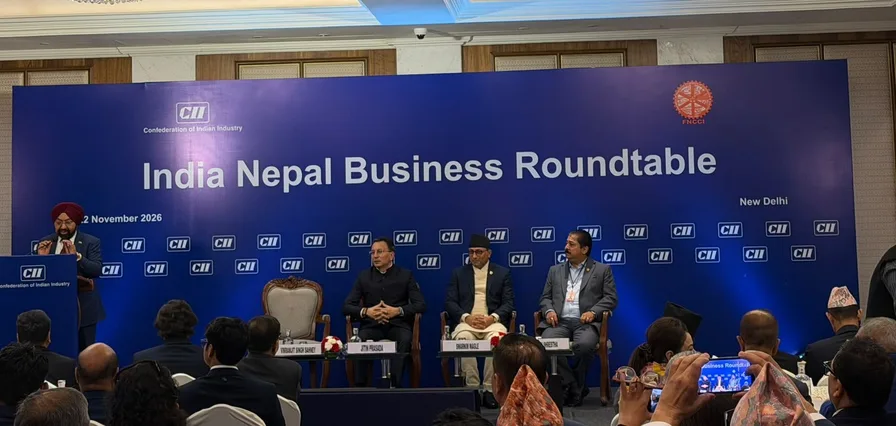
NEW DELHI — Nepali industrialists and business leaders have urged New Delhi to eliminate non-tariff trade barriers, expand cross-border infrastructure, and accelerate private-sector investment to make Nepal–India economic ties more pragmatic and result-oriented.
Speaking at the 'Nepal–India Business Roundtable' held in New Delhi on the sidelines of Prime Minister Balendra Shah's official visit to India, Nepali private-sector representatives highlighted persistent bottlenecks restricting Nepali exports to the Indian market despite close bilateral relations.
Responding to the Nepali delegation, Indian Minister of State for Commerce and Industry Jitin Prasada acknowledged strong prospects for bilateral collaboration in Nepal's manufacturing, infrastructure, and tourism sectors, urging both sides to accelerate the pace of economic development.
Nepal's Finance Minister Dr. Swarnim Wagle invited Indian industrialists to expand their footprint in Nepal, assuring them that the government is actively reforming policies to foster a predictable and investor-friendly business climate.
During the interaction, Nepali entrepreneurs pointed out that domestic products continue to face hurdles in accessing Indian markets, citing delays in quality certification renewals and restrictive trade duties on key industrial exports.
Addressing the forum, Federation of Nepalese Chambers of Commerce and Industry (FNCCI) President Anjan Shrestha called for transforming bilateral relations from traditional trade proximity into a modern partnership for economic prosperity. He proposed a seven-point framework prioritizing cooperation across trade, transit, connectivity, infrastructure, energy, investment, and technology.
While India remains Nepal's largest trading partner and top source of foreign direct investment (FDI)—accounting for roughly one-third of Nepal's total FDI stock—Shrestha noted that cumulative Indian private investment still stands below USD 1 billion, far short of its true potential.
To attract foreign capital, Shrestha highlighted recent regulatory reforms in Nepal, including automatic FDI approval across 102 sectors, removal of minimum investment thresholds in key areas, and streamlined licensing through a one-stop service center.
A major focal point of the Nepali business delegation's appeal was the removal of restrictive tariffs on jute and steel products. Shrestha drew attention to the anti-dumping duty imposed by India on Nepali jute since 2017, noting that the sector directly supports thousands of farmers and workers in eastern Nepal. He urged India to view Nepali manufacturers as complementary industrial partners rather than market competitors.
Similarly, he revealed that safeguard duties imposed on steel imports in India caused Nepal's steel exports to plunge by more than 60 percent in the last fiscal year.
Business leaders also voiced frustration over prolonged delays in renewing quality certificates from the Bureau of Indian Standards (BIS) and raw material origin complexities, which frequently leave Nepali consignments stranded at border checkpoints.
To resolve these recurring bottlenecks, Shrestha proposed forming a joint task force between FNCCI and the Confederation of Indian Industry (CII) to study trade barriers, quality standards, and trade remedies, and submit actionable recommendations to both governments.
The Nepali side also pressed for smoother access to Indian seaports, expanded railway cargo capacity, and the upgradation of integrated check posts. CII Director General Vikramjit Singh Sahney echoed these priorities, emphasizing customs modernization and expanded rail freight connectivity.
Highlighting mega-project opportunities, Shrestha noted that while Nepal has signed an agreement to export 10,000 megawatts of electricity to India within the next decade, only a fraction of the country's 40,000-megawatt economically viable hydropower potential has been harnessed so far. He invited Indian firms to invest in hydropower, tourism, agro-processing, pharmaceuticals, cement, IT, and industrial parks, as well as expressways, airports, and urban transit under public-private partnership (PPP) models.
Investment Board Nepal Chief Executive Officer Yangki Ukyab briefed Indian executives on Nepal's updated investment laws and spotlighted the Bhairahawa–Pokhara Expressway as a prime project ready for Indian capital.
Meanwhile, Confederation of Nepalese Industries representatives and former FNCCI President Bhawani Rana underscored the need to deepen bilateral tourism ties through improved air connectivity and joint tourism infrastructure development.
The New Delhi business roundtable underscores a critical shift in Nepal's economic diplomacy: moving beyond aid-centric bilateral requests toward resolving structural trade deficits and attracting private-sector capital.
Although India accounts for roughly one-third of Nepal's total FDI stock, having cumulative Indian investment remain under USD 1 billion demonstrates that geographical proximity and cultural ties have yet to translate into large-scale industrial capital inflows. By introducing automatic FDI approval in 102 sectors and pitching marquee PPP projects like the Bhairahawa–Pokhara Expressway alongside the 10,000 MW power export roadmap, Kathmandu is signaling readiness to absorb institutional Indian investment.
However, the data shared by Nepali industrialists exposes how non-tariff barriers and protectionist duties undermine Nepal's export competitiveness. The over 60 percent drop in steel exports due to Indian safeguard duties, combined with long-standing anti-dumping tariffs on jute and bureaucratic delays in BIS certification renewals, illustrates that tariff-free market access on paper is often neutralized by regulatory friction at the border.
Establishing a joint FNCCI–CII task force provides an institutional mechanism to address these commercial disputes before they escalate into diplomatic deadlocks. If backed by political will from both New Delhi and Kathmandu, streamlining BIS approvals, upgrading rail cargo corridors, and easing port access could significantly reduce logistics costs and help narrow Nepal's chronic trade deficit with its southern neighbor.
Written by
Dipesh Ghimire