Top
NEPSE Market Closes with Positive Growth on Final Trading Day of the Week
NEPSE Market Closes with Positive Growth on Final Trading Day of the Week On the final trading day of the week, the Nepal Stock Exchange (NEPSE) index closed with a positive gain. After a mild correction on Wednesday, NEPSE made a notable recovery on Thursday, rising by 9.23 points to close at 2,714.61. Along with the index increase, the overall trading volume saw an improvement, reflecting a boost in investor confidence. Trading Volume and Stock Movements: On Wednesday, the total trading volume was 8.92 billion NPR, with 332 stocks traded 94,174 times. However, on Thursday, trading increased significantly, reaching a value of 9.07 billion NPR, with 1.9 million shares being traded. Notably, four stocks saw their share prices hit positive circuit levels: SY Panel Nepal, Trishuli Hydroelectric Company, Srinagar Agri-tech Industry, and Corporate Development Bank. On the other hand, the share price of Kalika Power Company experienced the highest drop of 6.25%.
Dipesh Ghimire
3 min read
On the final trading day of the week, the Nepal Stock Exchange (NEPSE) index closed with a positive gain. After a mild correction on Wednesday, NEPSE made a notable recovery on Thursday, rising by 9.23 points to close at 2,714.61. Along with the index increase, the overall trading volume saw an improvement, reflecting a boost in investor confidence.
Trading Volume and Stock Movements:
On Wednesday, the total trading volume was 8.92 billion NPR, with 332 stocks traded 94,174 times. However, on Thursday, trading increased significantly, reaching a value of 9.07 billion NPR, with 1.9 million shares being traded. Notably, four stocks saw their share prices hit positive circuit levels: SY Panel Nepal, Trishuli Hydroelectric Company, Srinagar Agri-tech Industry, and Corporate Development Bank. On the other hand, the share price of Kalika Power Company experienced the highest drop of 6.25%.
Top Performers and Sector Movements:
Among the top performers, the eyes of investors were drawn to the significant rise in shares of SY Panel Nepal, Manjushree Finance, and Excel Development Bank, whose trading volumes exceeded 30 crore NPR each. Meanwhile, the hydroelectric and finance sectors saw notable increases in trading volume, indicating growing investor interest. The overall market was driven by the rise in the finance sub-index, which gained 2.38%. Additionally, sectors such as development banks, hotel & tourism, and production & processing also saw increases in their respective indices.
However, the trade sub-index experienced a slight decrease of 1.15%. Out of the 13 sub-sectors, 10 saw an upward movement, while 3 showed a decline.
Technical Analysis – Market Shows Strong Positive Momentum:
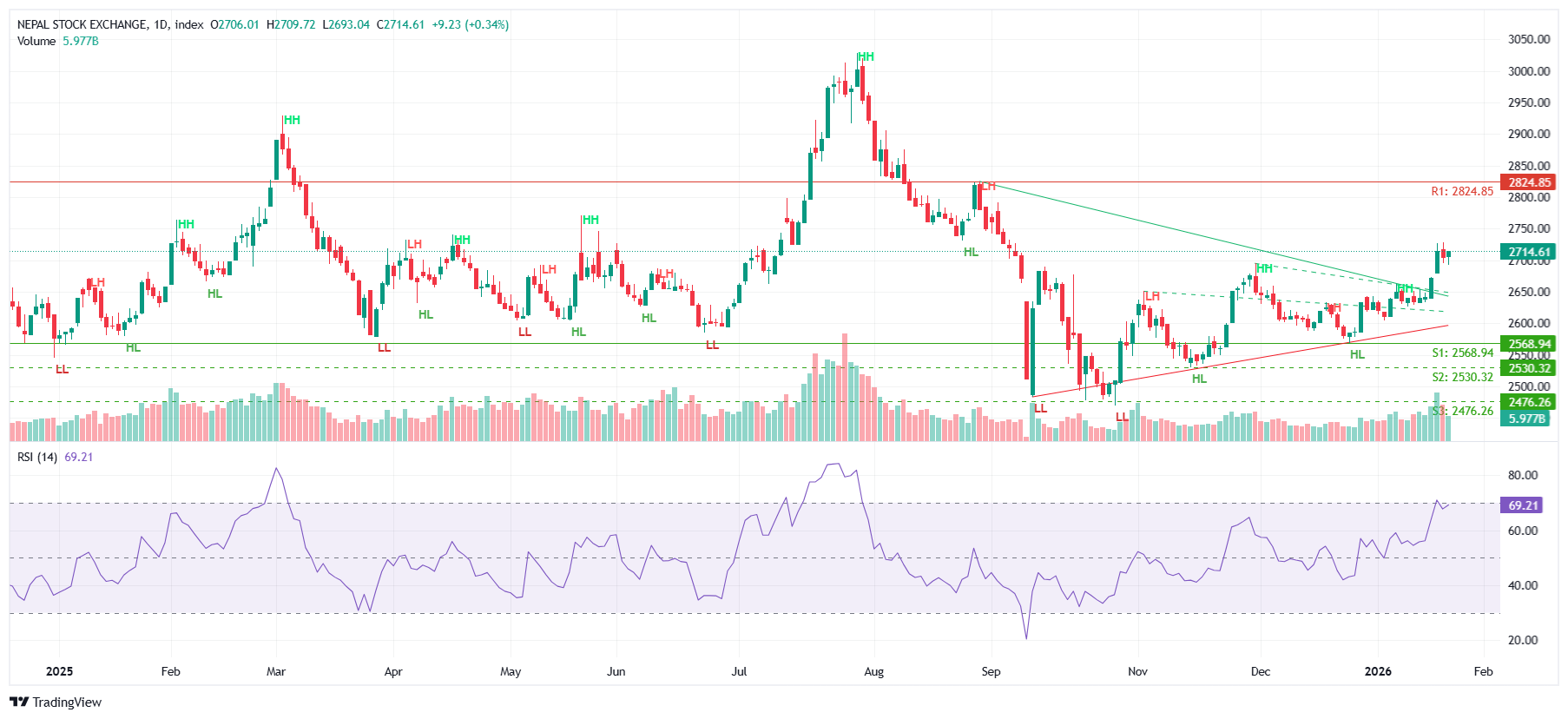
From a technical perspective, NEPSE continues to maintain a positive outlook. The market is currently forming an ascending triangle pattern and has been testing the 200-day moving average (MA) for support. The index has faced resistance at certain levels but continues to show overall growth potential.
RSI and MACD Indicators:
The Relative Strength Index (RSI) has reached 69.11, which is approaching the overbought territory, signaling that the market has been experiencing bullish momentum. However, this could also indicate a potential for market correction if the upward movement slows down. On the other hand, the Moving Average Convergence Divergence (MACD) indicator shows a bullish crossover, with the MACD line crossing above the zero line, suggesting that the positive momentum could continue for a while.
Market Behavior and Volatility:
On Thursday, the market opened with a gap-up, and the first few minutes saw the gap being filled, resulting in some negative movements. Despite a brief dip in the first half-hour, the market made a comeback and hit a daily high at 11:57 AM. From then, the market fluctuated but ultimately closed 14 points higher in the final 15 minutes of trading. This final push demonstrated a notable increase in trading volume, particularly from the hydroelectric and finance sectors.
Overall Market Outlook:
The positive market activity on the final trading day of the week has created an atmosphere of optimism and confidence among investors. Technical indicators, such as the RSI and MACD, indicate that the market could continue its positive trend, although there are some concerns of a potential pullback. The market’s current direction appears to be upwards, but the siders of caution suggest that investors should remain watchful of potential corrections as the market approaches higher levels of resistance.
Overall, NEPSE’s positive performance amidst a volatile trading environment signals that investor sentiment remains strong, with promising opportunities in specific sectors like hydro and finance. The market’s ability to maintain an upward trajectory in the coming days will depend on how it navigates these key resistance levels.
Advertisement
Written by
Dipesh Ghimire