Top
Latest
Popular
Top
Stock
Trading
Dipesh Ghimire
Non-Banking Assets of Banks and Financial Institutions in Nepal Soar to NPR 45 Billion
Non-Banking Assets of Banks and Financial Institutions in Nepal Soar to NPR 45 Billion In recent years, Nepal's banking and financial institutions have seen a significant rise in non-banking assets, which have now reached a staggering NPR 45 billion. This increase has been driven by an escalating number of assets being auctioned off as a result of defaulted loans, indicating a growing problem of non-performing loans (NPLs) within the sector. According to the Nepal Rastra Bank (NRB), as of the end of the fiscal year 081/82 (mid-April 2024), non-banking assets held by banks and financial institutions amounted to NPR 44.8 billion. The primary reason behind this increase is the surge in bad loans, where borrowers are unable to repay their debts, leading to the auction of collateral assets such as land, buildings, and vehicles, which are often held as security for loans.
Dipesh Ghimire
3 min read
In recent years, Nepal's banking and financial institutions have seen a significant rise in non-banking assets, which have now reached a staggering NPR 45 billion. This increase has been driven by an escalating number of assets being auctioned off as a result of defaulted loans, indicating a growing problem of non-performing loans (NPLs) within the sector.
According to the Nepal Rastra Bank (NRB), as of the end of the fiscal year 081/82 (mid-April 2024), non-banking assets held by banks and financial institutions amounted to NPR 44.8 billion. The primary reason behind this increase is the surge in bad loans, where borrowers are unable to repay their debts, leading to the auction of collateral assets such as land, buildings, and vehicles, which are often held as security for loans.
Banks have seen a rise in these non-banking assets as defaulted loans continue to rise. As of the end of the current fiscal year, bad loans accounted for 5.24% of total loans, a significant increase from 3.98% the previous year. The situation has been progressively worsening, with the default rate increasing each quarter since the start of the fiscal year.
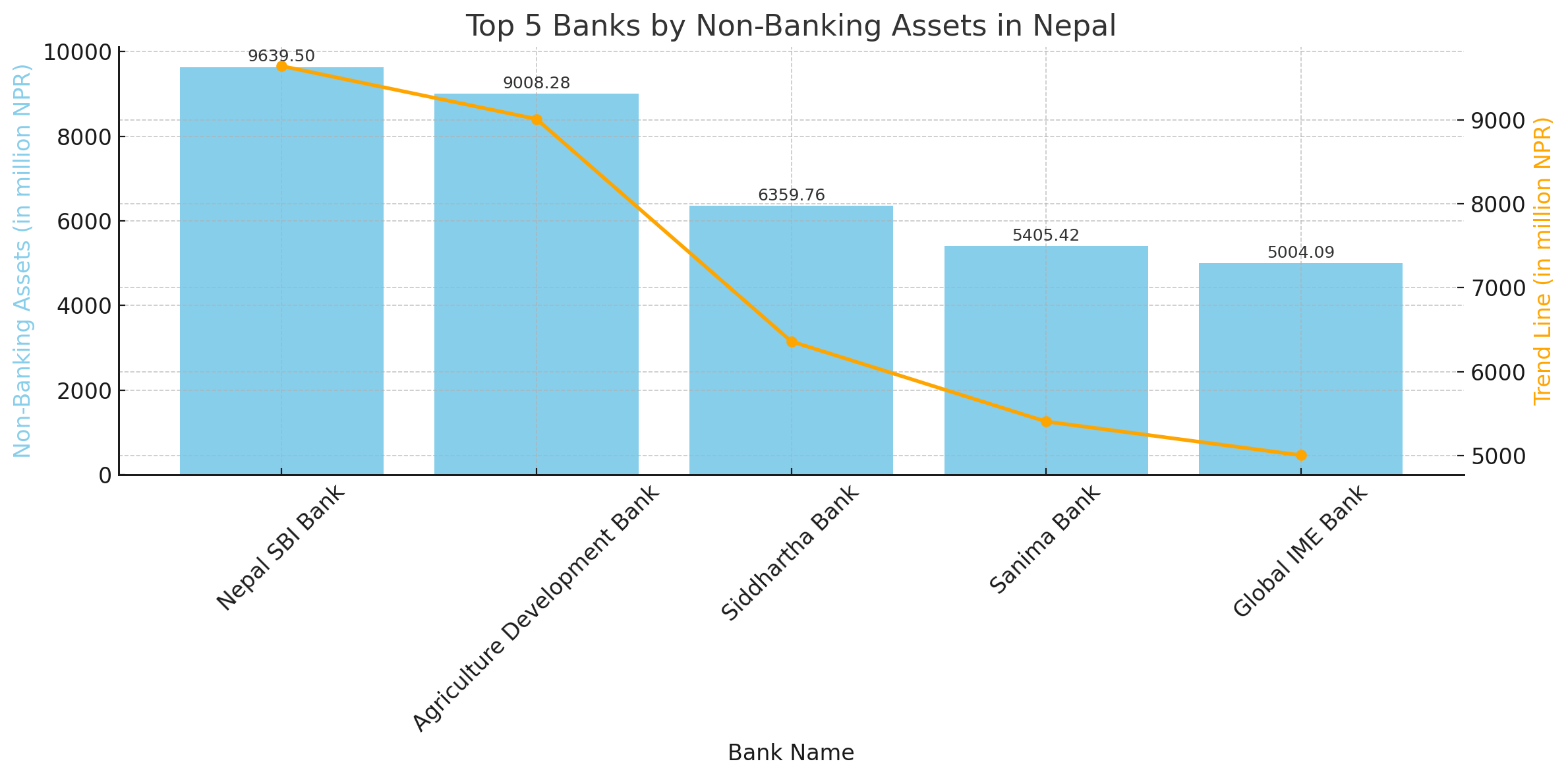
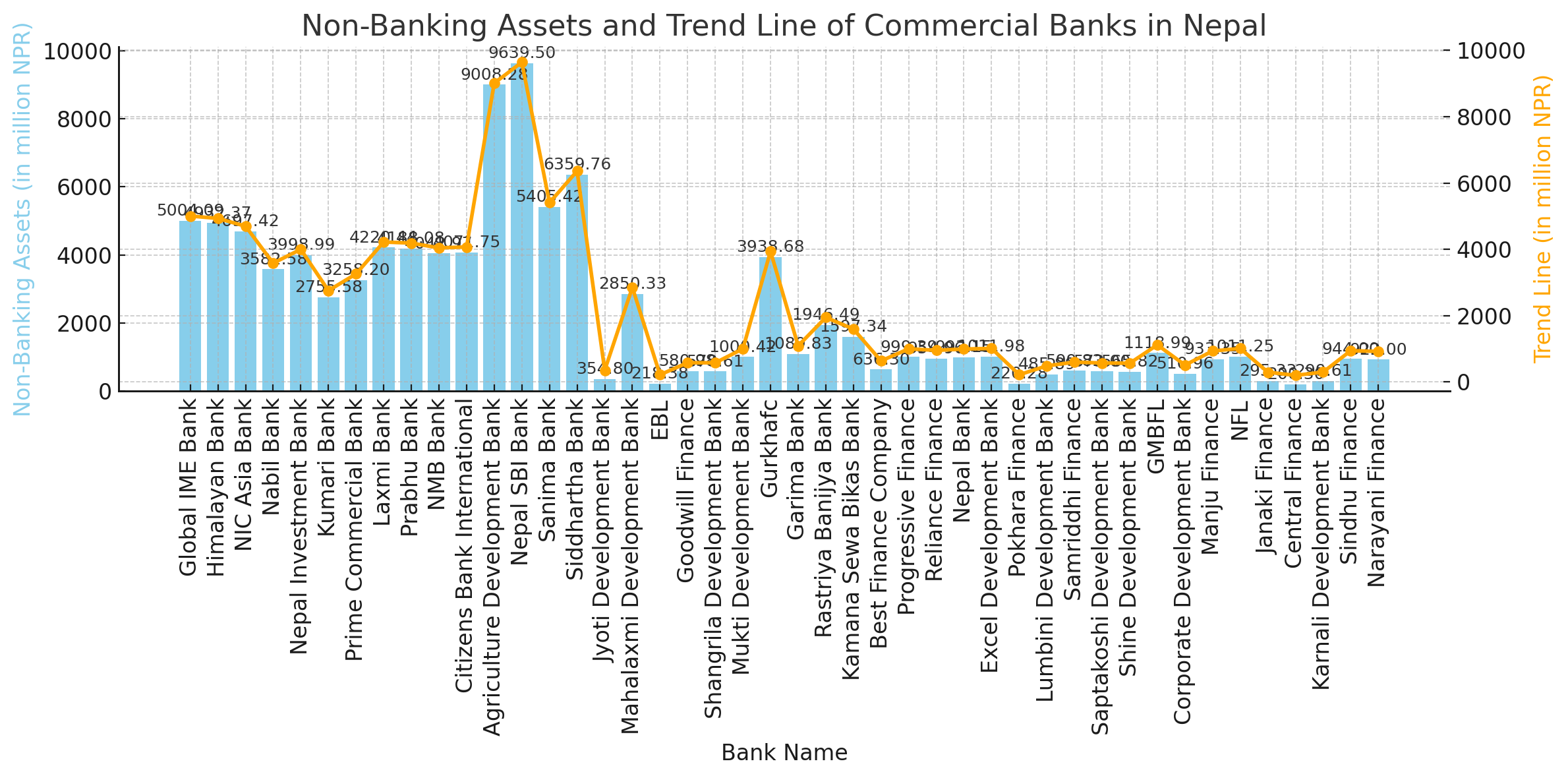
Among commercial banks, Global IME Bank holds the largest non-banking assets, amounting to NPR 5.99 billion, followed by Himalayan Bank at NPR 5.14 billion, NIC Asia Bank at NPR 4.58 billion, and Nabil Bank with NPR 3.79 billion. These banks are facing growing challenges in managing their defaulted loans and liquid assets as more assets are added to their portfolios.
What Are Non-Banking Assets?
Non-banking assets are assets held by banks that result from loans taken by individuals or entities where collateral such as land or vehicles has been pledged. If the borrower fails to repay the loan, the bank auctioned the collateral. When these assets remain unsold at auctions, banks retain them under their own name, increasing their inventory of non-banking assets.
However, as non-banking assets increase, banks' liquidity decreases. This results in a reduction in the funds available for lending, creating a negative cycle. In turn, this forces banks to classify bad loans and provide provisions to cover the potential losses, further depleting their profits. While this results in lower profits, banks are also unable to distribute dividends to investors.
The Impact on the Banking Sector
The increasing non-banking assets and bad loans have significant repercussions on Nepal's banking sector. The liquidity crunch and deteriorating financial health affect not only banks but also their customers. As banks’ cash flow is restricted due to rising bad debts, it limits their ability to provide loans to customers, impacting the broader economy.
Banks with larger portfolios of bad loans face considerable challenges in maintaining profitability. The growing inventory of non-banking assets means these banks are sitting on unsold property, which further burdens their balance sheets. As a result, these financial institutions may struggle to generate returns for investors, weakening their overall financial stability.
In response to this mounting issue, the government has announced plans to establish a Non-Banking Asset Management Company to better handle the growing non-performing assets and improve financial stability. This initiative was suggested by a high-level economic reform commission led by former Finance Secretary Rameshwar Khanal. The commission noted that due to the weak loan recovery systems and an increasing number of bad debts, a dedicated company is necessary to manage and liquidate non-banking assets more efficiently.
The rising number of non-banking assets and bad loans presents an ongoing challenge for Nepal’s banking sector. With the establishment of a Non-Banking Asset Management Company, the government aims to address these systemic issues by streamlining the recovery and liquidation processes, ultimately alleviating the pressure on banks. However, this solution may take time to implement, and the financial sector will need to manage this crisis carefully to prevent further deterioration in the health of Nepal’s banking system.
If the government successfully establishes the proposed management company, it could bring stability to the financial sector, improve asset recovery rates, and restore confidence among investors and depositors alike. The future of Nepal’s banking sector depends on how effectively these non-performing assets are handled and whether reforms can be implemented quickly enough to prevent further deterioration.
Advertisement
Written by
Dipesh Ghimire