Top
Parliament Debates Proposal to Separate Bankers and Business Owners in Nepal
Parliament Debates Proposal to Separate Bankers and Business Owners in Nepal A significant debate is currently taking place in Nepal’s House of Representatives over the first amendment to the Bank and Financial Institutions Act (BAFIA), 2080. The proposed bill, now under clause-wise discussion in the Finance Committee, contains a critical provision: any individual holding more than 1% shares in a bank or financial institution should not be allowed to borrow from that same institution. This directly implies that one cannot be both a banker (investor/promoter) and a business borrower at the same time.
Dipesh Ghimire
2 min read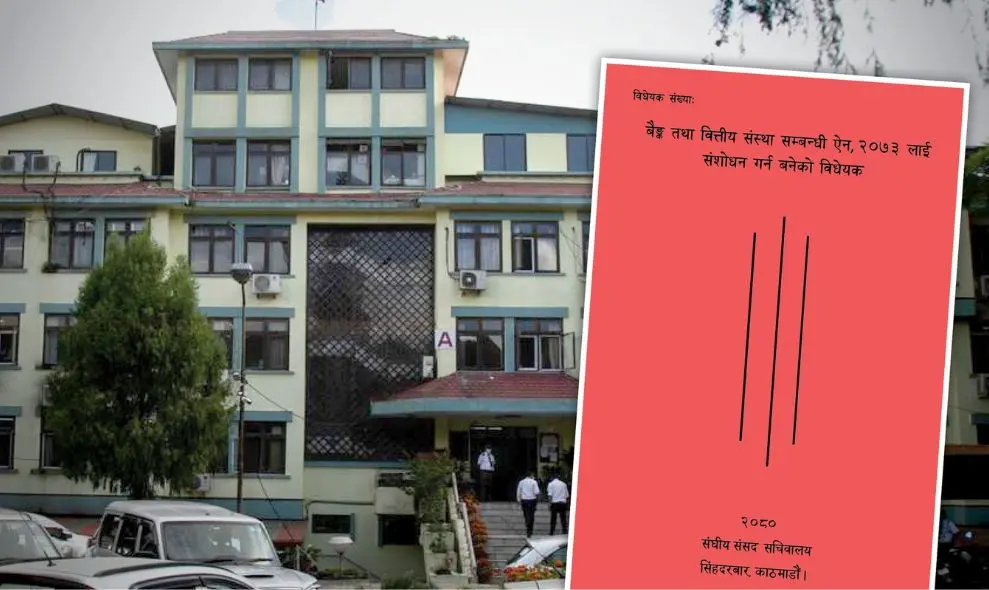
A significant debate is currently taking place in Nepal’s House of Representatives over the first amendment to the Bank and Financial Institutions Act (BAFIA), 2080. The proposed bill, now under clause-wise discussion in the Finance Committee, contains a critical provision: any individual holding more than 1% shares in a bank or financial institution should not be allowed to borrow from that same institution. This directly implies that one cannot be both a banker (investor/promoter) and a business borrower at the same time.
The bill seeks to eliminate the conflict of interest between the ownership of financial institutions and the use of their lending facilities. In Nepal, many large shareholders or board members of banks are also prominent business owners who take loans from their own banks. This practice has long raised questions about financial integrity and governance.
The key objective of the amendment is to separate the roles of bankers and business operators. However, in a small economy like Nepal where the same business groups dominate banks, insurance companies, hotels, and industries, making this separation is not so straightforward. Historically, such integration was necessary to build a functioning banking system, but now, with better regulations, technology, and transparency, reforms are both feasible and urgent.
The bill’s clause that bars individuals with more than 1% ownership from taking loans from the same bank is expected to reduce self-serving practices and improve governance. But in practice, many promoters circumvent this by exchanging favors — one group takes loans from another’s bank and vice versa. To address such tactics, Nepal Rastra Bank (NRB) must enhance regulatory oversight.
Another challenge lies in the illiquidity of promoter shares. It’s not easy for promoters to sell their stakes immediately. That’s why the government should not enforce the rule abruptly but implement it over a defined transition period, such as five years, allowing promoters to gradually exit or restructure their holdings.
The bill also highlights a deeper concern: conflicts of interest in parliamentary oversight. If lawmakers themselves have financial interests in the banking or business sectors, they are unlikely to support reforms that reduce their own influence. Hence, individuals with direct conflicts should not be included in the committee handling this amendment.
Another suggestion that came up during committee discussions was sector-based loan quotas (e.g., lending more in hills or plains). However, experts argue that loans should be distributed based on project viability, repayment capacity, and quality of business proposals, not geography.
Experts emphasize, “Banks primarily operate using public money, not just promoter capital. Therefore, bankers must act as custodians of public trust, not as businessmen serving their own interests.”
If implemented effectively, the bill would help curb insider lending, promote financial transparency, and encourage professional banking practices. But without proper enforcement and monitoring, it risks becoming yet another symbolic reform with no real impact.
In conclusion, this amendment is not just a legal tweak — it’s a structural reform aimed at de-linking finance and vested interests. For Nepal to build a robust, trustworthy financial system, the parliament and regulators must act with clarity, fairness, and long-term vision. If done right, this could become a turning point in Nepal’s journey toward financial accountability and inclusive banking.
Advertisement
Written by
Dipesh Ghimire