Top
Prime Minister Shah and Indian Counterpart Modi to Hold Crucial Bilateral Talks in New Delhi Today
Meanwhile, the active participation of Finance Minister Dr. Swarnim Wagle in courting Indian private-sector capital—paired with progress on the Lower Arun Hydropower Project and cross-border rail and check-post infrastructure—underscores a broader strategic shift. Both neighbors appear aligned on transitioning their bilateral relationship toward deep economic integration, cross-border energy trade, and supply-chain connectivity.
Dipesh Ghimire
3 min read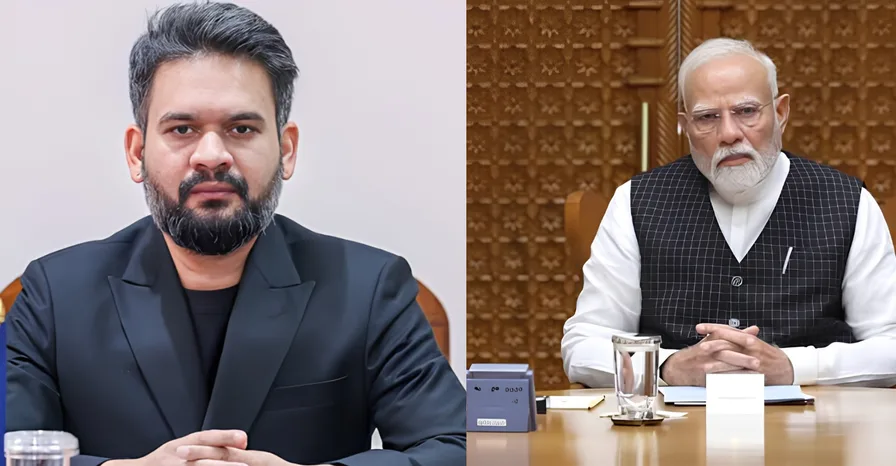
NEW DELHI — Prime Minister Balendra Shah and Indian Prime Minister Narendra Modi are scheduled to hold high-level bilateral talks at Hyderabad House in New Delhi on Monday, with post-disaster economic reconstruction, new air entry routes, energy cooperation, and cross-border infrastructure topping the agenda.
According to Nepal's Ministry of Foreign Affairs, the one-on-one and delegation-level meetings will begin at 11:00 AM local time (11:15 AM Nepal Standard Time). Following the deliberations, both leaders are expected to witness the signing of several bilateral agreements and jointly inaugurate completed Indian-assisted development projects.
Kathmandu views Prime Minister Shah's two-day official visit as a pivotal diplomatic opportunity to secure financial backing for infrastructure damaged by recent floods and landslides, break the deadlock over civil aviation routes, and accelerate stalled cross-border projects. Ahead of the talks, Nepal formally proposed a USD 2 billion assistance package—comprising both grants and concessional lines of credit—to support post-disaster recovery and large-scale infrastructure development.
Diplomatic circles indicate that New Delhi is preparing to announce an economic assistance package worth approximately USD 1.5 billion, structured as a blend of grant aid and soft loans. While the exact financial contours await formal announcement after the summit, the package is expected to anchor Nepal's immediate reconstruction drive.
Expanding air connectivity stands out as a primary strategic priority for the Nepali delegation. Kathmandu has pressed New Delhi to approve additional cross-border air entry routes via Bhairahawa and Mahendranagar to ensure the commercial viability of Gautam Buddha International Airport and facilitate international flights across western Nepal.
Energy, hydropower, railway, and road connectivity projects also feature prominently on the table. Both prime ministers are expected to virtually inaugurate or advance several flagship initiatives, including the Ayodhya–Janakpur railway service, the Lower Arun Hydropower Project, the National Police Academy in Panauti, the Integrated Check Post in Bhairahawa, and a cross-border bridge in Darchula.
Indian media reports suggest the two sides are also finalizing a comprehensive joint vision document and a joint communique outlining long-term cooperation across economic partnership, water resources, trade, transit, digital connectivity, education, health, tourism, and sports.
Following the bilateral talks and joint press briefing, Prime Minister Modi will host an official luncheon in honor of Prime Minister Shah and the visiting Nepali delegation.
Earlier in the morning, Prime Minister Shah is scheduled to visit Rajghat to pay floral tributes at the memorial of Mahatma Gandhi. Later in the afternoon, he will pay a courtesy call on Indian President Droupadi Murmu at Rashtrapati Bhavan before departing for Kathmandu later on Monday evening.
Prime Minister Shah is accompanied by a high-powered delegation comprising Finance Minister Dr. Swarnim Wagle, Foreign Minister Shishir Khanal, chief political advisors, senior bureaucrats, business leaders, and journalists. On Sunday, Finance Minister Wagle addressed Indian industrialists in New Delhi, pitching Nepal as an emerging investment destination.
Prime Minister Shah's inaugural state visit to New Delhi carries substantial geopolitical and macroeconomic weight, signaling a pragmatic reset focused on tangible economic deliverables rather than purely ceremonial diplomacy.
The centerpiece of the summit—Nepal's USD 2 billion reconstruction request against a projected USD 1.5 billion Indian financial commitment—highlights Kathmandu's urgent fiscal need following severe monsoon-induced infrastructure devastation. With domestic revenue constrained and capital expenditure sluggish, a blended package of grants and concessional credit from India offers critical fiscal breathing room without immediately straining Nepal's debt-servicing capacity.
Equally consequential is the push for air entry routes over Bhairahawa and Mahendranagar. For years, the lack of direct western air corridors has forced international carriers into lengthy detours, rendering Bhairahawa's newly built international airport underutilized and financially burdensome. Securing Indian clearance on this front would represent a major diplomatic breakthrough for Nepal's aviation and tourism sectors.
Meanwhile, the active participation of Finance Minister Dr. Swarnim Wagle in courting Indian private-sector capital—paired with progress on the Lower Arun Hydropower Project and cross-border rail and check-post infrastructure—underscores a broader strategic shift. Both neighbors appear aligned on transitioning their bilateral relationship toward deep economic integration, cross-border energy trade, and supply-chain connectivity.
Written by
Dipesh Ghimire