NEPSEtrading

Make smarter moves backed by machine learning. Join thousands of traders leveraging AI to maximize profits.

nepsetrading.com is an online news portal that provides insights into trading and investment by analyzing the stock market and the global economy. We create charts based on the analysis of various indicators. Please do not rely solely on this information for investment decisions. Self-study is crucial. Use this information only as an educational and informational resource.

Marketminds Investment Group Private Limited

DOIB Registration certificate no. :

4680-2081/2082

Chairman: Bishal Bikram Bimali

Director and Editor-in-chief:

Dipesh Ghimire

(

9802363868,

9851119988

)

Koteshwor 32 , Kathmandu

01-5253221

+977 9709066745

Contact support

Subscribe to our newsletter

Weekly insights from the NEPSE market in your inbox.

Market

StocksSectors

Company

About UsOur TeamTerms of UseOur PolicyTrainingContact Us

Help

SupportReportFAQ

© 2026 nepsetrading.com. All rights reserved.
This website is owned and operated by Marketminds Investment Group Private Limited.

Charts are powered byTrading View

NEPSEtrading

  • Home
  • Market
  • Charts
  • News
  • Blogs
  • Training
  • Pricing
  1. Blogs
  2. #RSDC #DividendHistory #Microf
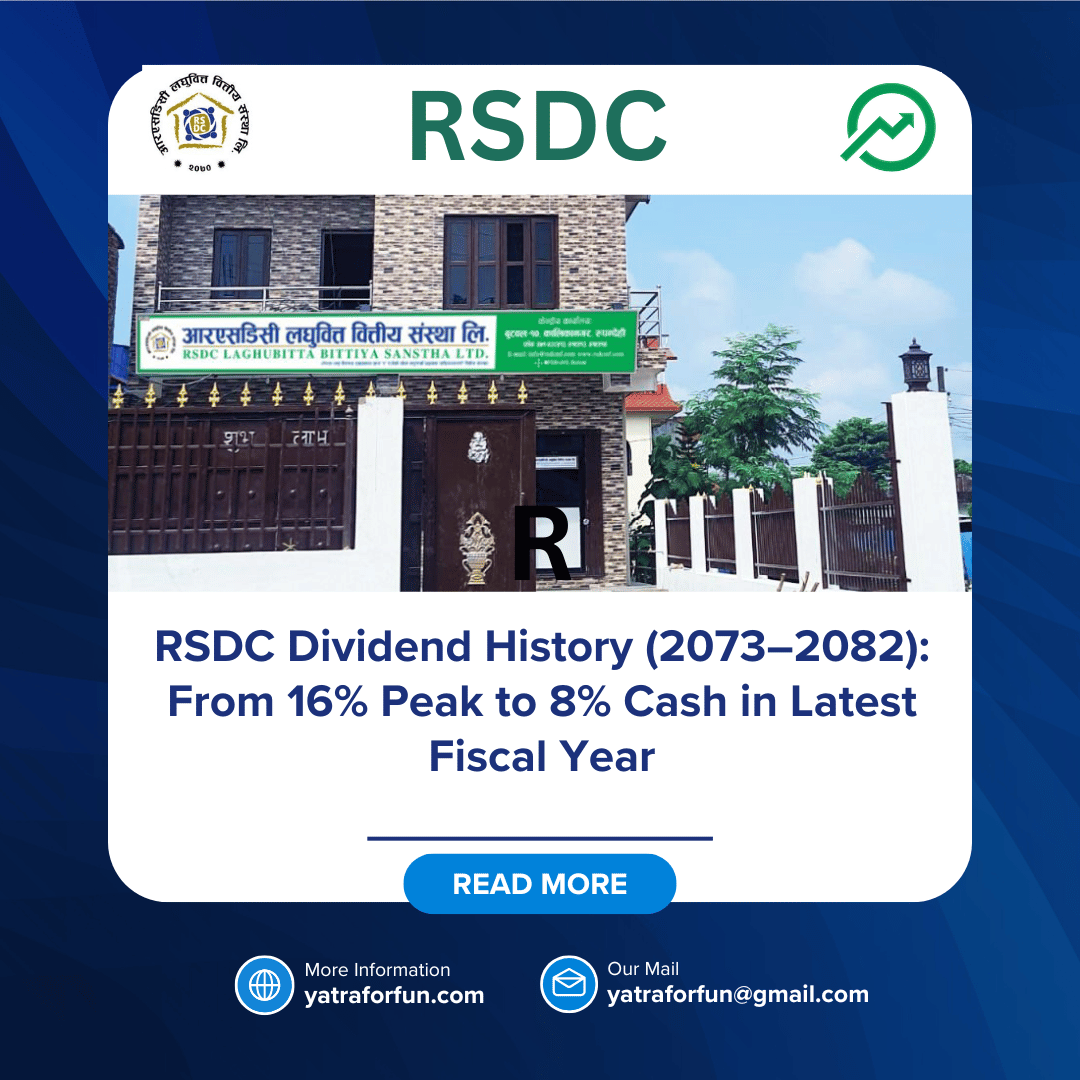
  3. RSDC Dividend History (2073–2082): From 16% Peak to 8% Cash in Latest Fiscal Year
#RSDC #DividendHistory #Microf

RSDC Dividend History (2073–2082): From 16% Peak to 8% Cash in Latest Fiscal Year

From 2073 to 2082, RSDC’s dividend journey evolved from high mixed distributions (cash + bonus) to a conservative cash-only approach. The 8% cash dividend for FY 2081/82 highlights the company’s commitment to maintaining shareholder trust while ensuring long-term financial sustainability.

SCSandeep Chaudhary
Published on October 9, 20251 min read
RSDC Dividend History (2073–2082): From 16% Peak to 8% Cash in Latest Fiscal Year

RSDC Laghubitta Bittiya Sanstha Limited (RSDC) has shown a dynamic dividend pattern over the past decade, reflecting the institution’s evolving financial performance and policy direction. From its early years of strong growth to recent moderation, the company’s dividend distribution history reveals how microfinance institutions in Nepal are balancing profitability, regulatory pressure, and capital management.

In its earlier years, RSDC was known for generous distributions. The highest recorded dividend came in FY 2075/76, when the company declared a total of 16%—including 10% bonus shares and 6% cash. This period reflected robust profitability and an expansion phase where bonus shares were favored to strengthen the capital base. The following years saw gradual moderation: in FY 2076/77, RSDC declared 9% bonus and 3.63% cash, totaling 12.63%. The next few years—FY 2077/78 (10% bonus + 0.53% cash), FY 2078/79 (8% bonus + 3% cash), and FY 2079/80 (8.6% bonus + 0.45% cash)—showed a balanced approach with smaller cash components, likely to preserve liquidity.

In FY 2080/81, the institution distributed 9.5% bonus and 0.5% cash, totaling 10%, marking another year of modest but stable payouts. However, the latest fiscal year 2081/82 signifies a major policy shift — RSDC declared only 8% cash dividend with no bonus shares. This decision indicates the company’s intent to conserve retained earnings and prioritize liquidity stability amid tightening financial regulations and market uncertainties.

The decade-long pattern, from 16% peak to 8% cash, mirrors Nepal’s broader microfinance trend—shifting from rapid expansion and high capital issuance toward prudent governance, risk control, and sustainable profitability. Investors interpret this steady, cash-only payout as a sign of maturity rather than weakness, as RSDC focuses on stability and compliance with Nepal Rastra Bank’s capital adequacy norms.

SC

Written by

Sandeep Chaudhary

RSDC Dividend History (2073–2082): From 16% Peak to 8% Cash in Latest Fiscal Year

Related News

View all
  • Tourism Earnings Slip While Education Spending Abroad Climbs: Nepal's Services Account Remains in Deficit at Rs.68 Billion
    Nepal’s Economy

    Tourism Earnings Slip While Education Spending Abroad Climbs: Nepal's Services Account Remains in Deficit at Rs.68 Billion

    10 Jun, 2026

  • Nepal's Terms of Trade Deteriorate by 16.9 Percent: Import Prices Surge 24 Percent While Export Prices Crawl at 3.1 Percent
    Nepal’s Economy

    Nepal's Terms of Trade Deteriorate by 16.9 Percent: Import Prices Surge 24 Percent While Export Prices Crawl at 3.1 Percent

    10 Jun, 2026

  • Trade Deficit Crosses Rs.1,443 Billion: Exports Grow But Imports Outpace Them, China-Bound Exports Collapse by 41 Percent
    Nepal’s Economy

    Trade Deficit Crosses Rs.1,443 Billion: Exports Grow But Imports Outpace Them, China-Bound Exports Collapse by 41 Percent

    10 Jun, 2026

Related News