Salary and Wage Growth Strengt
Salary and Wage Growth Strengthens Across Provinces, Sudurpashchim and Gandaki Record Highest Increases
Salary and Wage Growth Strengthens Across Provinces, Sudurpashchim and Gandaki Record Highest Increases Nepal’s provincial salary and wage levels have risen notably over the past year, with the national Salary and Wage Index climbing to 107.02 points in mid-October 2025 (Asoj 2082). According to the latest provincial wage data, overall wages increased by 4.48 percent compared to the same period last year, reflecting stronger labor market demand, rising cost-of-living adjustments, and expanding economic activity across the provinces.
Dipesh Ghimire
3 min read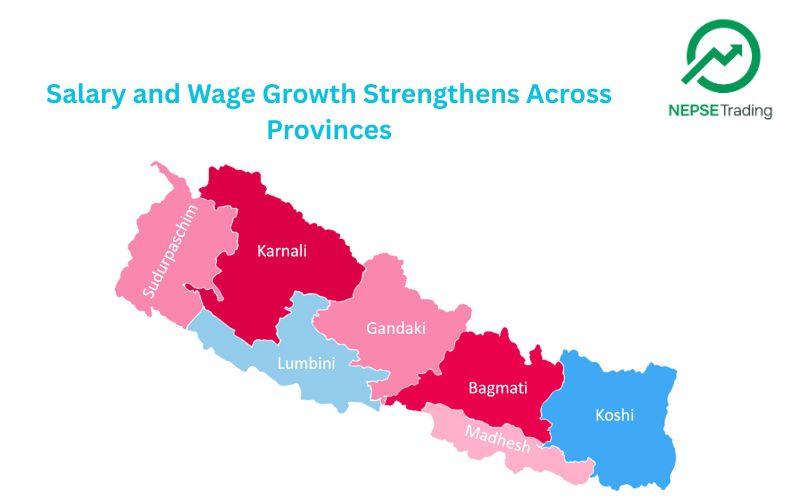
Nepal’s provincial salary and wage levels have risen notably over the past year, with the national Salary and Wage Index climbing to 107.02 points in mid-October 2025 (Asoj 2082). According to the latest provincial wage data, overall wages increased by 4.48 percent compared to the same period last year, reflecting stronger labor market demand, rising cost-of-living adjustments, and expanding economic activity across the provinces.
The wage index shows significant variation among provinces, indicating uneven economic recoveries and different sectoral dynamics. Sudurpashchim Province posted the strongest annual growth with a 6.40 percent increase, raising its index to 111.96. This acceleration highlights improving labor conditions in industries such as construction, seasonal agriculture, and services. Analysts suggest that out-migration and labor shortages in western districts have pushed employers to offer higher wages, while increased local development projects may have also contributed to wage growth.
Gandaki Province registered the second-highest wage growth at 9.42 percent compared to the base year 2023/24, placing its wage index at 111.52. Much of this rise is linked to higher labor demand in tourism, hospitality, construction, and small industries in Pokhara and surrounding districts. The province also benefited from increased inflows of domestic tourists and strengthening urban economies, requiring more labor in service-related sectors.
Lumbini Province also performed strongly, with a 6.68 percent rise in wages over last year. The wage index increased to 110.07, indicating mounting labor costs in manufacturing, construction, and industrial corridors such as Butwal, Bhairahawa, and Kapilvastu. Wage growth in Lumbini reflects the expansion of factories, growth in small-scale enterprises, and a rise in agricultural processing industries.
In contrast, the country’s largest economic region, Bagmati Province, recorded moderate wage growth, with a 4.16 percent increase from last year and a wage index of 106.03. While Bagmati remains the economic hub of Nepal, its wage growth appears more stable and controlled compared to other provinces. This may reflect better labor availability in Kathmandu Valley, higher competition among workers, and more regulated wage structures in corporate and service sectors. Analysts believe that institutional employment and formal sector dominance in Bagmati help maintain stable wage movement.
Madhesh Province posted a strong wage increase of 3.62 percent, bringing its wage index to 106.74. The rise is supported by expanding agricultural markets, cross-border trade, and growing economic activities in industrial belts like Birgunj and Janakpur. Madhesh has also experienced rising daily-wage rates due to seasonal labor shortages as local workers continue to migrate abroad.
Koshi Province saw the lowest wage growth among the provinces, with wages increasing by only 1.12 percent from last year. Its wage index reached 102.18, indicating modest changes in labor demand. While Koshi hosts emerging urban centers like Biratnagar, Dharan, and Itahari, the wage stagnation may reflect stable labor supply, increased mechanization in industries, and relatively slower growth in service-sector employment.
Karnali Province, despite being one of Nepal’s least developed regions, experienced a moderate wage rise of 1.36 percent, bringing its wage index to 104.51. The slower wage movement may be linked to limited industrial activity, lower urban concentration, and continued dependence on subsistence agriculture. However, increased government spending and local development projects may be helping to gradually push wages upward.
Nationally, the data indicates a clear pattern: provinces with stronger tourism activity, higher out-migration, and active construction sectors are experiencing faster wage growth. Meanwhile, more urbanized and stable markets such as Bagmati and Koshi show moderate wage adjustments. Economists note that wage disparities between provinces may widen if regional development remains uneven, but the rising wage trend across all provinces reflects an improving national labor landscape.
Advertisement
Written by
Dipesh Ghimire