Top
Structured Trading Strategies: Understanding Different Types of Market Entries
Structured Trading Strategies: Understanding Different Types of Market Entries In today’s rapidly evolving financial markets, traders are increasingly shifting toward systematic and disciplined approaches to improve consistency and reduce emotional decision-making. The chart titled “Different Types of Entries” presents a practical framework for understanding how traders enter positions around key supply and demand zones using structured confirmation methods.
Dipesh Ghimire
2 min read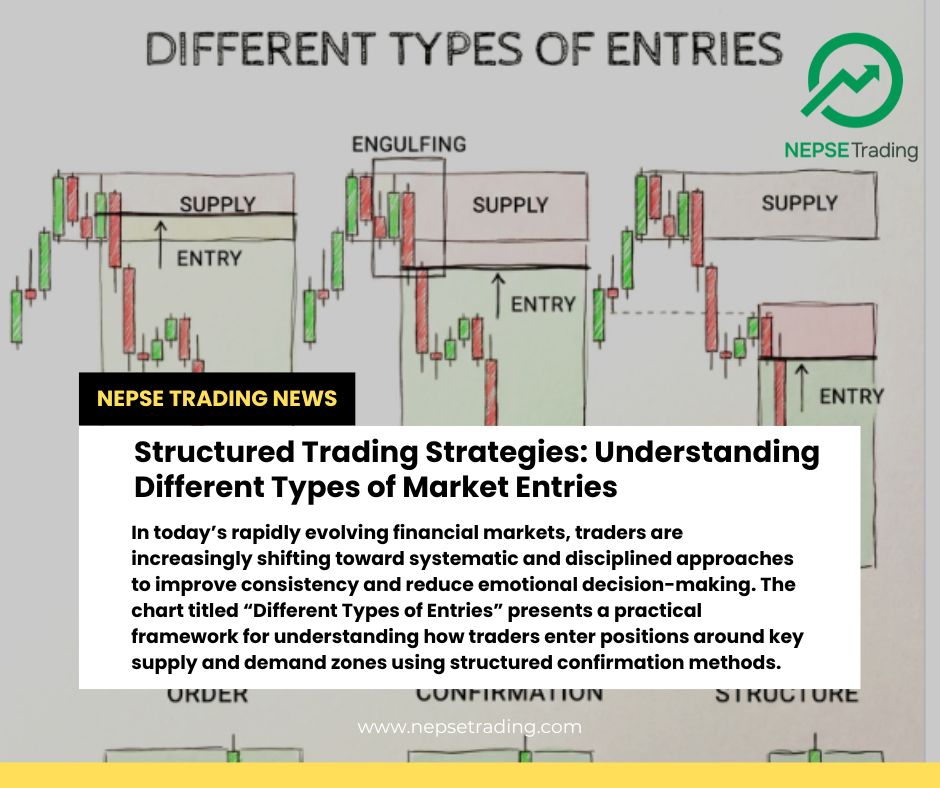
In today’s rapidly evolving financial markets, traders are increasingly shifting toward systematic and disciplined approaches to improve consistency and reduce emotional decision-making. The chart titled “Different Types of Entries” presents a practical framework for understanding how traders enter positions around key supply and demand zones using structured confirmation methods.
At the foundation of this framework lie supply and demand zones, which represent areas of strong selling and buying interest. Supply zones indicate regions where sellers dominate, often leading to price declines, while demand zones reflect areas where buyers step in, driving prices upward. These zones serve as critical reference points for professional traders, helping them identify high-probability entry locations.
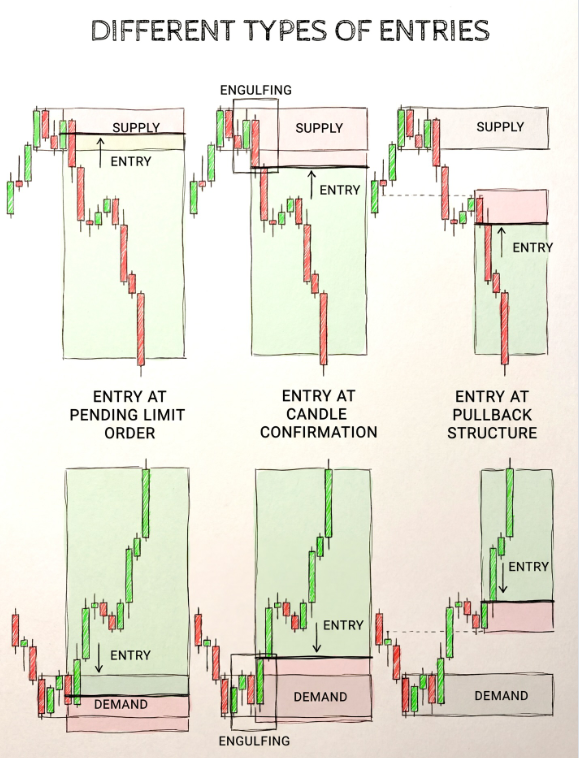
One major method highlighted in the chart is Entry at Pending Limit Order. In this approach, traders place buy or sell orders directly within supply or demand zones without waiting for further confirmation. This method allows traders to enter early and achieve favorable risk-to-reward ratios. However, it also carries higher risk, as price may break through the zone without reacting.
Another important technique is Entry at Candle Confirmation. Here, traders wait for strong price signals—such as engulfing candlestick patterns—before entering a trade. An engulfing candle indicates a sudden shift in market control, where buyers or sellers gain dominance. This confirmation increases the probability of successful trades but may result in slightly higher entry prices.
The chart also illustrates Entry at Pullback Structure, a more patient and conservative strategy. After price reacts from a supply or demand zone and breaks previous market structure, traders wait for a pullback before entering. This method aligns with trend confirmation and helps traders manage risk more effectively by entering near key structural levels.
A central feature in all three strategies is the Engulfing Pattern, which reflects strong market imbalance. A bullish engulfing near demand zones signals accumulation and potential upward movement, while a bearish engulfing near supply zones suggests distribution and possible downward momentum. These patterns often precede strong price movements, making them valuable tools for validation.
Overall, the framework demonstrates that successful trading is not based on guesswork but on understanding price behavior, market structure, and liquidity zones. By combining supply-demand analysis with confirmation techniques, traders can improve timing, minimize losses, and enhance long-term performance.
As market volatility continues to rise, structured entry strategies such as these are becoming essential for traders seeking sustainable success. Rather than chasing price movements, disciplined traders wait for high-probability setups, execute with precision, and manage risk systematically—turning uncertainty into opportunity.
Advertisement
Written by
Dipesh Ghimire