Nepal Clearing House Limited
What NCHL's New Fee Chart Really Tells Us About the Cost of Going Cashless
Taken as a whole, the schedule is far more than a regulatory disclosure. It is a coherent strategy hidden in a fee table: free at the bottom to win mass adoption, flat and modest in the middle to stay painless, gently steering users from paper to digital, and deliberately cheap on tax payments to support formalisation. The six-monthly disclosure requirement itself adds a layer of transparency, forcing the operator to keep these choices in public view. The real question the numbers raise is not whether the fees are affordable — they plainly are — but whether pricing this low can be sustained as transaction volumes explode, and who ultimately bears the cost of running the rails that increasingly carry Nepal's economy.
Dipesh Ghimire
4 min read
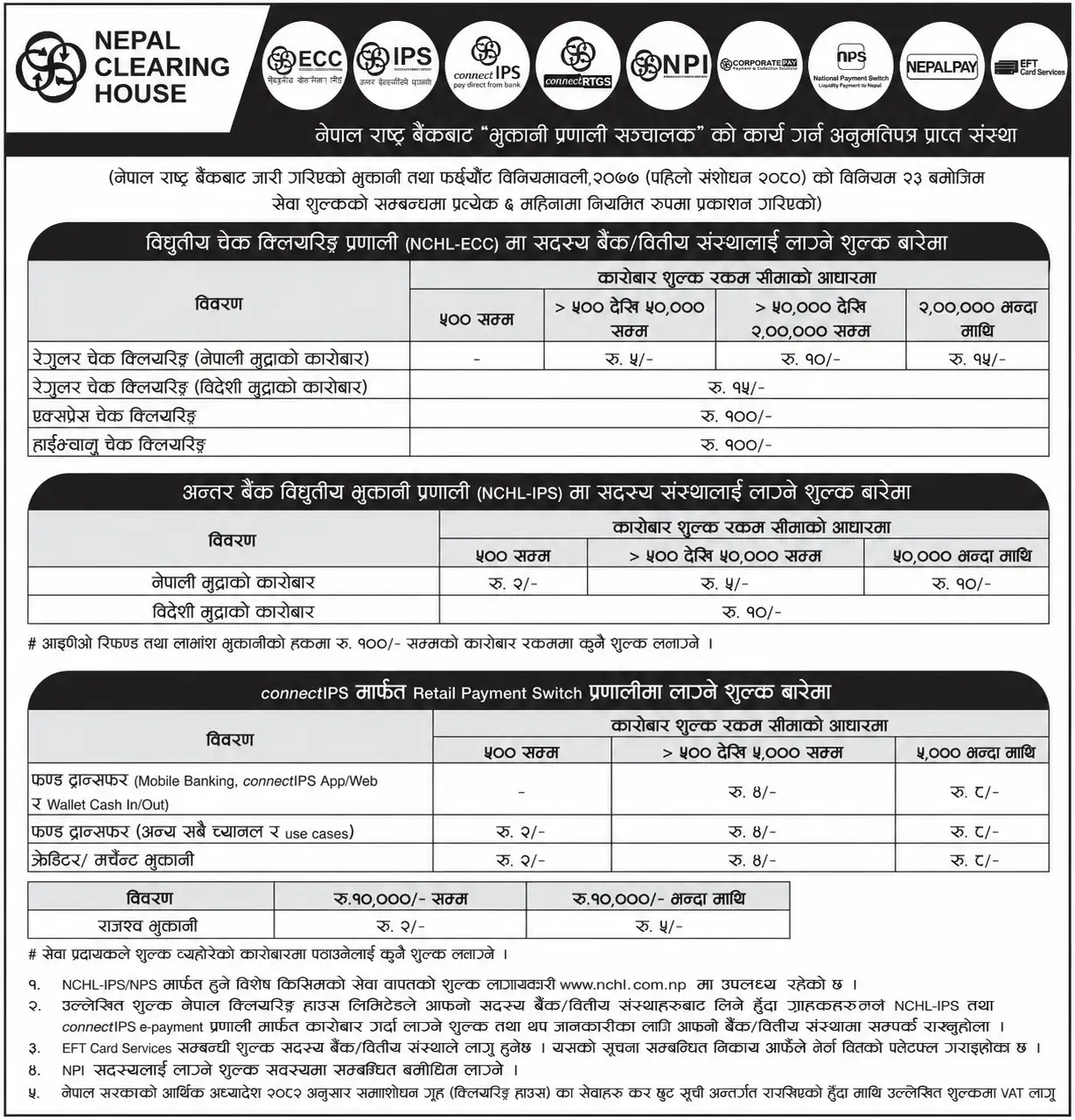
Kathmandu — At first glance, the fee schedule that Nepal Clearing House Limited (NCHL) has just published looks like a routine compliance exercise — a table of rupee amounts released because a bylaw requires it every six months. But read closely, the numbers reveal a deliberate pricing philosophy that shapes how millions of Nepalis pay for goods, taxes and transfers, and they explain why some digital habits cost nothing while others quietly add up.
The single most important feature running through the entire schedule is the zero-fee floor on small transactions. Across NCHL-ECC, connectIPS retail payments and QR transactions, anything up to Rs 500 is free. This is not an accident of pricing; it is a design choice aimed squarely at everyday, low-value payments — the tea shop bill, the small grocery purchase, the daily transfers that make up the bulk of retail activity. By keeping these free, the system removes the psychological friction that would otherwise push people back toward cash for tiny amounts, which is exactly where digital adoption is hardest to win.
The tiered structure above that floor follows a consistent logic: the larger the transaction, the higher the flat fee. In cheque clearing, the charge climbs from Rs 5 to Rs 10 to Rs 15 as amounts rise past Rs 50,000 and Rs 2 lakh. Crucially, these are flat fees per band, not percentages. This distinction matters enormously. A Rs 15 charge on a Rs 5 lakh cheque is almost invisible — a rounding error — whereas the same rupee amount would be punishing if applied to small sums. The model is therefore mildly progressive by design: it leans on the fact that high-value payers can easily absorb a fixed fee, while shielding low-value users almost entirely.
A comparison across the channels exposes where NCHL is nudging behaviour. Cheque clearing (ECC) is the most expensive tier, topping out at Rs 15, while the interbank IPS system and connectIPS retail payments stay far cheaper, mostly in the Rs 2 to Rs 10 range. This gap is telling. Cheques are paper-based, slower and costlier to process, so pricing them higher gently discourages their use, while the cheaper electronic rails are positioned as the preferred, modern alternative. In effect, the fee chart is a quiet signal steering users away from paper and toward fully digital transfers.
The connectIPS retail tiers reveal another layer of intent. Whether a payment goes through mobile banking, the app, the web or a QR code, the ceiling is just Rs 8 for anything above Rs 5,000. Capping the cost of even large retail payments at single-digit rupees is a strong statement: the operator is prioritising volume and ubiquity over squeezing revenue from each transaction. For a payments network, that trade-off makes sense — the value lies in becoming the default rail for the whole economy, not in maximising margin on any one transfer.
The treatment of revenue payments deserves particular attention. Paying government dues — taxes, fees, official charges — costs just Rs 2 up to Rs 10,000 and Rs 5 above that. By keeping the cost of paying the state almost negligible, the system directly supports formalisation: the cheaper and easier it is to pay taxes digitally, the fewer excuses remain for cash-based, undocumented dealings. This is where a technical fee schedule connects to a much larger policy goal of pulling more of the economy into the formal, traceable system.
Two smaller provisions round out the picture and reveal the operator's sensitivity to trust. The Rs 10 charge on foreign-currency IPS transactions — higher than the domestic equivalents — reflects the added complexity and risk of cross-currency settlement, a standard practice worldwide. More importantly, the explicit guarantee that no fee is charged on a failed transaction addresses one of the most corrosive fears in digital payments: being charged for money that never moved. In a market where trust in electronic systems is still being built, that single assurance may do more to encourage adoption than any of the low fees themselves.
Taken as a whole, the schedule is far more than a regulatory disclosure. It is a coherent strategy hidden in a fee table: free at the bottom to win mass adoption, flat and modest in the middle to stay painless, gently steering users from paper to digital, and deliberately cheap on tax payments to support formalisation. The six-monthly disclosure requirement itself adds a layer of transparency, forcing the operator to keep these choices in public view. The real question the numbers raise is not whether the fees are affordable — they plainly are — but whether pricing this low can be sustained as transaction volumes explode, and who ultimately bears the cost of running the rails that increasingly carry Nepal's economy.
Advertisement
Written by
Dipesh Ghimire